All species › Passerines › Ovenbirds and woodcreepers › Pale-breasted Spinetail
Position in the tree Birds Aves › Birds with a flexible palate Neognathae › All other modern birds Neoaves › Landbirds Telluraves › Falcons, parrots and passerines Australaves › Falcons and passerines Eufalconimorphae › Parrots and passerines Psittacopasserae
Pale-breasted Spinetail | Synallaxis albescens
Temmincks stekelstaart | Pijuí pechiblanco
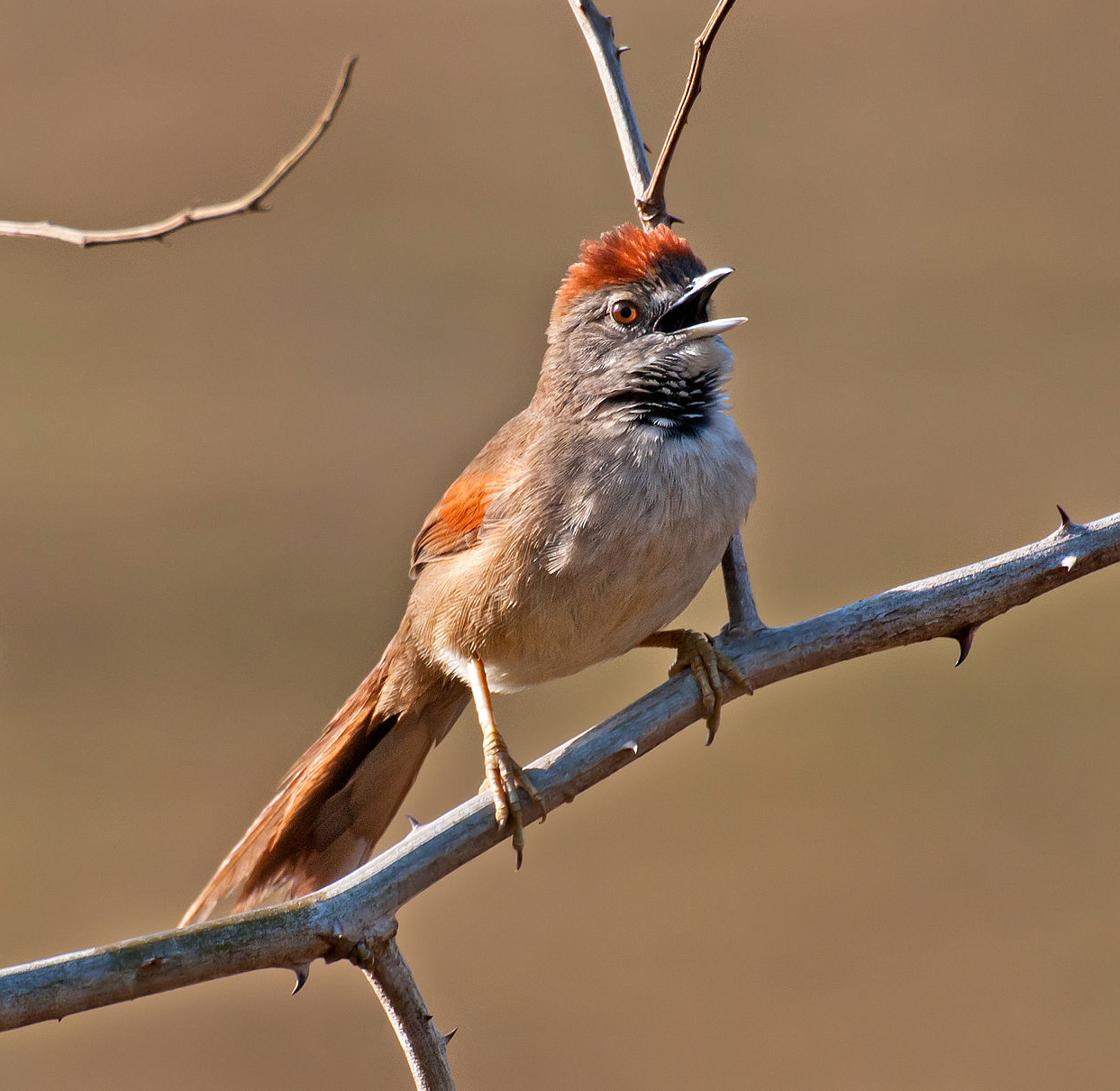
The Pale-breasted Spinetail is a slender, long-tailed spinetail of grassland with bushes, with a rufous crown, rufous wing coverts and pale underparts. Its monotonous, buzzy two-note call sounds all day from rank growth and pasture. In the guide area it lives in Costa Rica and Panama.
Voice
A tirelessly repeated, buzzy two-note phrase, the second note lower and harsh, often from a hidden spot low in a bush.
Recording: Franco Vushurovich — CC BY-NC-SA 4.0 · converted to mono · xeno-canto
Identification
15–16 cm, about half of which is tail; tail long, graduated and greyish-brown, with pointed feather tips. Crown and wing coverts rufous. Back and forehead greyish-brown. Underparts whitish to pale grey, flanks slightly browner; a dark patch on the throat that is not always visible. Bill short and pointed.
Confusion species
Slaty Spinetail Synallaxis brachyura is much darker, slate-grey, and lives in denser scrub. Rufous-breasted Spinetail Synallaxis erythrothorax has a rufous breast and does not occur together with this species.
Habitat
Grassland with scattered bushes, rank pastures, savanna, roadsides and young rank growth in the lowlands and lower hills. Forages low in grass and bushes for insects, usually in pairs. Builds a large stick nest with a tubular entrance, low in a bush.
Where the bird is most at home, classified by the vegetation units of Mexico and Central America.



Range and movements
Mainly the Pacific slope of southern Costa Rica and Panama; it is spreading with deforestation. Outside the guide area widespread in South America, from Colombia and Venezuela to Argentina.
- Resident
- dark = core range, pale = thinly spread
How and when to look
In bushy pastures in Panama and southern Costa Rica it is often heard first; waiting patiently usually brings the bird briefly to the top of a bush.
Conservation status
Not threatened. Common and benefits from forest being cleared for pasture.
Scientific name
Synallaxis albescens | Temminck, 1823
Temminck described the species in 1823 and placed it straight away in the genus where it still stands. The genus Synallaxis was introduced in 1818 by Vieillot. Synallaxis is Greek, from sunallaxis 'exchange'; why Vieillot chose the name is unclear. albescens is Latin for 'whitish', after the pale underparts. The specimen the first description was based on came from near Sorocaba, São Paulo, Brazil.