All species › Swifts › Hummingbirds › Plain-capped Starthroat
Position in the tree Birds Aves › Birds with a flexible palate Neognathae › All other modern birds Neoaves › Birds of the elements Elementaves › Nightjars and swifts Strisores
Plain-capped Starthroat | Heliomaster constantii
Vonkkeelkolibrie | Colibrí picudo
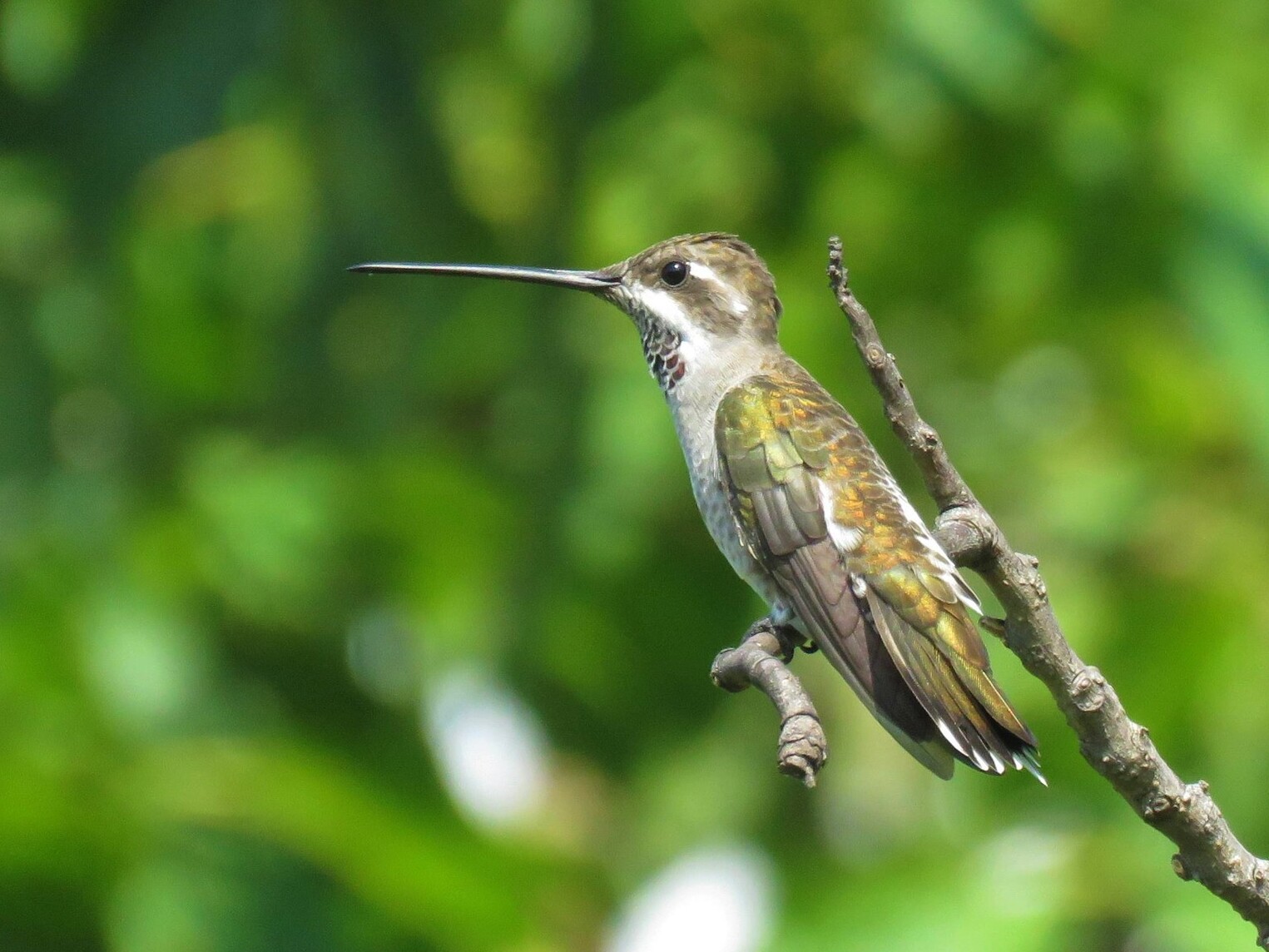
The Plain-capped Starthroat is the starthroat of the dry Pacific side of Mexico and Central America, from Sonora to Costa Rica. The red throat patch lights up only in good light. Like its close relative, it often perches on a bare branch, from where it catches insects in flight.
Voice
Usually silent. A sharp, high peek or cheek.
Recording: Richard E. Webster — CC BY-NC-SA 4.0 · converted to mono · xeno-canto
Identification
11–12 cm, with a very long, straight black bill. The upperparts are dull bronze-green, and the crown is dull, not glittering. A white stripe runs behind the eye, and a second, broad white malar stripe below the cheek. The throat is dark with a magenta-red glittering patch in the centre; the underparts are grey, with white tufts on the flanks and a white patch on the lower back. The sexes are alike; the female has a smaller glittering patch.
Confusion species
Long-billed Starthroat Heliomaster longirostris has, in the male, a glittering blue-green crown, a brighter red throat and only a white spot behind the eye; it lives mainly in more humid regions. Mangrove Hummingbird Chrysuronia boucardi and other amazilias have a shorter bill and no white facial stripes.
Habitat
Tropical dry forest, thorn scrub, gallery forest, open country with scattered trees and gardens, from sea level to about 1500 m. It feeds at flowering trees and cacti, and catches insects in flight from a high perch.
Where the bird is most at home, classified by the vegetation units of Mexico and Central America.





Range and movements
Endemic to the guide area. On the Pacific side of Mexico from southern Sonora and Chihuahua southwards, and on through Guatemala, El Salvador, Honduras and Nicaragua to north-western and central Costa Rica; also in dry interior valleys of Guatemala and Honduras. Rare in western Panama.
- Resident
- dark = core range, pale = thinly spread
How and when to look
In the dry forest of Guanacaste in Costa Rica, for example in Santa Rosa and Palo Verde National Parks, and in the Pacific lowlands of Nayarit, Jalisco and Oaxaca in Mexico. Often high on a bare branch at the edge of dry forest.
Conservation status
Not threatened. Fairly common in suitable habitat. The range is large; loss of dry forest affects the species locally.
Scientific name
Heliomaster constantii | (Delattre, 1843)
Delattre described the species in 1843 as Ornismya constantii; because it was later moved to another genus, the author and year stand in brackets. The genus Heliomaster was introduced in 1850 by Bonaparte. Heliomaster is Greek, from hēlios 'sun' and mastēr 'seeker': 'sun-seeker'. constantii honours the French naturalist and taxidermist Charles Constant (1820–1905). The specimen the first description was based on came from Bolsón, Costa Rica (replacing the erroneous 'Guatemala').