All species › Gamebirds › Guans, curassows and chachalacas › Plain Chachalaca
Position in the tree Birds Aves › Birds with a flexible palate Neognathae › Fowl Galloanserae
Plain Chachalaca | Ortalis vetula
Bruine chachalaca | Chachalaca vetula
The Plain Chachalaca is the most widespread chachalaca in the guide area, a slender, long-tailed gamebird of scrub, forest edge and secondary forest on the Caribbean side, from north-eastern Mexico to north-western Costa Rica. Flocks are most noticeable for their deafening dawn chorus, which gave the genus its onomatopoeic name. Outside the guide area the species lives only in the far south of Texas.
Voice
Mainly at dawn, and also at dusk, flocks sing a loud, grating, rhythmic chorus of repeated three-note phrases, cha-cha-lak or ka-ka-luk, with birds answering each other and the sound passing from flock to flock. The male has a lower voice than the female. Also hoarse, creaking calls and soft cackling.
Recording: Scott Crabtree — CC BY-NC-SA 4.0 · converted to mono · xeno-canto
Identification
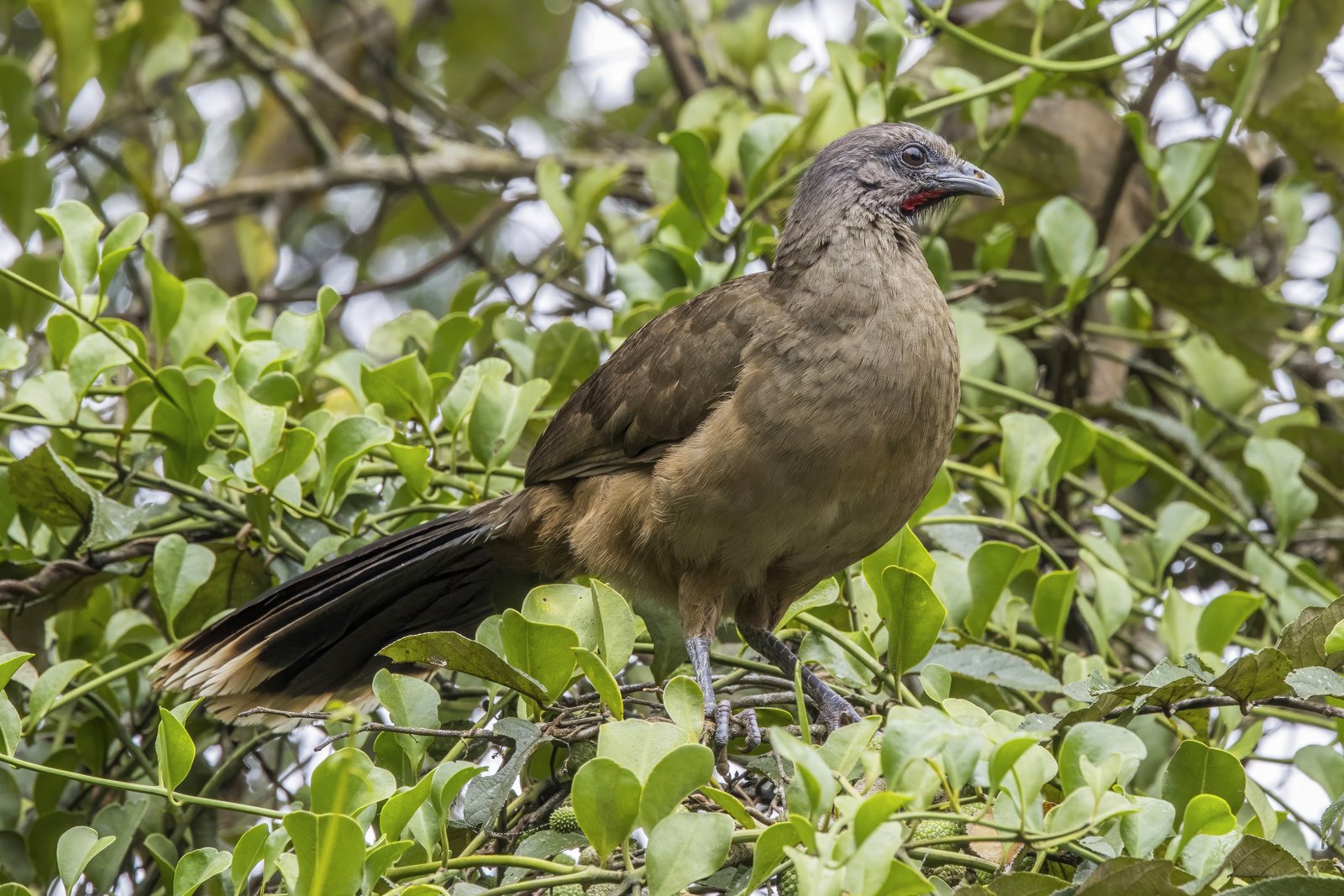
48–58 cm; a slender gamebird with a small head, a long neck and a long, broad, rounded tail. The upperparts are plain olive-brown, the head and neck greyer. The underparts are paler, greyish to ochre-brown; birds on the Yucatán Peninsula are paler and greyer than those in north-eastern Mexico. The tail is dark with a green gloss, the outer feathers with broad whitish to pale ochre tips. There is bare grey skin around the eye, and a bare pink to red patch on the throat, which is brighter in the breeding season. Male and female are alike.
Confusion species
White-bellied Chachalaca Ortalis leucogastra has a white belly, a browner head and white tail tips, and lives on the Pacific side from Chiapas to Nicaragua. Grey-headed Chachalaca Ortalis cinereiceps has a dark grey head and rufous primaries that stand out in flight; it lives further south and east, from eastern Honduras to Panama. Crested Guan Penelope purpurascens is much larger and darker, with white streaks on the neck and breast and a large red dewlap.
Habitat
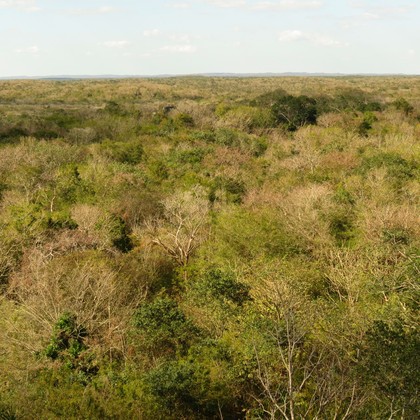
Dense scrub, secondary forest, forest edges, gallery and riparian forest, the edges of dry and humid forest, plantations and large gardens near villages; from sea level to about 1000 m, locally higher. It lives in groups of a few to more than ten birds, which clamber mainly through shrubs and trees and rarely fly far. It eats fruit, leaves, buds and flowers. The nest is a small platform of twigs in a shrub or tree.
Where the bird is most at home, classified by the vegetation units of Mexico and Central America.





Range and movements
In Mexico from Nuevo León and Tamaulipas through San Luis Potosí, eastern Querétaro and Hidalgo, Puebla and Veracruz to northern Oaxaca, Tabasco and Chiapas, and across the whole Yucatán Peninsula (Campeche, Yucatán, Quintana Roo). Further in Belize, Guatemala, Honduras, with a subspecies of its own on the island of Utila, and in Nicaragua and north-western Costa Rica, mainly in Guanacaste and around the Gulf of Nicoya. Outside the guide area only in southern Texas.
- Resident
- dark = core range, pale = thinly spread
How and when to look
On the Yucatán Peninsula and in Belize almost everywhere in scrub near villages, along roads and at Maya ruins such as Tikal and Calakmul. The dawn chorus is often the first sound of the day; following the sound usually leads to the birds in the shrubs or treetops shortly afterwards.
Conservation status
Not threatened. A common species that copes well with logged and fragmented forest and has therefore benefited in many places from the opening up of the landscape. It is hunted locally.
Scientific name
Ortalis vetula | (Wagler, 1830)
Wagler described the species in 1830 as Penelope vetula; because it was later moved to another genus, the author and year stand in brackets. The genus Ortalis was introduced in 1786 by Merrem. Ortalis is Greek for 'chick, young hen'. vetula is Latin for 'little old woman', perhaps after the loud, cackling calls. The specimen the first description was based on came from Tampico, Tamaulipas, Mexico.