All species › Passerines › Tanagers and allies › Purple Honeycreeper
Position in the tree Birds Aves › Birds with a flexible palate Neognathae › All other modern birds Neoaves › Landbirds Telluraves › Falcons, parrots and passerines Australaves › Falcons and passerines Eufalconimorphae › Parrots and passerines Psittacopasserae
Purple Honeycreeper | Cyanerpes caeruleus
Purpersuikervogel | Mielero cerúleo
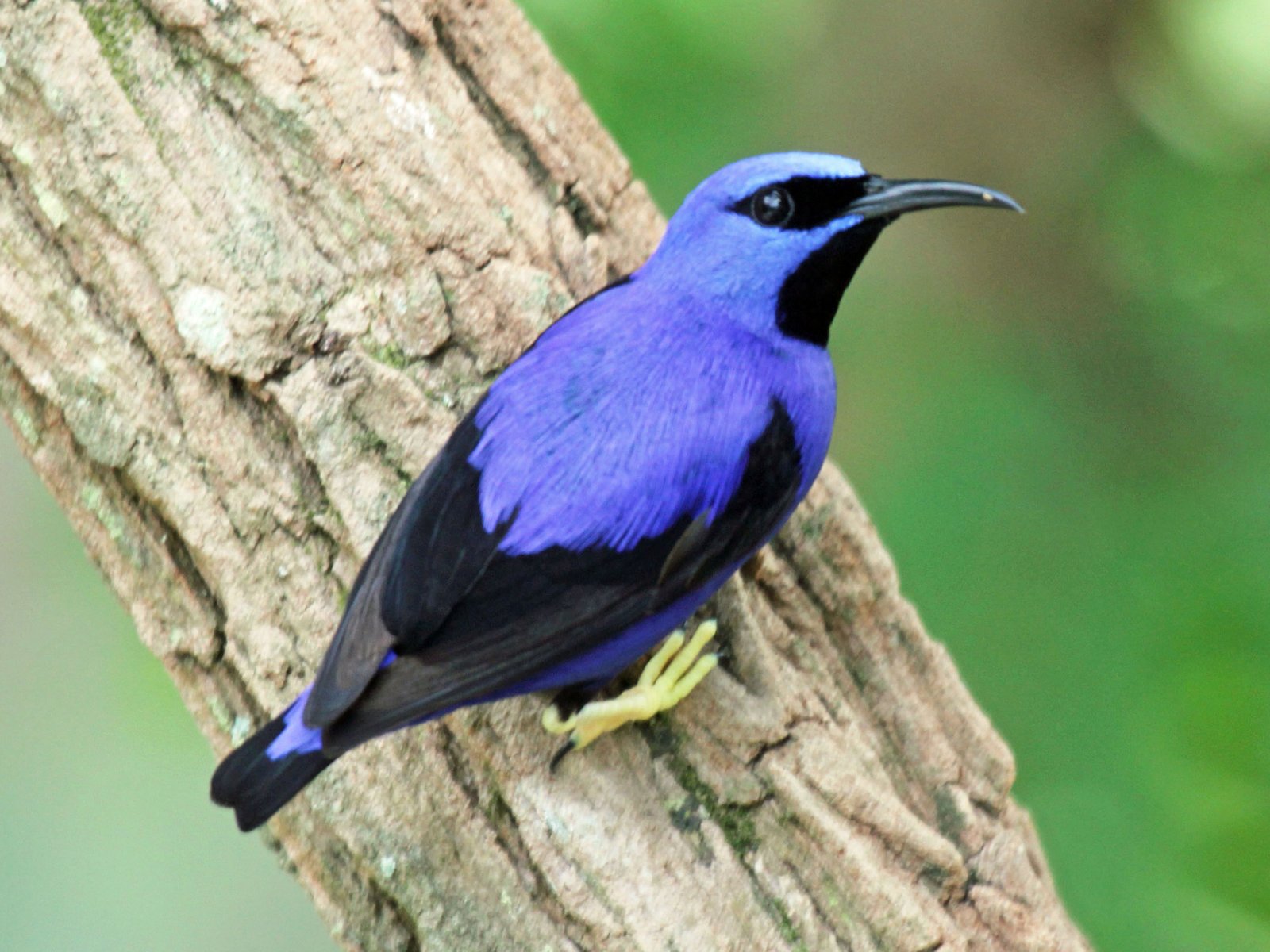
The Purple Honeycreeper is a small honeycreeper with a long, curved bill and yellow legs that searches the canopy of humid forest for nectar and fruit. It is widespread in northern South America and in the guide area reaches only eastern Panama.
Voice
A thin, high tsee and a soft, dry twitter; not very vocal.
Recording: JAYRSON ARAUJO DE OLIVEIRA — CC BY-NC-SA 4.0 · converted to mono · xeno-canto
Identification
10–11 cm. Small, with a short tail and a long, thin, curved bill. The male is glossy purple-blue with a small black throat patch, black lores, black wings and tail. The female is green with an ochre-brown face and ochre throat, a blue malar stripe and green streaks on the paler underparts. Legs yellow in both sexes.
Confusion species
Shining Honeycreeper Cyanerpes lucidus is very similar; the male has a larger black throat patch, the female a bluish head and blue streaks on the breast. Red-legged Honeycreeper Cyanerpes cyaneus is larger, with red legs and a turquoise crown. The female Blue Dacnis Dacnis cayana has a short, pointed bill.
Habitat
Canopy and edges of humid lowland and foothill forest, clearings with flowering trees and mature secondary forest.
Where the bird is most at home, classified by the vegetation units of Mexico and Central America.



Range and movements
Eastern Panama, mainly in Darién and Guna Yala; scarce and local. Outside the guide area in northern South America, from Colombia and Venezuela to Amazonia and Bolivia, and on Trinidad.
- Resident
- dark = core range, pale = thinly spread
How and when to look
At flowering trees along forest edges in Darién, look closely at male honeycreepers: the size of the black throat patch, and in females above all the colour of the face and breast streaks, separate this species from Shining Honeycreeper.
Conservation status
Not threatened (LC). Common in South America; scarce in Panama.
Scientific name
Cyanerpes caeruleus | (Linnaeus, 1758)
Linnaeus described the species in 1758 as Certhia caerulea; because it was later moved to another genus, the author and year stand in brackets. The genus Cyanerpes was introduced in 1899 by Oberholser. Cyanerpes is Greek, from kuanos 'dark blue' and herpēs 'creeper'. caeruleus is Latin for 'blue'. The specimen the first description was based on came from Suriname.