All species › Swifts › Hummingbirds › Purple-throated Mountaingem
Position in the tree Birds Aves › Birds with a flexible palate Neognathae › All other modern birds Neoaves › Birds of the elements Elementaves › Nightjars and swifts Strisores
Purple-throated Mountaingem | Lampornis calolaemus
Purperkeeljuweelkolibrie | Colibrí gorjipúrpura
The Purple-throated Mountaingem is the mountaingem of the middle elevations of Nicaragua, Costa Rica and western Panama. The male has a purple throat, the female cinnamon underparts. In cloud forest it is one of the commonest hummingbirds and often visits feeders at lodges.

Voice
A dry, hard chik or chet, often repeated, and in chases a rattling twitter.
Recording: Paul Driver — CC BY-NC-SA 3.0 · converted to mono · xeno-canto
Identification
10–11 cm, with a straight black bill. The upperparts are green, with a white stripe behind the eye and a dark cheek patch. The male has a glittering purple to violet throat, grey-green underparts and a blue-black tail. The female has a cinnamon throat and underparts and a dark tail with grey tips to the outer feathers.
Confusion species
White-throated Mountaingem Lampornis castaneoventris lives higher in the mountains; the male has a white throat and, in Costa Rica, a grey tail. Females of the two species are very alike, so elevation and nearby males help with identification. White-bellied Mountaingem Lampornis hemileucus has a white belly, and the male a small violet throat patch. Fiery-throated Hummingbird Panterpe insignis has a fiery red to golden throat and a blue breast patch.
Habitat
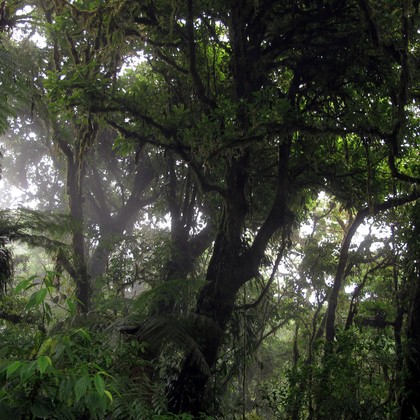
Cloud forest, forest edges, scrubby clearings and gardens in the mountains, at about 1000 to 2500 m, locally lower. It feeds in the understorey and middle strata at flowers of shrubs, epiphytes and vines, and catches small insects. Males defend flowering shrubs against other hummingbirds.
Where the bird is most at home, classified by the vegetation units of Mexico and Central America.




Range and movements
Endemic to the guide area. In the highlands of Nicaragua, in Costa Rica in the Cordillera de Tilarán, the Cordillera Central and the lower parts of the Cordillera de Talamanca, and in western Panama east to Veraguas.
- Resident
- dark = core range, pale = thinly spread
How and when to look
In the cloud forest of Monteverde in Costa Rica, especially at the feeders at the edge of the reserve, and on the slopes of Poás volcano. In Panama in the mountains around Boquete and at Fortuna.
Conservation status
Not threatened. Common in suitable montane forest. Loss of cloud forest affects the species locally, but it also uses forest edges and gardens.
Scientific name
Lampornis calolaemus | (Salvin, 1865)
Salvin described the species in 1865 as Oreopyra calolaema; because it was later moved to another genus, the author and year stand in brackets. The genus Lampornis was introduced in 1827 by Swainson. Lampornis is Greek, from lampē 'torch, light' and ornis 'bird': 'light-bird', after the glittering throat. calolaemus is Greek, from kalos 'beautiful' and laimos 'throat', after the male's purple throat. The specimen the first description was based on came from Irazú Volcano, Costa Rica.