All species › Passerines › Manakins › Red-capped Manakin
Position in the tree Birds Aves › Birds with a flexible palate Neognathae › All other modern birds Neoaves › Landbirds Telluraves › Falcons, parrots and passerines Australaves › Falcons and passerines Eufalconimorphae › Parrots and passerines Psittacopasserae
Red-capped Manakin | Ceratopipra mentalis
Geelbroekmanakin | Manaquín cabeza roja
The Red-capped Manakin is the most widespread manakin of the guide area, from south-eastern Mexico to Panama. The black male has a glossy red head and yellow thighs. In display the male slides backwards along a horizontal branch with rapid steps.

Voice
A sharp pseet or tsik and a high, thin buzz. Males at the display ground also produce snapping sounds with the wings.
Recording: Nick Talbot — CC BY-NC-SA 4.0 · converted to mono · xeno-canto
Identification
10 cm. Male: body glossy black, head and neck scarlet, chin and thighs yellow; iris white, bill pale. The yellow thighs are only visible when the bird displays. Female olive-green, slightly paler and yellower below, with a pale bill and fairly pale legs.
Confusion species
Golden-headed Manakin Ceratopipra erythrocephala (eastern Panama) has a golden-yellow rather than red head and red thighs. Female manakins are hard to separate; that of White-collared Manakin Manacus candei has orange legs, that of White-crowned Manakin Pseudopipra pipra a greyish head.
Habitat
Understorey and mid-levels of humid lowland and foothill forest, mature secondary forest and semi-evergreen seasonal forest, mostly below 1000 m. It eats mainly small fruits and some insects. Males display in loose groups on branches a few metres above the ground.
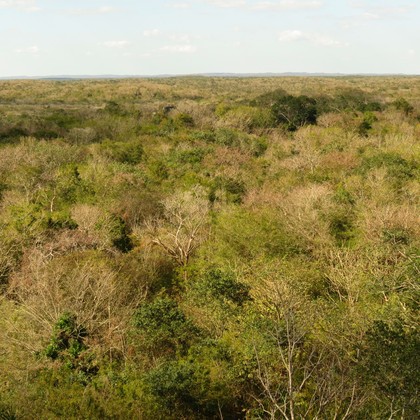
Where the bird is most at home, classified by the vegetation units of Mexico and Central America.




Range and movements
South-eastern Mexico (southern Veracruz, Oaxaca, Tabasco, Chiapas and the southern Yucatán Peninsula) through Belize, Guatemala and the Caribbean slope of Honduras and Nicaragua to Costa Rica and Panama, where it occurs on both slopes. Outside the guide area in western Colombia and Ecuador.
- Resident
- dark = core range, pale = thinly spread
How and when to look
Common at La Selva in Costa Rica, at Tikal in Guatemala and along Pipeline Road (Camino del Oleoducto) in Panama. It often sits still at mid-levels and is easiest to find at fruiting shrubs.
Conservation status
Not threatened. Common and widespread, also in mature secondary forest; disappears where forest is cleared entirely.
Scientific name
Ceratopipra mentalis | (Sclater, 1857) (GBIF: Pipra mentalis)
Sclater described the species in 1857 as Pipra mentalis; because it was later moved to another genus, the author and year stand in brackets. The genus Ceratopipra was introduced in 1854 by Bonaparte. Ceratopipra combines Greek keras 'horn' with the genus Pipra, after the horn-like crest feathers of the type species, the Scarlet-horned Manakin. mentalis is Latin for 'of the chin', from mentum 'chin', presumably after the male's yellow chin. The specimen the first description was based on came from Córdoba, Veracruz, Mexico.