All species › Parrots › African and New World parrots › Red-fronted Parrotlet
Position in the tree Birds Aves › Birds with a flexible palate Neognathae › All other modern birds Neoaves › Landbirds Telluraves › Falcons, parrots and passerines Australaves › Falcons and passerines Eufalconimorphae › Parrots and passerines Psittacopasserae
Red-fronted Parrotlet | Touit costaricensis
Costa Ricaanse papegaai | Cotorrita costarricense
The Red-fronted Parrotlet is a small, stocky parrot with a short, square tail that occurs only in Costa Rica and western Panama. It lives in the canopy of humid montane and foothill forest, mainly on the Caribbean slope, and moves up and down the slopes with the seasons. It is quiet and keeps high in the canopy, and is seldom recorded.

Voice
A soft, nasal nyee or naa and a short, hoarse chatter, mainly in flight; perched birds are usually silent.
Recording: Enrique Varela — CC BY-NC-SA 4.0 · converted to mono · xeno-canto
Identification
15–17 cm. Green, with a red forehead, red lores and a red patch around the eye that extends behind it. There is a red patch on the leading edge of the wing and on the primary coverts, visible in flight; the underwing coverts are yellow. The short tail is yellow with a black terminal band, the central feathers green. The female has less red on the wing. The bill is pale yellowish. Flight fast and direct, in pairs or small, tight groups.
Confusion species
Blue-fronted Parrotlet Touit dilectissimus, mainly in central and eastern Panama, has a blue forehead and a red stripe below the eye instead of a red forehead. Barred Parakeet Bolborhynchus lineola is finely barred black and has a pointed tail without red. Brown-hooded Parrot Pyrilia haematotis is larger, with a brown head.
Habitat
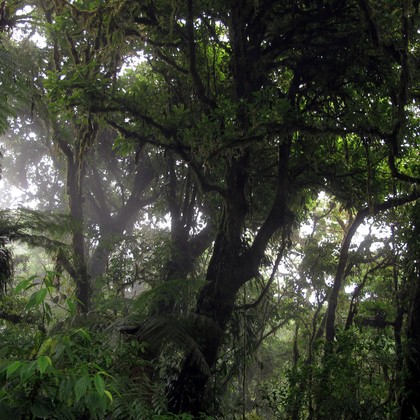
Humid foothill forest and montane rainforest, also cloud forest and high forest edges; it breeds higher up the slopes, roughly between 500 and 3000 m, and after breeding descends to foothill forest and sometimes into the lowlands. It eats fruit, seeds, flowers and epiphytes high in the canopy. It nests in cavities, including in termite nests and epiphyte clumps in trees.
Where the bird is most at home, classified by the vegetation units of Mexico and Central America.



Range and movements
Only in Costa Rica and western Panama: the Caribbean slopes and highlands of the Cordillera de Guanacaste, Cordillera de Tilarán, Cordillera Central and Cordillera de Talamanca, locally also on the Pacific side (for example around Monteverde); in Panama in Bocas del Toro, Chiriquí, Ngäbe-Buglé and northern Veraguas. Everywhere scarce and irregular.
- Resident
- dark = core range, pale = thinly spread
How and when to look
Usually seen as a small group flying fast over the forest on the Caribbean slopes of the Costa Rican mountains; the soft nasal call is often the first sign. In fruiting trees and epiphytes the birds sit still and their green colour blends into the foliage.
Conservation status
Near Threatened. A small range and a small population that is declining through the loss of foothill forest, on which the birds depend outside the breeding season.
Scientific name
Touit costaricensis | (Cory, 1913)
Cory described the species in 1913 as Urochroma costaricensis; because it was later moved to another genus, the author and year stand in brackets. The genus Touit was introduced in 1855 by Gray. Touit comes from Tupi: tuí eté 'true little parrot', recorded by Marcgrave in 1648 as 'Tuiete'. costaricensis is Modern Latin for 'of Costa Rica', the country the type specimen came from. The specimen the first description was based on came from near Puerto Limón, Costa Rica.