All species › Passerines › Cardinals and allies › Rose-breasted Grosbeak
Position in the tree Birds Aves › Birds with a flexible palate Neognathae › All other modern birds Neoaves › Landbirds Telluraves › Falcons, parrots and passerines Australaves › Falcons and passerines Eufalconimorphae › Parrots and passerines Psittacopasserae
Rose-breasted Grosbeak | Pheucticus ludovicianus
Roodborstkardinaal | Picogordo pecho rosa
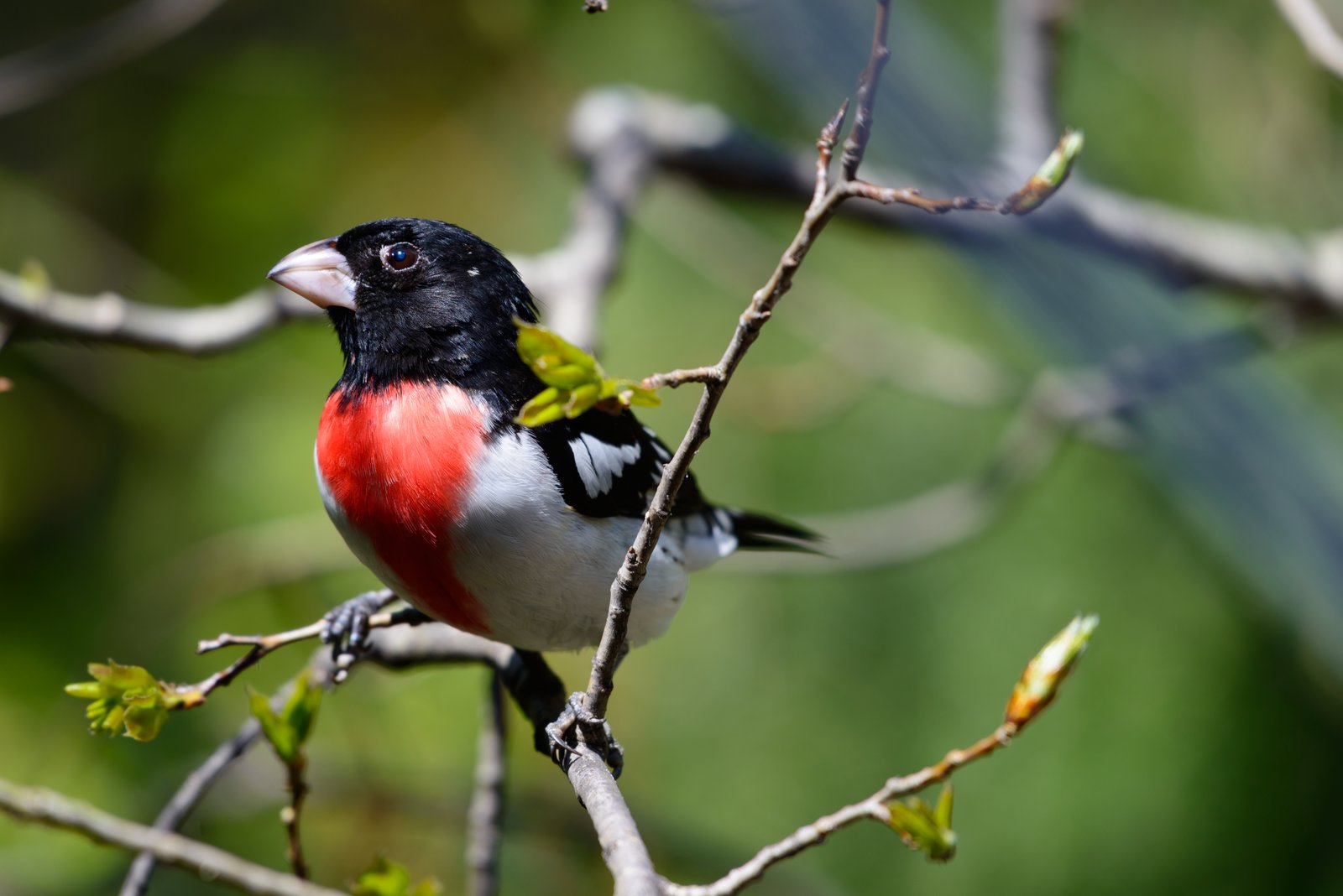
The Rose-breasted Grosbeak is a grosbeak with a heavy, pale bill; the breeding male has a black head and back and a rose-red triangle on the white breast. It breeds in deciduous forest in eastern North America. In the guide area it is a common winter visitor and passage migrant, from Mexico to Panama.
Voice
The song is a long, flowing series of whistled phrases, similar to the song of a thrush but sweeter. The call is a sharp, squeaky eek, like a shoe sole on a smooth floor; in the guide area this is the sound most often heard.
Recording: Sue Riffe — CC BY-NC-SA 4.0 · shortened to the first 60 s, mono · xeno-canto
Identification
18–21 cm. Bill heavy, triangular and pale pinkish ivory. The breeding male has a black head, throat and back, a rose-red triangle on the breast, white underparts, a white rump and black wings with white wing bars and a white patch at the base of the primaries; the underwing coverts are rose-red. In winter plumage, as usually seen in the guide area, the male is browner, with a streaked head, a pale eyebrow and a partly hidden pink breast patch. The female is brown with a broad white eyebrow, a whitish breast with dense brown streaks and yellow underwing coverts. Young males already show pink in the underwing.
Confusion species
Females and young of Black-headed Grosbeak Pheucticus melanocephalus have an orange-buff breast with fine streaks only on the flanks and a bicoloured bill with a dark upper mandible. Hybrids between the two species occur. Female Western Tanager Piranga ludoviciana has a much smaller bill and is yellowish green without streaks.
Habitat
In winter forest edges, secondary forest, clearings with trees, shade coffee, plantations, parks and gardens, from sea level to about 3000 m, mainly in hill country and mountains. It eats mostly fruit and seeds and often visits fruiting trees, sometimes in small groups.
Where the bird is most at home, classified by the vegetation units of Mexico and Central America.






Range and movements
Breeds in southern Canada and the eastern and central United States. Winters from central and southern Mexico through all of Central America to Panama, and on into north-western South America to Venezuela and Peru. On migration also in eastern Mexico and on the Yucatán Peninsula.
- Winter visitor (c. Oct–Mar)
- dark = core range, pale = thinly spread
How and when to look
In winter regularly seen in fruiting trees at forest edges and in gardens in the hills and mountains from Guatemala to Costa Rica. The squeaky call often gives it away before the plumage does.
Conservation status
Not threatened (LC). Common; the breeding population in North America is large but has declined markedly since the 1960s.
Scientific name
Pheucticus ludovicianus | (Linnaeus, 1766)
Linnaeus described the species in 1766 as Loxia ludoviciana; because it was later moved to another genus, the author and year stand in brackets. The genus Pheucticus was introduced in 1850 by Reichenbach. Pheucticus is Greek, from pheuktikos 'shy, inclined to avoid'. ludovicianus is Latin for 'of Louisiana', the territory named after King Louis (Ludovicus) XIV. The specimen the first description was based on came from Louisiana.