All species › Waders, gulls and terns › Skimmers, noddies, terns and gulls › Royal Tern
Position in the tree Birds Aves › Birds with a flexible palate Neognathae › All other modern birds Neoaves › Birds of the elements Elementaves › Cranes and waders Gruimorphae
Royal Tern | Thalasseus maximus
Koningsstern | Charrán real
The Royal Tern is the large crested tern seen on almost every coast in the guide area: resting on jetties, buoys and sandbars or fishing in bays and harbours. It is the commonest large tern there, on both the Pacific and Caribbean coasts. West African birds, formerly included in this species, are now treated as a separate species, Thalasseus albididorsalis.

Voice
A loud, rolling kee-rr or keer-rup, lower and less rasping than the calls of Sandwich and Elegant Terns; also a more melodious, whistled tourrr-ee.
Recording: David Darrell-Lambert — CC BY-NC-SA 4.0 · converted to mono · xeno-canto
Identification
45–50 cm, large and powerful, with long, narrow wings, a forked tail and a thick, straight, orange to orange-red bill. In breeding plumage a black cap with a short, shaggy crest; this plumage is held only briefly, and for most of the year the forehead is white and the black remains only as a ragged fringe around the hindcrown that does not enclose the eye. The upperparts are pale grey, the underparts white. In flight the primaries are mostly pale from below, with a narrow dark trailing edge. The legs are black. Juveniles have a paler, yellow-orange bill, dark spots on the wings and a dark bar across the secondary coverts.
Confusion species
Caspian Tern Hydroprogne caspia is heavier, with a thick, deep red bill, a darker, streaked cap even in winter and dark primaries from below. Elegant Tern Thalasseus elegans of the Pacific coast is smaller and slimmer, with a longer, thinner, slightly drooping bill, a longer crest and, in winter, more black around the eye. Sandwich Tern Thalasseus sandvicensis is smaller and has a thin black bill with a yellow tip.
Habitat
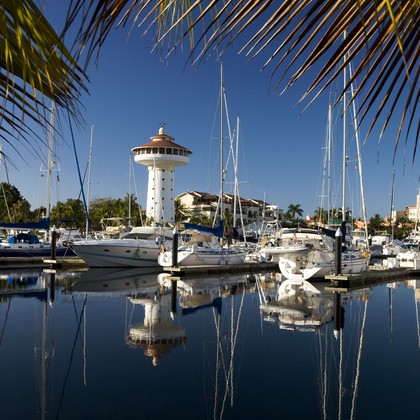
Coastal waters, shallow bays, lagoons, harbours, estuaries and mudflats; less often far out at sea. It fishes by plunge-diving from a greater height than Sandwich Tern. It roosts in flocks on sandbars, beaches, quays, jetties and buoys. It breeds in dense colonies on bare islets, often together with Sandwich or Elegant Terns.
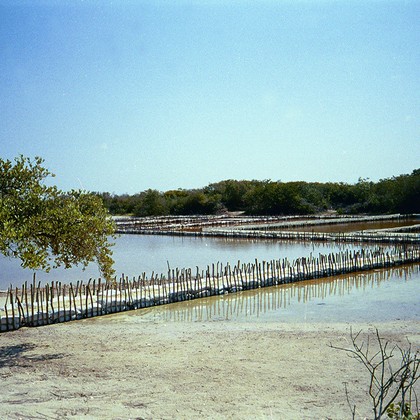
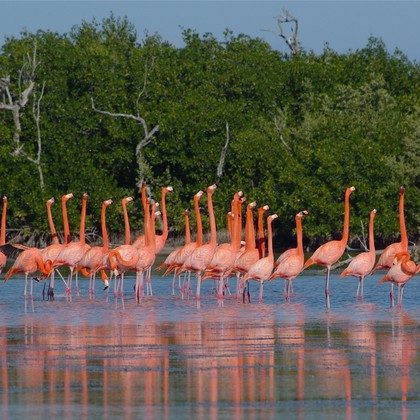
Where the bird is most at home, classified by the vegetation units of Mexico and Central America.



Range and movements
Along both coasts of the whole guide area, from Baja California and Tamaulipas to Panama. Breeds locally on islets in the Gulf of California, including Isla Rasa, on the Pacific coast of Baja California and along the Gulf of Mexico and the Yucatán Peninsula. Outside the guide area the species breeds along the Atlantic and Pacific coasts of the United States, in the Caribbean and along the coasts of South America to Argentina.
- Resident
- dark = core range, pale = thinly spread
How and when to look
Almost any harbour, quay or sandbar along the coast is promising, and resting flocks often allow close views. Elegant, Caspian and Sandwich Terns can be found among them; comparing bill shape and colour in such a flock is the best practice.
Conservation status
Not threatened. The species is numerous and widespread, but breeding colonies on low islets are vulnerable to disturbance, egg collecting, introduced rats and flooding during storms.
Scientific name
Thalasseus maximus | (Boddaert, 1783)
Boddaert described the species in 1783 as Sterna maxima; because it was later moved to another genus, the author and year stand in brackets. The genus Thalasseus was introduced in 1822 by Boie. Thalasseus derives from Ancient Greek thalassa 'sea'. maximus is Latin for 'greatest, largest'; it is one of the largest terns. The specimen the first description was based on came from Cayenne, French Guiana.