All species › Passerines › Thrushes and allies › Ruddy-capped Nightingale-Thrush
Position in the tree Birds Aves › Birds with a flexible palate Neognathae › All other modern birds Neoaves › Landbirds Telluraves › Falcons, parrots and passerines Australaves › Falcons and passerines Eufalconimorphae › Parrots and passerines Psittacopasserae
Ruddy-capped Nightingale-Thrush | Catharus frantzii
Bergdwerglijster | Zorzal de Frantzius
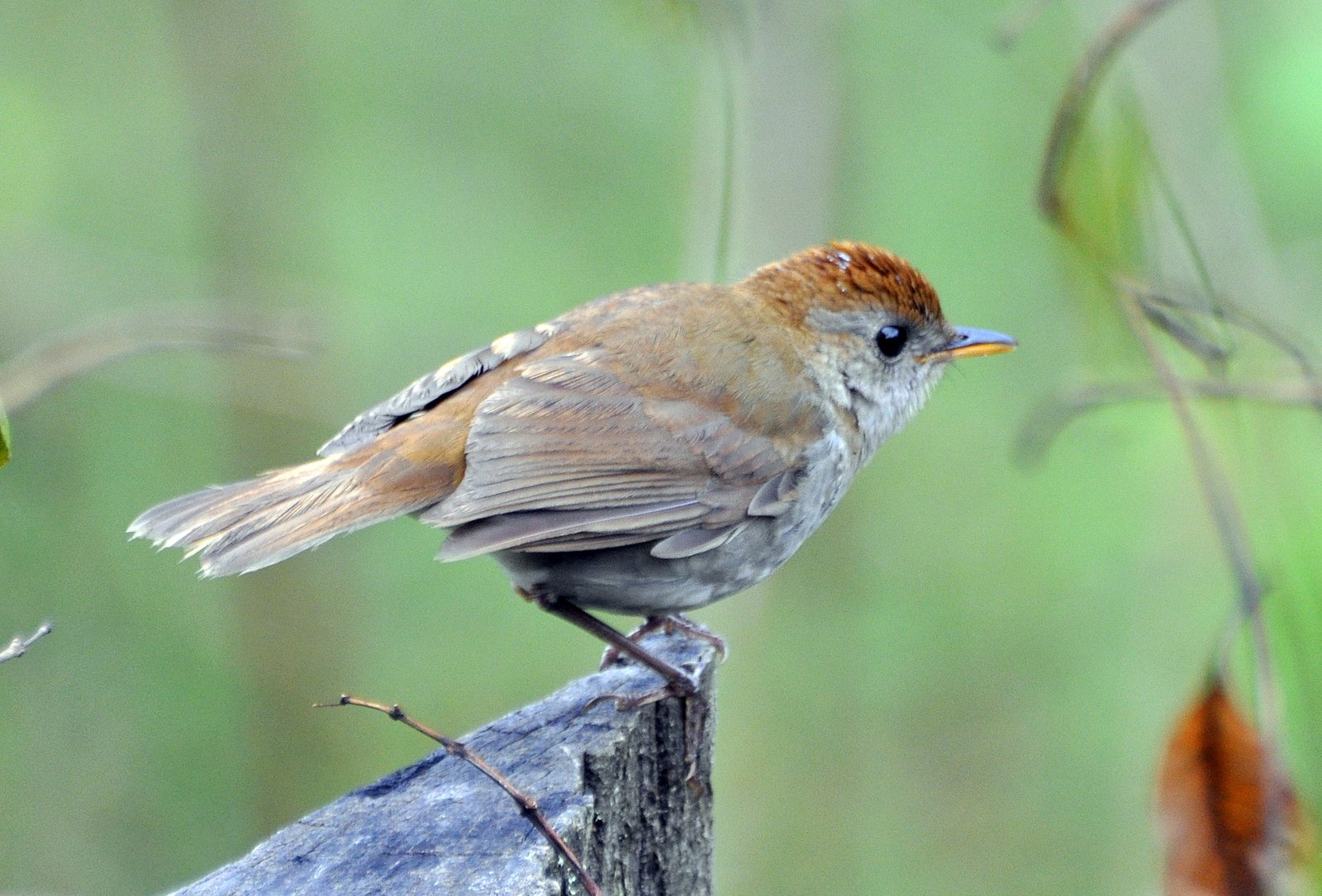
The Ruddy-capped Nightingale-Thrush is a brown and grey nightingale-thrush of montane forest understorey, from central Mexico to western Panama. It is marked by the warm rufous crown and the two-toned bill with an orange lower mandible. It is usually heard before it is seen.
Voice
The song consists of varied, clear whistled phrases, often with a rolling or trilled ending, alternated with short pauses; it differs from region to region. Calls include a nasal, plaintive nyeh and a dry tick.
Recording: Jessica Thompson Ambriz — CC BY-NC-SA 4.0 · converted to mono · xeno-canto
Identification
15–17 cm. Crown and hindneck warm rufous, merging into olive-brown back, wings and tail. Cheeks and side of neck grey; throat pale grey to whitish, breast and flanks plain grey, belly whitish. Upper mandible dark, lower mandible orange-yellow; legs pale pinkish- to yellowish-brown. No conspicuous eye-ring. The sexes are alike; juveniles are browner with pale and dark spots.
Confusion species
Russet Nightingale-Thrush Catharus occidentalis (Mexico only) is more uniformly russet without a contrasting crown and has a buffy breast with faint dark spots. Black-billed Nightingale-Thrush Catharus gracilirostris (Costa Rica and Panama) has an all-black bill and usually lives higher up. Orange-billed Nightingale-Thrush Catharus aurantiirostris has an all-orange bill, orange legs and an orange eye-ring, and Black-headed Nightingale-Thrush Catharus mexicanus has a black cap and an orange eye-ring.
Habitat
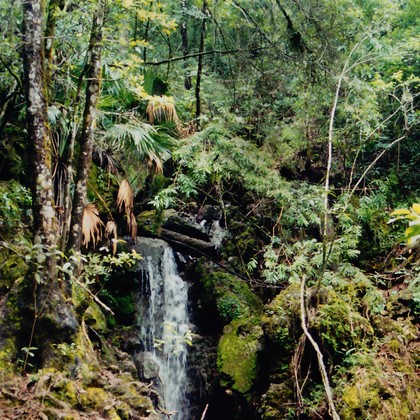
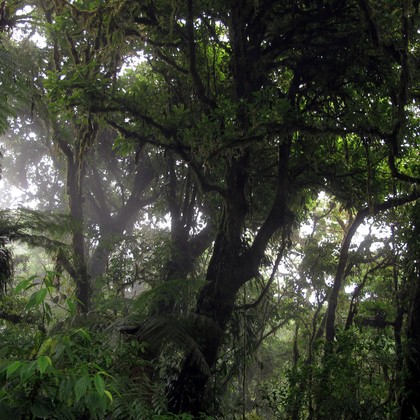
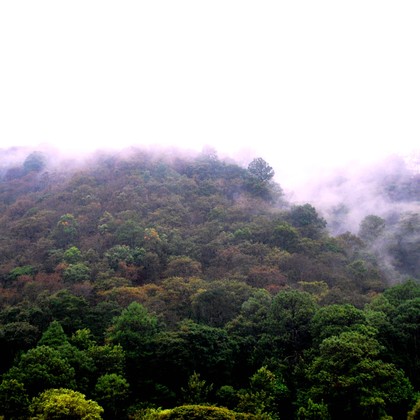
Understorey of humid montane forest, cloud forest and pine-oak forest with a dense shrub layer, also ravines, forest edges and mature secondary forest; mostly between 1350 and 3000 m. It forages on and just above the ground for insects, spiders and small fruits, often in the cover of dense vegetation.
Where the bird is most at home, classified by the vegetation units of Mexico and Central America.
Range and movements
Only in the guide area: in Mexico in the mountains of Jalisco and Michoacán, the Trans-Mexican Volcanic Belt, the Sierra Madre Oriental from Hidalgo, and the mountains of Guerrero, Oaxaca and Chiapas; further in the highlands of Guatemala, El Salvador, Honduras and Nicaragua, and in Costa Rica and western Panama (Chiriquí).
- Resident
- dark = core range, pale = thinly spread
How and when to look
In Costa Rica and Panama easily found along forest trails around San Gerardo de Dota, Monteverde and Boquete. At dawn it sometimes shows briefly on a trail or forest edge; otherwise best tracked down by its song from the shrub layer.
Conservation status
Not threatened (LC). Widespread and locally common in montane forest. Clearance of montane forest and conversion to pasture or cropland cause local declines.
Scientific name
Catharus frantzii | Cabanis, 1861
Cabanis described the species in 1861 and placed it straight away in the genus where it still stands. The genus Catharus was introduced in 1850 by Bonaparte. Catharus is from Ancient Greek katharos 'pure, clean', a name given for the clean plumage of the orange-billed nightingale-thrush. frantzii honours the German physician and naturalist Alexander von Frantzius (1821–1877), who worked in Costa Rica from 1853 to 1868. The specimen the first description was based on came from Irazú Volcano, Costa Rica.