All species › Swifts › Hummingbirds › Rufous Hummingbird
Position in the tree Birds Aves › Birds with a flexible palate Neognathae › All other modern birds Neoaves › Birds of the elements Elementaves › Nightjars and swifts Strisores
Rufous Hummingbird | Selasphorus rufus
Rosse kolibrie | Zumbador rufo
The Rufous Hummingbird breeds further north than any other hummingbird, as far as southern Alaska, and winters mainly in the highlands and on the Pacific side of Mexico. Its migration follows a loop: north along the Pacific coast in spring, south through the mountains in late summer. As early as July the first males reappear in northern Mexico.

Voice
The call is a hard, dry chip, speeded up in chases into a rattling chip-chip-chip with a squeezed zee-chuppity-chup in between. In flight the wings of the adult male produce a high, whining buzz.
Recording: Peter Ward and Ken Hall — CC BY-NC-SA 4.0 · converted to mono · xeno-canto
Identification
8–9 cm, with a straight, fairly short black bill. The male is largely orange-rufous, with a white breast and a metallic orange-red throat that flashes from gold to scarlet; the back is usually entirely rufous, but some males have green feathers on the back. The female is green above, with rufous flanks, a rufous tail base, white tips to the outer tail feathers and usually a small orange-red spot in the centre of the throat. Young birds resemble the female, with little or no red on the throat.
Confusion species
Allen's Hummingbird Selasphorus sasin often cannot be separated with certainty in the field. The male of that species has an entirely green back; green-backed male Rufous can only be told by the shape of the tail feathers, which are narrower in Allen's, especially the outermost. Females and young birds of the two species cannot be separated in the field. Broad-tailed Hummingbird Selasphorus platycercus is larger, with a rose-red throat in the male and less rufous on the flanks and tail in the female. Calliope Hummingbird Selasphorus calliope is smaller and shorter-tailed, with little rufous at the tail base.
Habitat
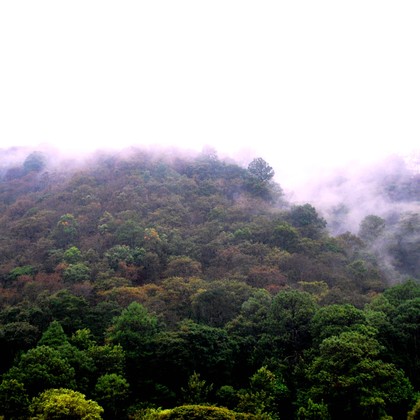
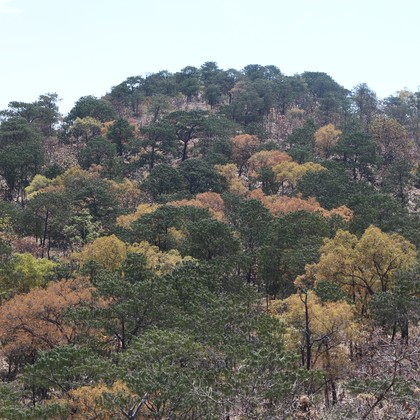
In winter mainly in pine-oak forest, forest edges, clearings and flowery scrub in the highlands, and on the Pacific side also in dry forest and gardens at lower elevations; on migration also in flowery mountain meadows above 3000 m. It fiercely defends a flowering shrub or feeder and chases larger hummingbirds away.
Where the bird is most at home, classified by the vegetation units of Mexico and Central America.


Range and movements
Winters mainly in Sinaloa, Nayarit, Jalisco, Colima and Michoacán and in the highlands of central and southern Mexico to Oaxaca, with a few records as far as Guatemala and Costa Rica. In late summer, from July, it passes through the Sierra Madre Occidental in Sonora, Chihuahua and Durango; in spring it moves north mainly along the Pacific side and through Baja California. Does not breed in the guide area; the breeding range lies in the north-western United States, western Canada and southern Alaska.
- Winter visitor (c. Oct–Mar)
- dark = core range, pale = thinly spread
How and when to look
In July and August at flowering plants in mountain meadows and along forest edges in the Sierra Madre Occidental in Chihuahua and Durango. In winter at flowering shrubs and trees along forest edges in the mountains of Jalisco and Nayarit.
Conservation status
Near Threatened. Counts in the breeding and wintering areas point to a long-term decline. Causes include the loss of flowery forest edges and scrub and shifts in the flowering time of food plants, which then match migration less well.
Scientific name
Selasphorus rufus | (Gmelin, 1788)
Gmelin described the species in 1788 as Trochilus rufus; because it was later moved to another genus, the author and year stand in brackets. The genus Selasphorus was introduced in 1832 by Swainson. Selasphorus is Greek, from selas 'light, flame' and -phoros 'bearing': 'light-bearer', after the fiery, glittering throat. rufus is Latin for 'red, rufous', after the male's rufous plumage. The specimen the first description was based on came from Nootka Sound, Vancouver Island, Canada.