All species › Passerines › Antbirds › Rufous-rumped Antwren
Position in the tree Birds Aves › Birds with a flexible palate Neognathae › All other modern birds Neoaves › Landbirds Telluraves › Falcons, parrots and passerines Australaves › Falcons and passerines Eufalconimorphae › Parrots and passerines Psittacopasserae
Rufous-rumped Antwren | Euchrepomis callinota
Grijswangmiersluiper | Hormiguerito lomirrufo
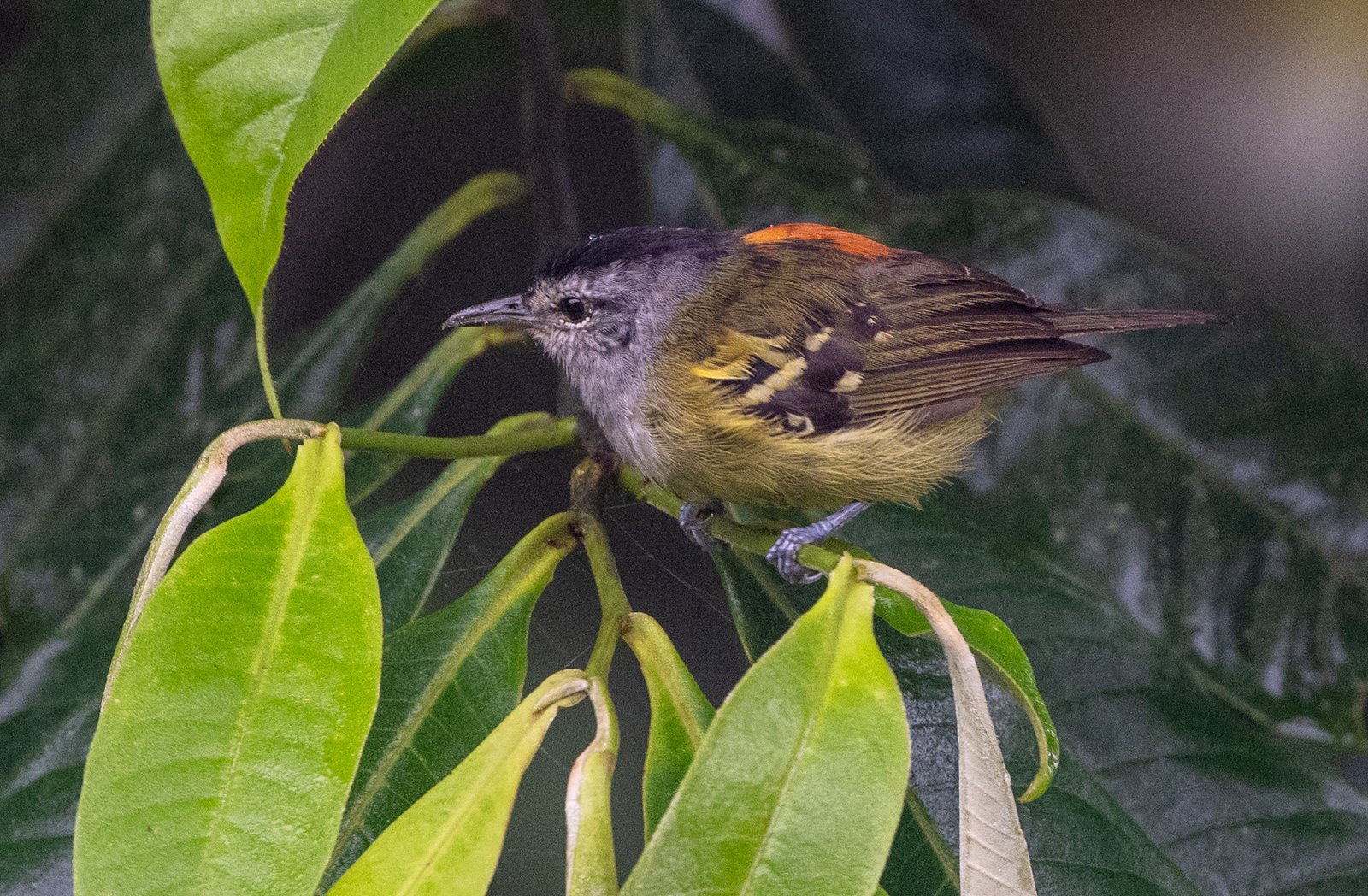
The Rufous-rumped Antwren is a small, warbler-like antwren of the canopy of foothill and montane forest, with a conspicuous rufous rump. It searches high in the trees for insects, usually in mixed flocks. In the guide area it lives only in Costa Rica and Panama, where it is scarce.
Voice
The song is a high, thin, fast trill or series of notes that rises slightly. Also short, high calls.
Recording: rudy gelis — CC BY-NC-SA 4.0 · converted to mono · xeno-canto
Identification
10–11 cm. Male with black crown, grey cheeks and a narrow yellow eyebrow. Back olive-green, rump bright rufous. Wings dark with two white wing bars and a yellow shoulder patch. Throat whitish, breast grey, belly and undertail coverts yellow. The female has an olive instead of black crown. Bill thin and pointed.
Confusion species
Small warblers and vireos in the same mixed flocks lack the combination of rufous rump, two white wing bars and grey cheeks. Other antwrens in the guide area have neither a rufous rump nor yellow underparts.
Habitat
Canopy and edges of humid foothill and lower montane forest, mostly between about 700 and 1500 m. It searches leaves and vines for small insects, nearly always in mixed flocks with tanagers and other small birds.
Where the bird is most at home, classified by the vegetation units of Mexico and Central America.


Range and movements
Locally on the slopes of Costa Rica and western and eastern Panama. Outside the guide area along the Andes from Colombia and Venezuela to Peru.
- Resident
- dark = core range, pale = thinly spread
How and when to look
In mixed flocks high in the trees it stands out mainly by its rufous rump, which shows well even against the sky as the bird flies from branch to branch.
Conservation status
Not threatened. Scarce and local in the guide area, and little noticed because it lives in the canopy.
Scientific name
Euchrepomis callinota | (Sclater, 1855) (GBIF: Terenura callinota)
Sclater described the species in 1855 as Formicivora callinota; because it was later moved to another genus, the author and year stand in brackets. The genus Euchrepomis was introduced in 2012 by Bravo, Remsen, Whitney & Brumfield. Euchrepomis is Greek, from eukhrōs 'bright-coloured' and epōmis 'point of the shoulder', after the bright yellow or orange-rufous lesser coverts of the males. callinota is Greek, from kallos 'beauty' and -nōtos '-backed', after the rufous rump. The specimen the first description was based on came from Bogotá, Colombia.