All species › Passerines › New World sparrows › Rusty Sparrow
Position in the tree Birds Aves › Birds with a flexible palate Neognathae › All other modern birds Neoaves › Landbirds Telluraves › Falcons, parrots and passerines Australaves › Falcons and passerines Eufalconimorphae › Parrots and passerines Psittacopasserae
Rusty Sparrow | Aimophila rufescens
Roestruggors | Zacatonero rojizo
The Rusty Sparrow is a large, rufous-brown sparrow of the grassy understorey of oak and pine-oak woodland. It has a strikingly heavy bill and a rich, varied song. Its range extends from north-western Mexico to north-western Costa Rica.

Voice
The song is a short, clear and varied phrase of whistled notes, often ending in a trill; pairs sometimes duet with a fast, chattering chi-di-di-di. The call is a sharp tsip and a hard, nasal chak.
Recording: Manuel Grosselet — CC BY-NC-SA 4.0 · shortened to the first 60 s, mono · xeno-canto
Identification
17–19 cm. Large and sturdy, with a long tail and a heavy bill: the upper mandible dark, the lower mandible bluish-grey. Crown rufous with a narrow grey central stripe; supercilium grey, sometimes buff in front of the eye, with a rufous eye-stripe and a sharp black malar stripe. Back rufous-brown with dark streaks; wings and tail warm rufous. Underparts unstreaked grey, warm buff-brown on the flanks and undertail-coverts, paler in the centre of the belly. Young birds are finely streaked on the breast and flanks. The sexes are alike.
Confusion species
Rufous-crowned Sparrow Aimophila ruficeps is clearly smaller, with a thin bill, a white eye-ring, a less streaked back and a shorter tail, and lives mainly on rocky, grassy slopes. Oaxaca Sparrow Aimophila notosticta is smaller, with an all-dark bill, a darker, greyer head and a more heavily streaked back. Botteri's Sparrow Peucaea botterii lacks the rufous crown and black malar stripe and lives in open grassland.
Habitat
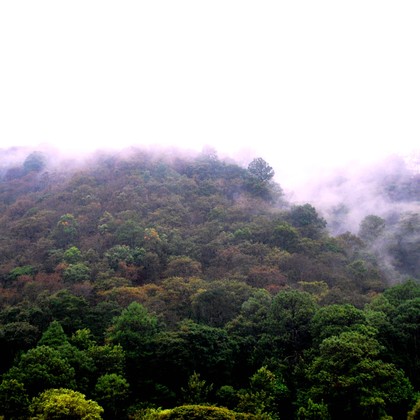
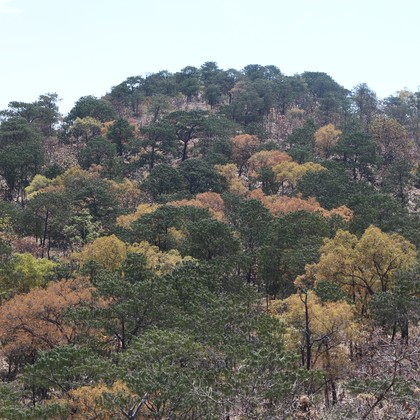
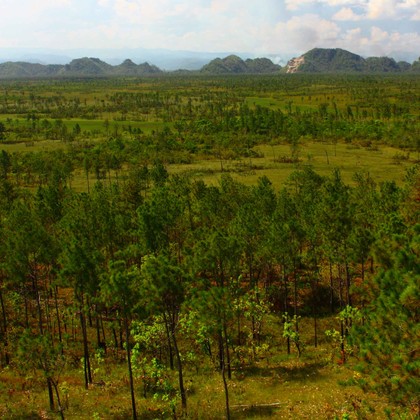
Grassy understorey and scrub in open oak woodland, pine-oak woodland and pine savanna, also forest edges, scrub on slopes and overgrown pastures, from sea level to about 2500 m. It feeds on the ground under shrubs on seeds and insects and sings from a low branch or bush.
Where the bird is most at home, classified by the vegetation units of Mexico and Central America.

Range and movements
From Sonora and Chihuahua south along the Sierra Madre Occidental and the Pacific slope through western, central and southern Mexico to Chiapas and the pine savannas of Belize and the Mosquitia. Further through the highlands of Guatemala, El Salvador and Honduras to Nicaragua and north-western Costa Rica.
- Resident
- dark = core range, pale = thinly spread
How and when to look
Regularly heard in the pine savanna of Mountain Pine Ridge in Belize and in the oak and pine-oak woodlands of the highlands of Guatemala and Honduras. A singing bird is often the first sign; soft pishing usually brings it out to investigate.
Conservation status
Not threatened (LC). Widespread and locally common. It retreats locally where woodland is converted to farmland or where the understorey disappears through overgrazing and burning.
Scientific name
Aimophila rufescens | (Swainson, 1827)
Swainson described the species in 1827 as Pipilo rufescens; because it was later moved to another genus, the author and year stand in brackets. The genus Aimophila was introduced in 1837 by Swainson. Aimophila is Greek, from haimos 'thicket' and philos 'loving': 'thicket-lover'. rufescens is Latin for 'reddish', after the rusty crown and upperparts. The specimen the first description was based on came from Temascaltepec, State of Mexico, Mexico.