All species › Passerines › Tanagers and allies › Saffron Finch
Position in the tree Birds Aves › Birds with a flexible palate Neognathae › All other modern birds Neoaves › Landbirds Telluraves › Falcons, parrots and passerines Australaves › Falcons and passerines Eufalconimorphae › Parrots and passerines Psittacopasserae
Saffron Finch | Sicalis flaveola
Gewone saffraangors | Chirigüe azafranado
The Saffron Finch is a compact, bright yellow finch-like tanager of open country with scattered trees, lawns and villages. It feeds on the ground in small groups, mainly on seeds. In the guide area it lives only in Panama, where the birds probably descend from escaped cage birds, and it is spreading westwards.
Voice
Song a series of sharp, metallic chips and short phrases, such as tsip tsip tsee-tsit, often repeated from a roof, wire or treetop. Call a short, clear pink.
Recording: Jacob Wijpkema — CC BY-NC-SA 4.0 · shortened to the first 60 s, mono · xeno-canto
Identification
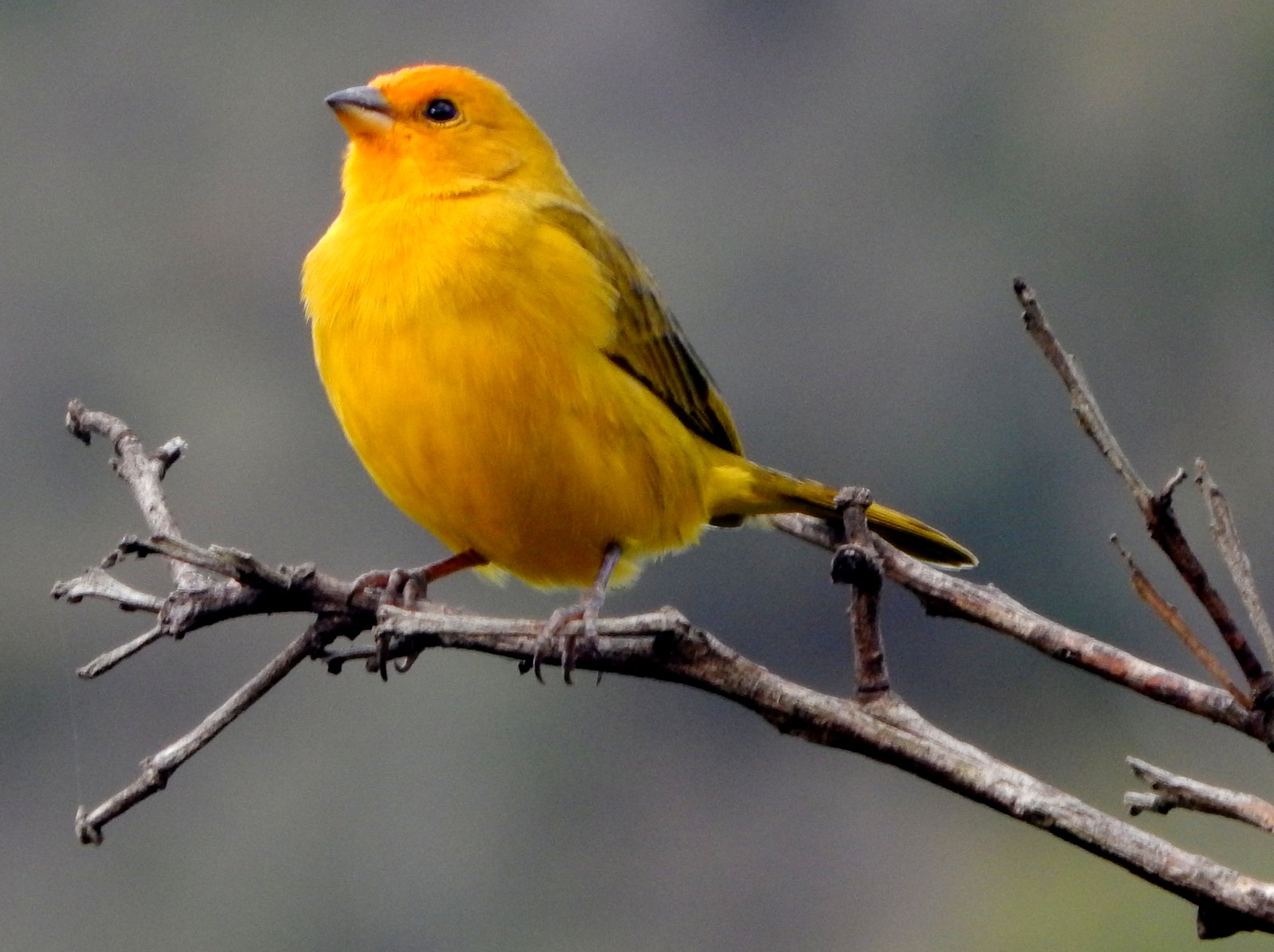
13.5–15 cm. Male entirely bright yellow with an orange forehead and forecrown; back and scapulars slightly greener yellow with faint dark streaks. Wings and tail dark with yellowish-green edges. Short, conical bill, upper mandible dark, lower mandible paler. The female resembles the male but is duller, with less orange on the head. Young birds are greyish-brown with pale, streaked underparts, a yellow band across the breast and yellow undertail coverts; they only gradually turn yellow.
Confusion species
Grassland Yellow-Finch Sicalis luteola is smaller, has a clearly dark-streaked back and crown, no orange on the head and lives in grassland and rice fields. The female Lesser Goldfinch Spinus psaltria is smaller and has a white wing patch. Yellow warblers (Setophaga) have a thin, pointed bill. Young Saffron Finches can suggest a sparrow or seedeater, but the yellow breast band and yellow undertail coverts identify the species.
Habitat
Open and semi-open lowland country: grassland and pasture with scattered trees, field edges, lawns, sports fields, parks, farmyards and villages, especially in drier areas. It feeds in small groups on the ground on seeds, also on small insects. It nests in cavities: under roof tiles, in holes in walls, tree holes and old nests of other birds.
Where the bird is most at home, classified by the vegetation units of Mexico and Central America.


Range and movements
In the guide area only in Panama, mainly in the Pacific lowlands from the Panama City area to the Azuero Peninsula and further west into Chiriquí; there are records up to near the border with Costa Rica. Outside the guide area native to a large part of South America, from Colombia and Venezuela to northern Argentina; introduced to Jamaica, Puerto Rico and Hawaii.
- Resident
- dark = core range, pale = thinly spread
How and when to look
Regularly seen on lawns, sports fields and in villages around Panama City and in the dry lowlands of the Azuero Peninsula. Groups often sit on the ground under trees or on roofs.
Conservation status
Not threatened (LC). Common and increasing in Panama. In South America the species is widely trapped as a cage bird.
Scientific name
Sicalis flaveola | (Linnaeus, 1766)
Linnaeus described the species in 1766 as Fringilla flaveola; because it was later moved to another genus, the author and year stand in brackets. The genus Sicalis was introduced in 1828 by Boie. Sicalis comes from Greek sikalis, a small black-headed bird mentioned by Aristotle and Epicharmus, perhaps a Sylvia warbler. flaveola is a diminutive of Latin flavus 'golden-yellow', after the bright yellow plumage. The specimen the first description was based on came from Suriname (designated later).