All species › Parrots › African and New World parrots › Saffron-headed Parrot
Position in the tree Birds Aves › Birds with a flexible palate Neognathae › All other modern birds Neoaves › Landbirds Telluraves › Falcons, parrots and passerines Australaves › Falcons and passerines Eufalconimorphae › Parrots and passerines Psittacopasserae
Saffron-headed Parrot | Pyrilia pyrilia
Saffraankoppapegaai | Loro cabeciamarillo
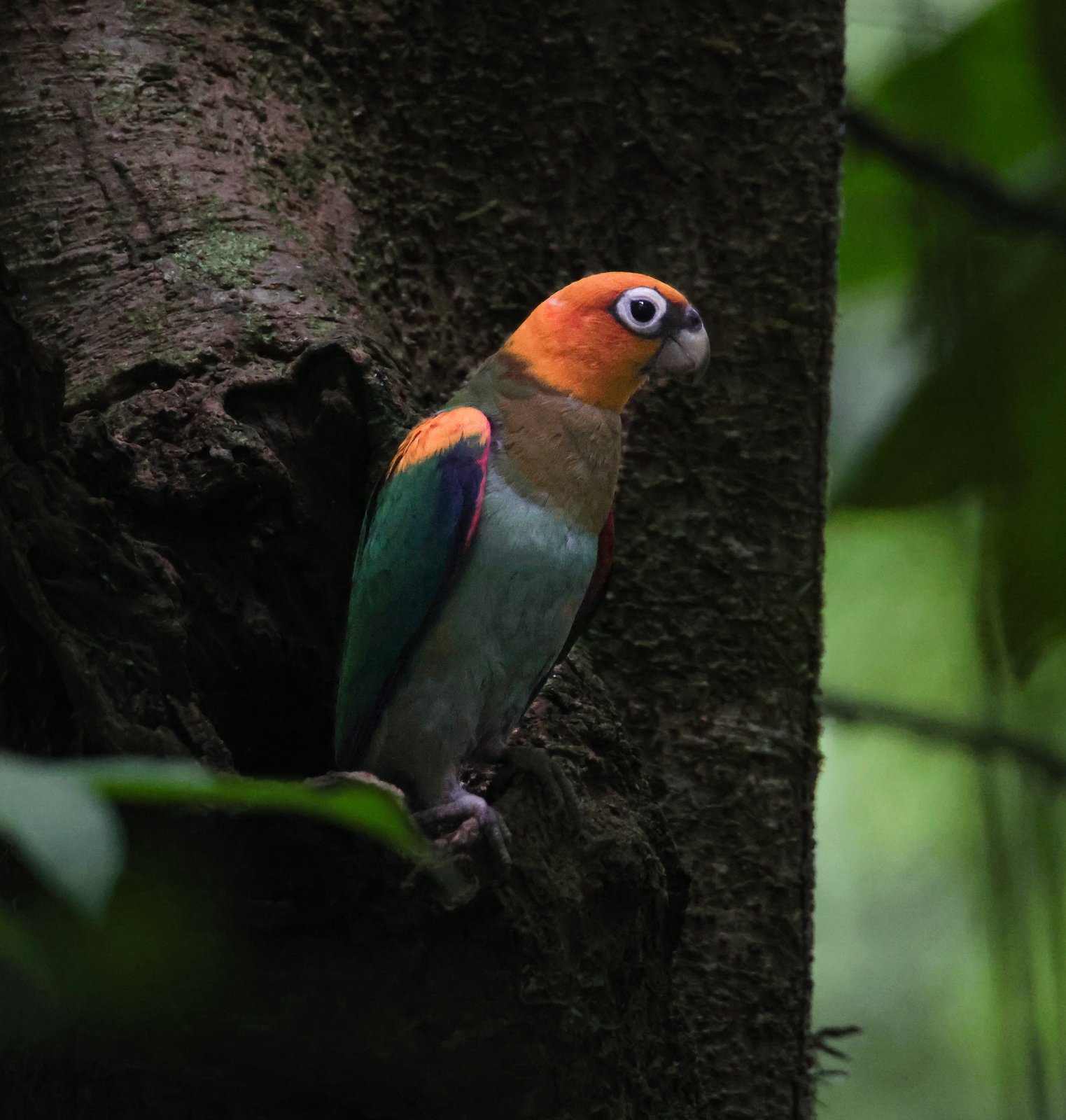
The Saffron-headed Parrot is a small, stocky parrot with a bright yellow head and a short tail. In the guide area it occurs only in eastern Panama, mainly in Darién, at the northern edge of a range that lies otherwise in Colombia and Venezuela. It lives in pairs or small groups in the canopy of humid lowland and foothill forest.
Voice
A high, shrill and somewhat nasal chee-eek or kweek-kweek, mainly in flight; perched birds give a softer chatter.
Recording: Orlando A. Acevedo-Charry — CC BY-NC-SA 3.0 · converted to mono · xeno-canto
Identification
23–25 cm. Head and neck are saffron to orange-yellow, with a bare, whitish ring around the eye and a pale, horn-coloured bill. Back, wings and the short, square tail are green, the breast olive-green. In flight the red underwing coverts and dark blue primaries stand out. Young birds have a greenish head with little yellow. Male and female are alike.
Confusion species
Its yellow head makes it hard to confuse within its small range. The Brown-hooded Parrot Pyrilia haematotis has the same shape and also red underwing coverts, but a dark brown head with a red ear patch. The Blue-headed Parrot Pionus menstruus is larger, with a blue head and red undertail coverts. Amazons such as the Yellow-crowned Amazon Amazona ochrocephala are much larger and show yellow only on the forehead and crown.
Habitat
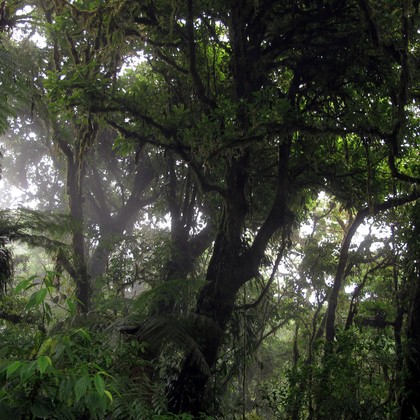
Humid lowland and foothill forest up into lower montane forest, forest edges and old secondary forest; in Panama mainly in the hill country of Darién. It eats fruit and seeds high in the crowns, where it often sits quietly and inconspicuously among the leaves. It nests in a tree cavity.
Where the bird is most at home, classified by the vegetation units of Mexico and Central America.




Range and movements
In the guide area only in eastern Panama: in Darién, including the hills around Cerro Pirre, and locally in the adjacent east of Panamá province. Outside the guide area in northern and western Colombia and northwestern Venezuela.
- Resident
- dark = core range, pale = thinly spread
How and when to look
The best chance is in Darién National Park, around Cana and on the slopes of Cerro Pirre. Pairs and small groups fly calling over the forest mainly early in the morning; perched, their green backs make them hard to find.
Conservation status
Near Threatened. The species is declining through deforestation, especially in Colombia and Venezuela, and is trapped for the cage-bird trade. In remote eastern Panama its habitat is still largely intact.
Scientific name
Pyrilia pyrilia | (Bonaparte, 1853) (GBIF: Pionopsitta pyrilia)
Bonaparte described the species in 1853 as Psittacula pyrilia; because it was later moved to another genus, the author and year stand in brackets. The genus Pyrilia was introduced in 1856 by Bonaparte. Pyrilia comes from the species name pyrilia: Greek pur 'fire' and Latin ilia 'flanks', after the orange-red underwing and flanks. pyrilia is formed from Greek pur 'fire' and Latin ilia 'flanks', after the orange-red underwing and flanks. The specimen the first description was based on came from Riohacha, foot of the Sierra Nevada de Santa Marta, Colombia.