All species › Pigeons and doves › Doves and pigeons › Scaled Pigeon
Position in the tree Birds Aves › Birds with a flexible palate Neognathae › All other modern birds Neoaves › Doves, turacos and allies Columbaves › Doves and sandgrouse Columbimorphae
Scaled Pigeon | Patagioenas speciosa
Geschubde duif | Paloma escamosa
The Scaled Pigeon is a large, rufous-brown forest pigeon with a heavily scaled neck and breast and a bright red bill with a white tip. It lives in the canopy of humid lowland forest from south-eastern Mexico to Panama and on into South America. It is usually noticed only when it flies over the forest or sits high in a bare treetop.

Voice
A deep, powerful cooing in a repeated series, roughly whooo, kuk-crooo, with a long first note. Often from a tall canopy tree and heard mainly in the morning.
Recording: Jacob Wijpkema — CC BY-NC-SA 4.0 · converted to mono · xeno-canto
Identification
28–33 cm. The male is chestnut-brown on the back and wing coverts with a purple gloss; the head and crown are purplish brown. The neck, breast and upper back are heavily scaled: the feathers are pale with dark, purple to green-glossed fringes. The belly is paler, dirty white to buff and also scaled, the undertail coverts white. The flight feathers and tail are dark brown. The bill is red with a white tip, the eye dark with a red eye-ring, the legs coral red. The female is duller and browner, with a less crisp scaled pattern; young birds are more uniformly brown.
Confusion species
No other pigeon in the guide area has the scaled pattern on the neck and breast. Pale-vented Pigeon Patagioenas cayennensis is plain vinaceous without scaling, with a black bill and a blue-grey rump. Red-billed Pigeon P. flavirostris has a pale bill with a red base and a grey belly. Ruddy Pigeon P. subvinacea is smaller and uniformly dark rufous-brown, with a black bill.
Habitat
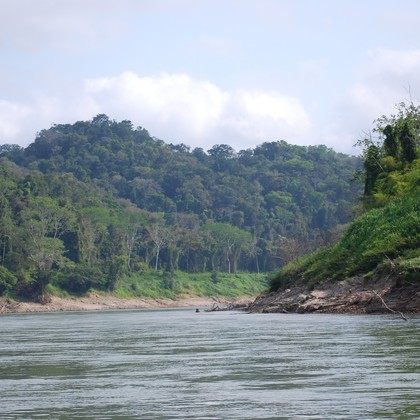
The canopy and edges of humid lowland and foothill forest, tall second growth and tall trees in semi-open country, from sea level to about 1000 m. Lives mainly in the canopy and rarely comes down to the ground; by day it also flies over open country with scattered trees. Eats mainly fruit and berries. The nest is a flimsy platform of twigs in a tree, usually with one egg.
Where the bird is most at home, classified by the vegetation units of Mexico and Central America.




Range and movements
From south-eastern Mexico (southern Veracruz and Oaxaca, Tabasco, Chiapas and the Yucatán Peninsula, mainly Campeche and Quintana Roo) through Belize, northern Guatemala, Honduras and the Caribbean lowlands of Nicaragua to Costa Rica and Panama. In Costa Rica mainly on the Caribbean side and in the south of the Pacific side; in Panama on both slopes. Absent from El Salvador. Outside the guide area to western Ecuador and, east of the Andes, over much of tropical South America to north-eastern Argentina.
- Resident
- dark = core range, pale = thinly spread
How and when to look
From observation towers and clearings above the forest, as at Calakmul in Mexico, Tikal in Guatemala and along Pipeline Road in Panama. Birds sit in bare treetops in the morning; the red bill with a white tip is a good feature through a telescope.
Conservation status
Not threatened. Fairly common in larger forest tracts, but scarcer where lowland forest has been cleared. Hunted locally.
Scientific name
Patagioenas speciosa | (Gmelin, 1789)
Gmelin described the species in 1789 as Columba speciosa; because it was later moved to another genus, the author and year stand in brackets. The genus Patagioenas was introduced in 1853 by Reichenbach. Patagioenas is Greek, from patageō 'to clatter' and oinas 'pigeon', after the clattering wings on take-off. speciosa is Latin for 'beautiful, splendid', after the scaly, glossy plumage of neck and breast. The specimen the first description was based on came from Cayenne, French Guiana.