All species › Passerines › Tanagers and allies › Silver-throated Tanager
Position in the tree Birds Aves › Birds with a flexible palate Neognathae › All other modern birds Neoaves › Landbirds Telluraves › Falcons, parrots and passerines Australaves › Falcons and passerines Eufalconimorphae › Parrots and passerines Psittacopasserae
Silver-throated Tanager | Tangara icterocephala
Zilverkeeltangare | Tangara goliplateada
The Silver-throated Tanager is a small, bright yellow tanager with a silvery-white throat, one of the most frequently seen tanagers in the foothills and mountains of Costa Rica and Panama. It lives in small groups that often form the core of mixed flocks. Outside the guide area it occurs in western Colombia and Ecuador.

Voice
The call is a dry, buzzy bzzt or tzeet, often repeated and heard mainly in groups. A true song is almost absent.
Recording: Scott Olmstead — CC BY-NC-SA 4.0 · converted to mono · xeno-canto
Identification
12–13 cm. Head and underparts bright yellow, throat silvery white and bordered at the side by a narrow black malar stripe. Back yellow to yellow-green with black streaks. Wings and tail black with green edges. Bill short and black. Female duller and greener yellow, with a greyer white throat; young birds greener still.
Confusion species
Emerald Tanager Tangara florida is green rather than yellow, with a black ear patch. Yellow euphonias, such as Yellow-crowned Euphonia Euphonia luteicapilla, are smaller and stockier and lack the silvery-white throat and the streaked back. Black-and-yellow Tanager Chrysothlypis chrysomelas has a uniformly yellow head and underparts without a white throat and, in the male, black upperparts.
Habitat
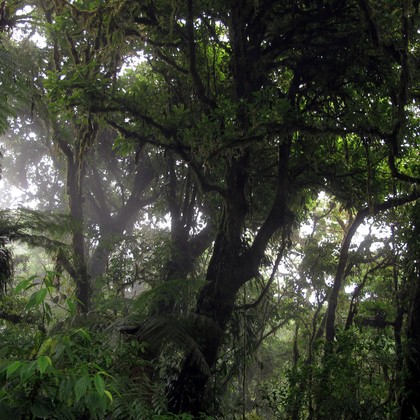
Canopy and edges of humid foothill and montane forest, cloud forest, mature secondary forest, clearings with tall trees, and gardens and shade-coffee plantations, roughly between 600 and 2000 m, mainly between 700 and 1800 m. It lives in pairs or small groups, often with mixed flocks. It eats fruit and insects.
Where the bird is most at home, classified by the vegetation units of Mexico and Central America.



Range and movements
Foothills and mountains of Costa Rica on both slopes, mainly on the Caribbean slope, and of Panama east to the mountains of Darién. Outside the guide area in western Colombia and western Ecuador.
- Resident
- dark = core range, pale = thinly spread
How and when to look
Common at Monteverde, in Tapantí and at Rancho Naturalista in Costa Rica, and around Boquete, at El Valle de Antón and on Cerro Azul in Panama, often at fruit feeders.
Conservation status
Not threatened (LC). Common and tolerant of secondary forest and semi-open country with trees.
Scientific name
Tangara icterocephala | (Bonaparte, 1851)
Bonaparte described the species in 1851 as Calliste icterocephala; because it was later moved to another genus, the author and year stand in brackets. The genus Tangara was introduced in 1760 by Brisson. Tangara is a Tupi name from Brazil, often explained as 'dancer', for a brightly coloured bird. icterocephala is Greek, from ikteros 'jaundice, yellow' and kephalē 'head': 'yellow-headed', after the yellow head. The specimen the first description was based on came from Punta Playa, south of Quito, Ecuador.