All species › Passerines › Thrushes and allies › Slate-colored Solitaire
Position in the tree Birds Aves › Birds with a flexible palate Neognathae › All other modern birds Neoaves › Landbirds Telluraves › Falcons, parrots and passerines Australaves › Falcons and passerines Eufalconimorphae › Parrots and passerines Psittacopasserae
Slate-colored Solitaire | Myadestes unicolor
Leigrijze solitaire | Clarín unicolor
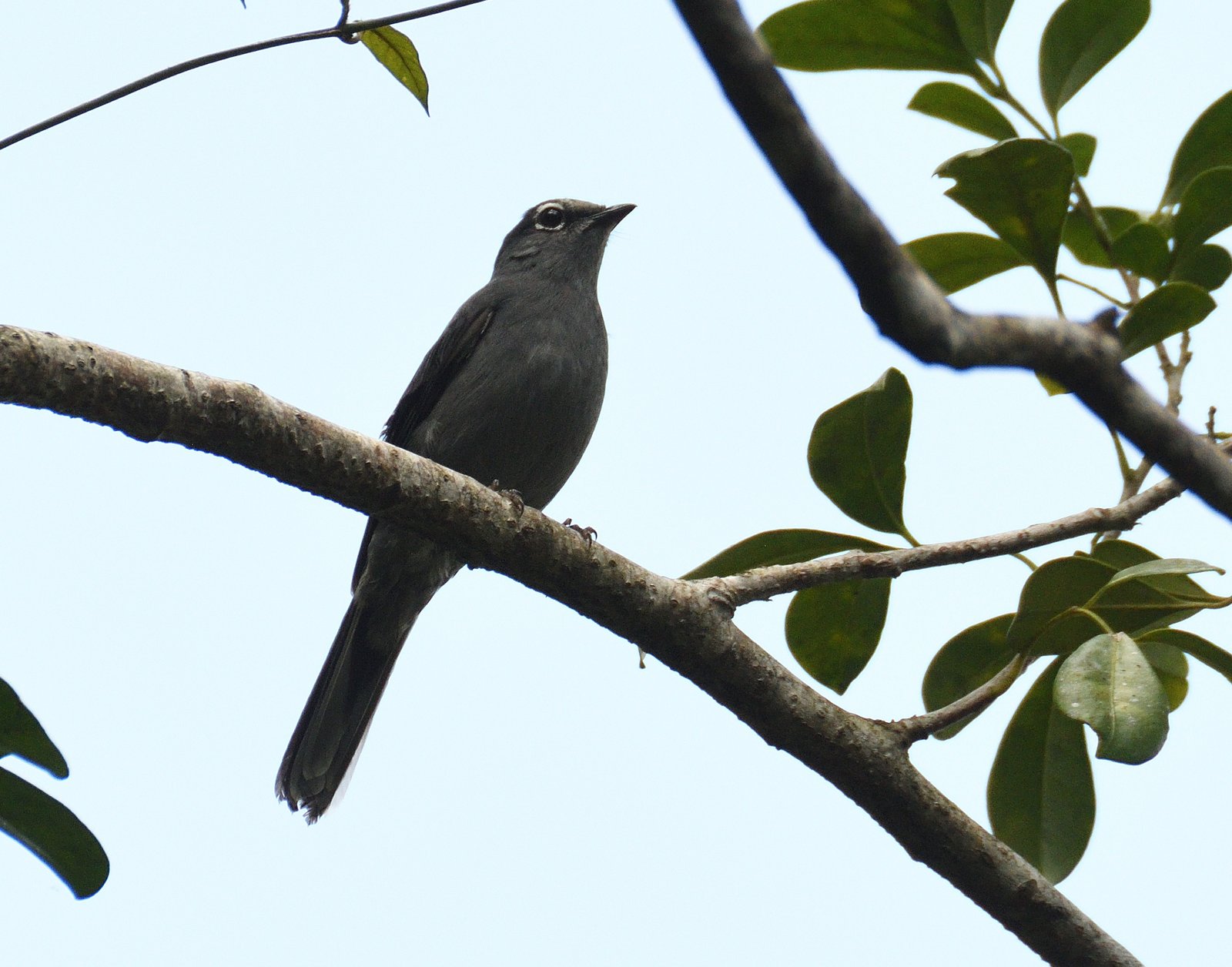
The Slate-colored Solitaire is a uniformly grey thrush of cloud forest from southern Mexico to Nicaragua. Its song, a slow series of pure whistled notes with a glassy ring, carries far through montane forest, while the bird itself sits quietly and well hidden in the mid-storey.
Voice
The song is a slow, ethereal series of pure, whistled notes at varying pitch, with occasional metallic trills; it often sounds from far away and is hard to locate. The call is a nasal rrenk.
Recording: GABRIEL LEITE — CC BY-NC-SA 4.0 · converted to mono · xeno-canto
Identification
19–21 cm. Slender, with a short black bill and a fairly long tail. Entirely slate-grey, slightly paler on the belly; white crescents above and below the eye form a broken eye-ring. Wings and tail darker grey, the outer tail feathers with pale edges. In flight a silvery-grey band on the underwing. The sexes are alike. Juveniles brownish with buff spots.
Confusion species
Brown-backed Solitaire Myadestes occidentalis has an olive-brown back and wings, a paler throat and a dark malar stripe, and lives more in pine-oak forest. Mountain Thrush Turdus plebejus is bulkier and more olive-grey, has a longer bill and lacks the white crescents around the eye.
Habitat
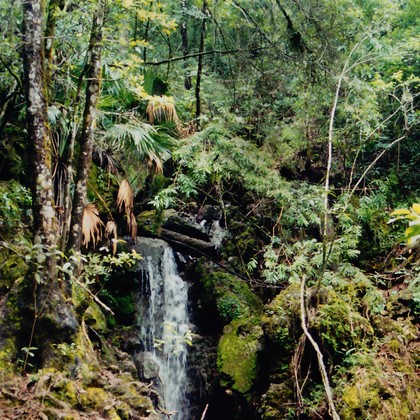
Humid montane forest and cloud forest, especially with many epiphytes, also adjacent secondary forest and shade coffee, mostly between 900 and 2500 m; outside the breeding season some birds move lower. It lives mainly in the mid-storey. It eats small fruits and berries and also insects. It nests in a niche in a trunk or bank.
Where the bird is most at home, classified by the vegetation units of Mexico and Central America.


Range and movements
Occurs only in the guide area: from south-eastern San Luis Potosí and Hidalgo through Veracruz, Oaxaca and Chiapas to Guatemala, locally Belize, El Salvador, Honduras and northern Nicaragua.
- Resident
- dark = core range, pale = thinly spread
How and when to look
Easily heard at El Triunfo in Chiapas and at Cusuco in Honduras. Following the song usually leads to the bird sitting quietly on a branch in the mid-storey, often near a fruiting tree.
Conservation status
Not threatened. Locally fairly common in cloud forest, but sensitive to the clearance and fragmentation of that forest. It is trapped for the songbird trade.
Scientific name
Myadestes unicolor | Sclater, 1857
Sclater described the species in 1857 and placed it straight away in the genus where it still stands. The genus Myadestes was introduced in 1838 by Swainson. Myadestes is Greek, from muia 'fly' and edestēs 'eater': 'fly-eater'. unicolor is Latin for 'one-coloured', after the plain slate-grey plumage. The specimen the first description was based on came from Córdoba, Veracruz, Mexico.