All species › Passerines › Gnatwrens and gnatcatchers › Slate-throated Gnatcatcher
Position in the tree Birds Aves › Birds with a flexible palate Neognathae › All other modern birds Neoaves › Landbirds Telluraves › Falcons, parrots and passerines Australaves › Falcons and passerines Eufalconimorphae › Parrots and passerines Psittacopasserae
Slate-throated Gnatcatcher | Polioptila schistaceigula
Grijskeelmuggenvanger | Perlita pizarrosa
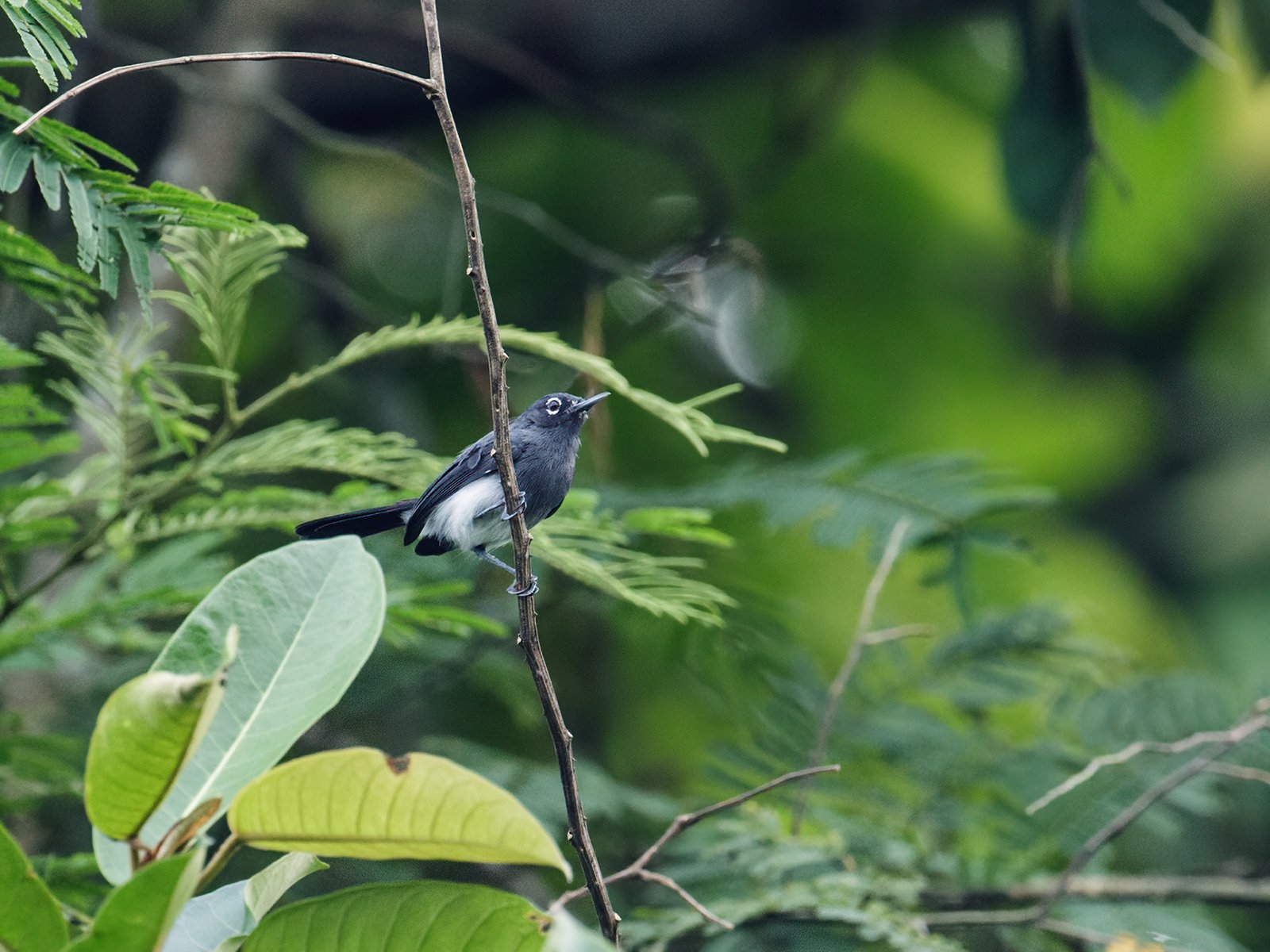
The Slate-throated Gnatcatcher is a dark gnatcatcher of the canopy of humid forest. In the guide area it occurs only in eastern Panama, where it is scarce and lives mainly in the foothills.
Voice
A dry, short series of chipping notes and nasal, mewing calls, as in other gnatcatchers.
Recording: Olaf Jahn — CC BY-NC-SA 4.0 · converted to mono · xeno-canto
Identification
10 cm. Upperparts dark slate-grey. Throat and breast slate-grey, belly white, so that the dark throat and breast contrast sharply. Tail long and narrow, black with white along the outer feathers. Bill short and thin.
Confusion species
White-browed Gnatcatcher Polioptila bilineata has a white throat and underparts and a white supercilium. Other small canopy birds such as antwrens (Myrmotherula) have a shorter tail and usually wing bars.
Habitat
Canopy and edges of humid hill and foothill forest. It gleans small insects from foliage and often joins mixed canopy flocks.
Where the bird is most at home, classified by the vegetation units of Mexico and Central America.


Range and movements
In the guide area only in eastern Panama, mainly in Darién. Outside the guide area in western Colombia and north-western Ecuador.
- Resident
- dark = core range, pale = thinly spread
How and when to look
Search mixed canopy flocks in the foothill forest of Darién. The dark throat is the best feature.
Conservation status
Not threatened. In the guide area scarce and local, confined to eastern Panama.
Scientific name
Polioptila schistaceigula | Hartert, 1898
Hartert described the species in 1898 and placed it straight away in the genus where it still stands. The genus Polioptila was introduced in 1855 by Sclater. Polioptila is Greek, from polios 'grey' and ptilon 'feather': 'grey-feathered'. schistaceigula is Latin, from schistaceus 'slate-grey' and gula 'throat', after the dark grey throat. The specimen the first description was based on came from Cachaví, Esmeraldas, Ecuador.