All species › Passerines › Thrushes and allies › Slaty-backed Nightingale-Thrush
Position in the tree Birds Aves › Birds with a flexible palate Neognathae › All other modern birds Neoaves › Landbirds Telluraves › Falcons, parrots and passerines Australaves › Falcons and passerines Eufalconimorphae › Parrots and passerines Psittacopasserae
Slaty-backed Nightingale-Thrush | Catharus fuscater
Grijsrugdwerglijster | Zorzalito sombrío
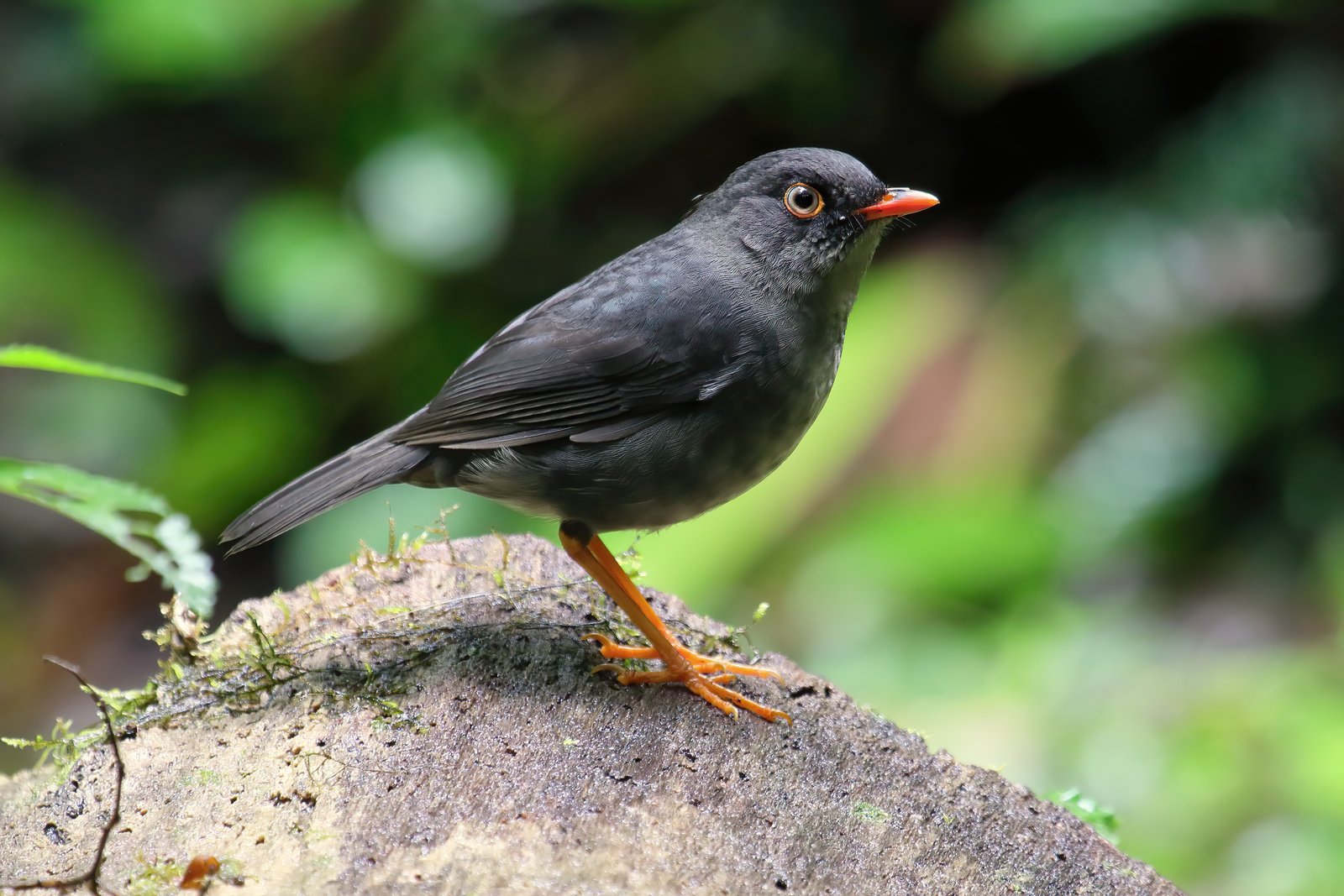
The Slaty-backed Nightingale-Thrush is a dark grey nightingale-thrush of humid montane forest, with an orange bill, eye-ring and legs and a strikingly pale iris. It lives on the forest floor in the understorey and is known chiefly for its slow, fluting song. In the guide area it occurs only in Costa Rica and Panama.
Voice
The song is a slow series of clear, fluting phrases of two or three notes, often with a somewhat reverberating, ethereal quality, repeated with pauses. The call is a nasal, mewing meeah and a soft, dry tick.
Recording: Juan Freile — CC BY-NC-SA 4.0 · converted to mono · xeno-canto
Identification
16–18 cm. Upperparts plain dark slate-grey, head blackish. Iris whitish to pale grey, surrounded by a narrow orange eye-ring; bill and legs orange. Underparts grey, centre of belly white to yellowish white. The sexes are alike. Juveniles are browner, with pale spots on the upperparts and dark spots on the underparts.
Confusion species
Black-headed Nightingale-Thrush Catharus mexicanus has a dark iris and an olive-brown, not slate-grey back, and a more sharply contrasting black cap. Black-billed Nightingale-Thrush Catharus gracilirostris lives higher, has a black bill and brown upperparts. Black-faced Solitaire Myadestes melanops has a short bill and perches more upright in the mid-storey.
Habitat
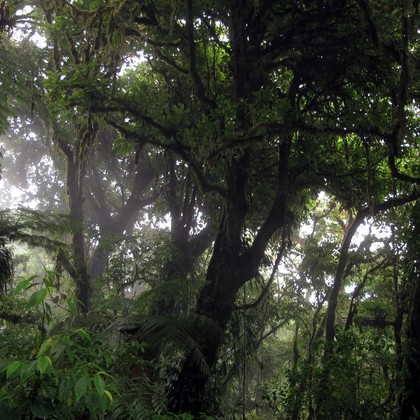
Understorey and floor of humid evergreen montane rainforest and upper foothill forest, often along streams and in ravines; in the guide area mostly between about 750 and 2000 m. It searches the ground for insects and other invertebrates and also eats small fruits.
Where the bird is most at home, classified by the vegetation units of Mexico and Central America.

Range and movements
In the guide area in the mountains of Costa Rica, mainly the central and southern cordilleras, and in Panama, both in the west and in the eastern mountains to Darién. Outside the guide area in the Andes of Colombia, Venezuela, Ecuador, Peru and Bolivia.
- Resident
- dark = core range, pale = thinly spread
How and when to look
In Costa Rica regularly heard in Tapantí National Park and along trails in the montane forest of Braulio Carrillo; in Panama around Fortuna. It sometimes comes out onto a forest trail at dusk.
Conservation status
Not threatened (LC). Widespread, but tied to undisturbed humid montane forest.
Scientific name
Catharus fuscater | (de Lafresnaye, 1845)
De Lafresnaye described the species in 1845 as M[yioturdus] fuscater; because it was later moved to another genus, the author and year stand in brackets. The genus Catharus was introduced in 1850 by Bonaparte. Catharus is from Ancient Greek katharos 'pure, clean', a name given for the clean plumage of the orange-billed nightingale-thrush. fuscater is Latin, from fuscus 'dusky' and ater 'black', after the dark slaty plumage. The specimen the first description was based on came from Bogotá, Colombia.