All species › Passerines › Tyrant flycatchers and allies › Slaty-capped Flycatcher
Position in the tree Birds Aves › Birds with a flexible palate Neognathae › All other modern birds Neoaves › Landbirds Telluraves › Falcons, parrots and passerines Australaves › Falcons and passerines Eufalconimorphae › Parrots and passerines Psittacopasserae
Slaty-capped Flycatcher | Leptopogon superciliaris
Grijskruinleptopogon | Mosquerito orejinegro
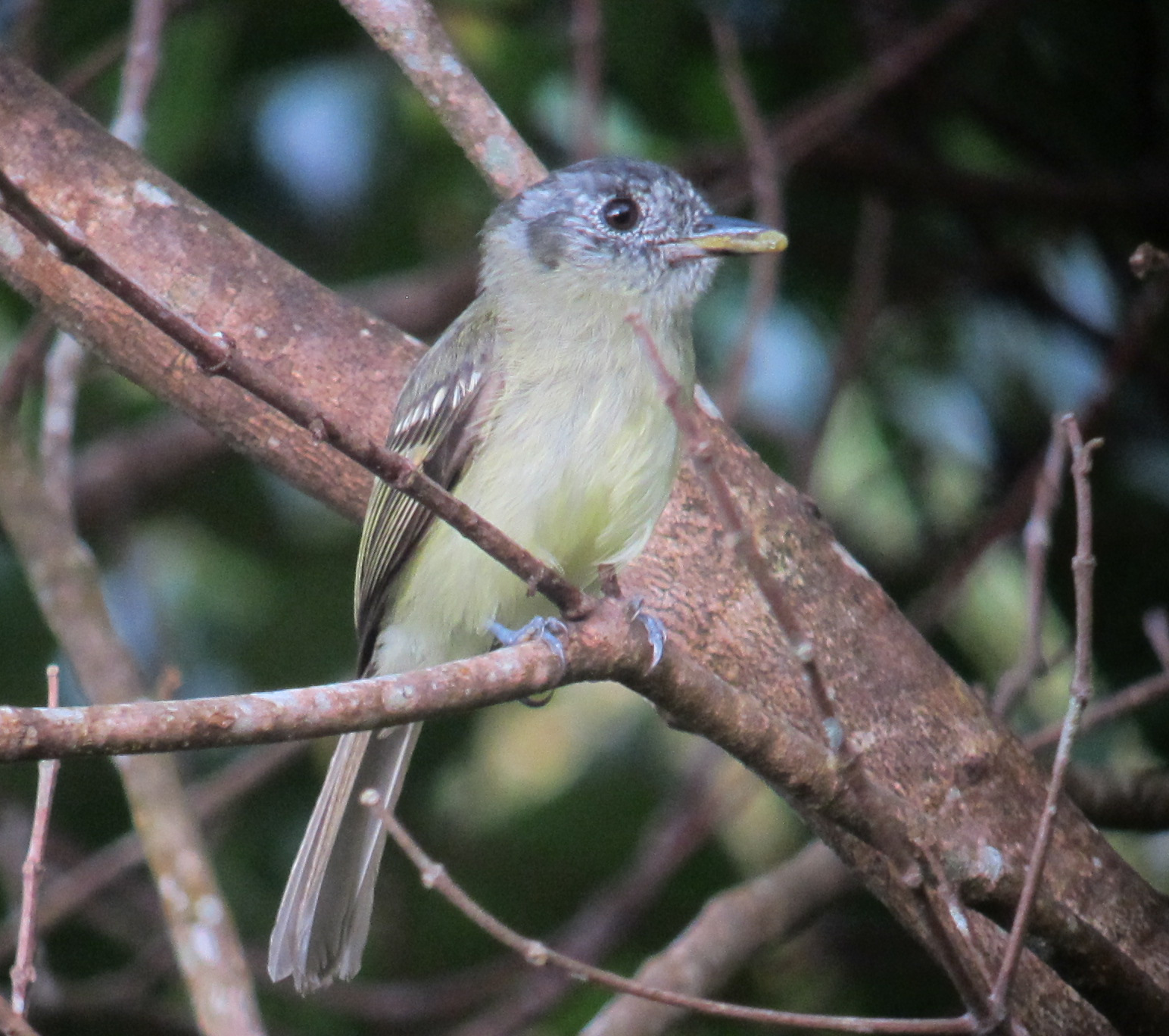
The Slaty-capped Flycatcher is a Leptopogon flycatcher of foothill and montane forest, with a slate-grey crown, a black-and-white patterned face and a yellow belly. Like its relatives it regularly lifts one wing above the back. In the guide area it lives in Costa Rica and Panama.
Voice
A sharp, squeaky skee-uw or chee-oo, often followed by a short rattling series.
Recording: José María Loaiza B. — CC BY-NC-SA 4.0 · converted to mono · xeno-canto
Identification
13–14 cm. Crown slate-grey. Face white with grey speckling and a conspicuous black patch on the ear coverts; a narrow whitish supercilium above the eye. Upperparts olive-green. Wings dark with two yellowish to ochre wing bars. Throat whitish, breast olive-grey, belly yellow. Bill thin and dark. Sexes alike.
Confusion species
Sepia-capped Flycatcher Leptopogon amaurocephalus has a brown crown, a less crisply marked face and lives mainly lower, in the lowlands. Rufous-browed Tyrannulet Phylloscartes superciliaris has a similar face pattern, but is smaller, with a rufous supercilium, white underparts and no wing bars.
Habitat
Middle levels and understorey of humid foothill and montane forest, mainly between about 600 and 1800 m, also forest edges and mature secondary forest. It often accompanies mixed flocks, perches upright and sallies to leaves to take insects; it also eats small fruits.
Where the bird is most at home, classified by the vegetation units of Mexico and Central America.



Range and movements
Foothill and montane forest of Costa Rica and western Panama, on both slopes of the mountain ranges, and in the mountains of eastern Panama (Darién). Outside the guide area in the Andes and coastal mountains of South America, from Venezuela and Colombia to Bolivia.
- Resident
- dark = core range, pale = thinly spread
How and when to look
On trails through foothill forest in Costa Rica and western Panama it is a regular member of mixed flocks. The black ear patch on the white face shows well even in the gloom.
Conservation status
Not threatened. Fairly common in suitable forest; disappears where foothill forest is cleared.
Scientific name
Leptopogon superciliaris | Tschudi, 1844
Tschudi described the species in 1844 and placed it straight away in the genus where it still stands. The genus Leptopogon was introduced in 1844 by Cabanis. Leptopogon is Greek, from leptos 'fine, slender' and pōgōn 'beard', after the fine bristles at the base of the bill. superciliaris is Modern Latin for 'eyebrowed', from supercilium 'eyebrow', after the pale supercilium. The specimen the first description was based on came from Vitoc, Peru.