All species › Passerines › Tanagers and allies › Slaty Finch
Position in the tree Birds Aves › Birds with a flexible palate Neognathae › All other modern birds Neoaves › Landbirds Telluraves › Falcons, parrots and passerines Australaves › Falcons and passerines Eufalconimorphae › Parrots and passerines Psittacopasserae
Slaty Finch | Haplospiza rustica
Leikleurige musgors | Semillero pizarra
The Slaty Finch is a small, dark finch-like tanager of montane forest, closely tied to flowering and seeding bamboo. It wanders and can suddenly appear in numbers where bamboo is seeding, then be absent again for years. In the guide area it is best known from the mountains of Costa Rica and Panama.

Voice
Song a short, dry, insect-like series, such as tsi-tsi-tsi-zzzz, often ending in a buzzy trill. Call a high, thin tsit.
Recording: Carlos Delgado JUMABITA — CC BY-NC-SA 4.0 · shortened to the first 60 s, mono · xeno-canto
Identification
12–13 cm. Male uniformly dark slate-grey, wings and tail blackish. Bill dark, conical but fairly long and sharply pointed, with a straight edge. The female is olive-brown above, paler brownish-olive below with faint dark streaks on breast and flanks; wings without distinct wing bars. Young males resemble females.
Confusion species
Peg-billed Finch Acanthidops bairdi is paler grey, has a longer, pointed bill with a pale lower mandible, and the female has buff wing bars. The male Slate-colored Seedeater Sporophila schistacea has a yellow bill and a white patch on the wing and usually on the side of the neck. The male Blue Seedeater Amaurospiza concolor is blue-black with a shorter, thicker bill. Slaty Flowerpiercer Diglossa plumbea has an upturned bill hooked at the tip.
Habitat
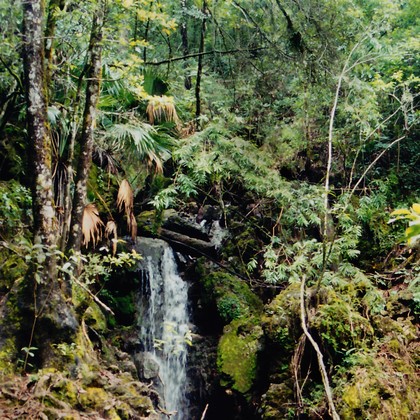
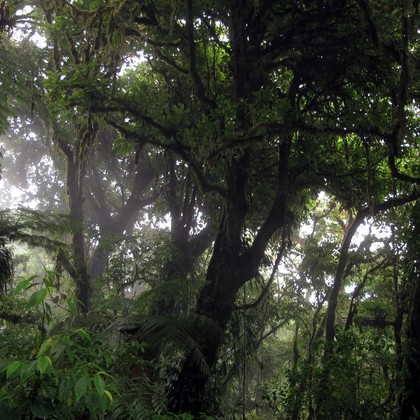
Understorey and edges of humid montane forest and cloud forest, mostly between 1200 and 3000 m, especially where Chusquea bamboo grows; in years of mass bamboo seeding also in clearings and scrub. It eats bamboo seed and other seeds. Outside such years scarce and hidden in the understorey.
Where the bird is most at home, classified by the vegetation units of Mexico and Central America.


Range and movements
In the guide area mainly in the mountains of Costa Rica and western Panama, with records also in eastern Panama. In addition very locally and irregularly further north in the mountains of southern Mexico and northern Central America. Outside the guide area in the Andes from Venezuela to Bolivia and on the tepuis of southern Venezuela.
- Resident
- dark = core range, pale = thinly spread
How and when to look
The chance is greatest in years when bamboo is seeding, for example in the mountains of the Cordillera de Talamanca in Costa Rica. Groups of seedeater-like birds in seeding bamboo are worth checking.
Conservation status
Not threatened (LC). Numbers vary greatly from year to year with bamboo flowering; dependent on montane forest with bamboo.
Scientific name
Haplospiza rustica | (Tschudi, 1844)
Tschudi described the species in 1844 as Phrygilus rusticus; because it was later moved to another genus, the author and year stand in brackets. The genus Haplospiza was introduced in 1851 by Cabanis. Haplospiza is Greek, from haploos 'simple, plain' and spiza 'finch', after the plain, unmarked plumage. rustica is Latin for 'rustic, plain', after the inconspicuous, plain slate-grey plumage. The specimen the first description was based on came from Peru.