All species › Passerines › Thrushes and allies › Sooty Thrush
Position in the tree Birds Aves › Birds with a flexible palate Neognathae › All other modern birds Neoaves › Landbirds Telluraves › Falcons, parrots and passerines Australaves › Falcons and passerines Eufalconimorphae › Parrots and passerines Psittacopasserae
Sooty Thrush | Turdus nigrescens
Roetlijster | Mirlo negruzco
The Sooty Thrush is a large, dark thrush of the high mountains of Costa Rica and western Panama. With its sooty black plumage, orange bill and legs and pale iris it stands out in open country above the treeline and along forest edges. It occurs only in the guide area.

Voice
The song is a fairly soft, scratchy and squeaky series of short, creaky notes, with little melody. The call is a dry, grating krrr or kreek, often given on take-off.
Recording: Daniel Lane — CC BY-NC-SA 3.0 · shortened to the first 60 s, mono · xeno-canto
Identification
24–26 cm. Plumage almost uniformly dark sooty brown to blackish, the female slightly browner and duller than the male. Bill and legs bright orange, with a narrow orange ring around the eye. The iris is strikingly pale grey to whitish. Juveniles are browner, with pale shaft streaks above and spots below, and have a darker bill.
Confusion species
Mountain Thrush Turdus plebejus lives in the same mountains but mainly in closed forest; it is olive-brown rather than sooty black and has a blackish bill, dark legs and a dark eye. Other dark thrushes with a yellow bill, such as Black Thrush Turdus infuscatus, occur only further north, from Mexico to Honduras, and have a dark eye.
Habitat
Páramo, high pastures, scrub and the edges and clearings of oak and montane forest, mostly above 2100 m up to the highest peaks; also pastures, roadsides and farm gardens in the highlands. It forages on the ground for earthworms and insects and eats much fruit in berry bushes.
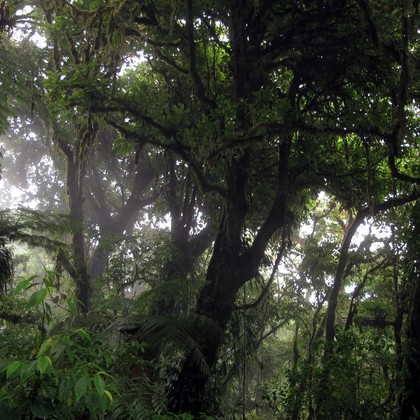
Where the bird is most at home, classified by the vegetation units of Mexico and Central America.


Range and movements
Endemic to the guide area: the highlands of Costa Rica, mainly the Cordillera de Talamanca and the high volcanoes of the Cordillera Central, and the Chiriquí highlands of western Panama.
- Resident
- dark = core range, pale = thinly spread
How and when to look
Common along the Pan-American Highway at Cerro de la Muerte in Costa Rica and on the slopes of Irazú and Barú volcanoes. It often perches on fence posts, roadsides and open grassy patches.
Conservation status
Not threatened (LC). Common within a small, high-altitude range. It may be sensitive to warming that shrinks the high-mountain zone.
Scientific name
Turdus nigrescens | Cabanis, 1861
Cabanis described the species in 1861 and placed it straight away in the genus where it still stands. The genus Turdus was introduced in 1758 by Linnaeus. Turdus is the ordinary Latin word for 'thrush'. nigrescens is Latin for 'blackish', after the dark, sooty plumage. The specimen the first description was based on came from Irazú Volcano, Costa Rica.