All species › Passerines › Tyrant flycatchers and allies › Sulphur-bellied Flycatcher
Position in the tree Birds Aves › Birds with a flexible palate Neognathae › All other modern birds Neoaves › Landbirds Telluraves › Falcons, parrots and passerines Australaves › Falcons and passerines Eufalconimorphae › Parrots and passerines Psittacopasserae
Sulphur-bellied Flycatcher | Myiodynastes luteiventris
Zwavelbuiktiran | Papamoscas atigrado
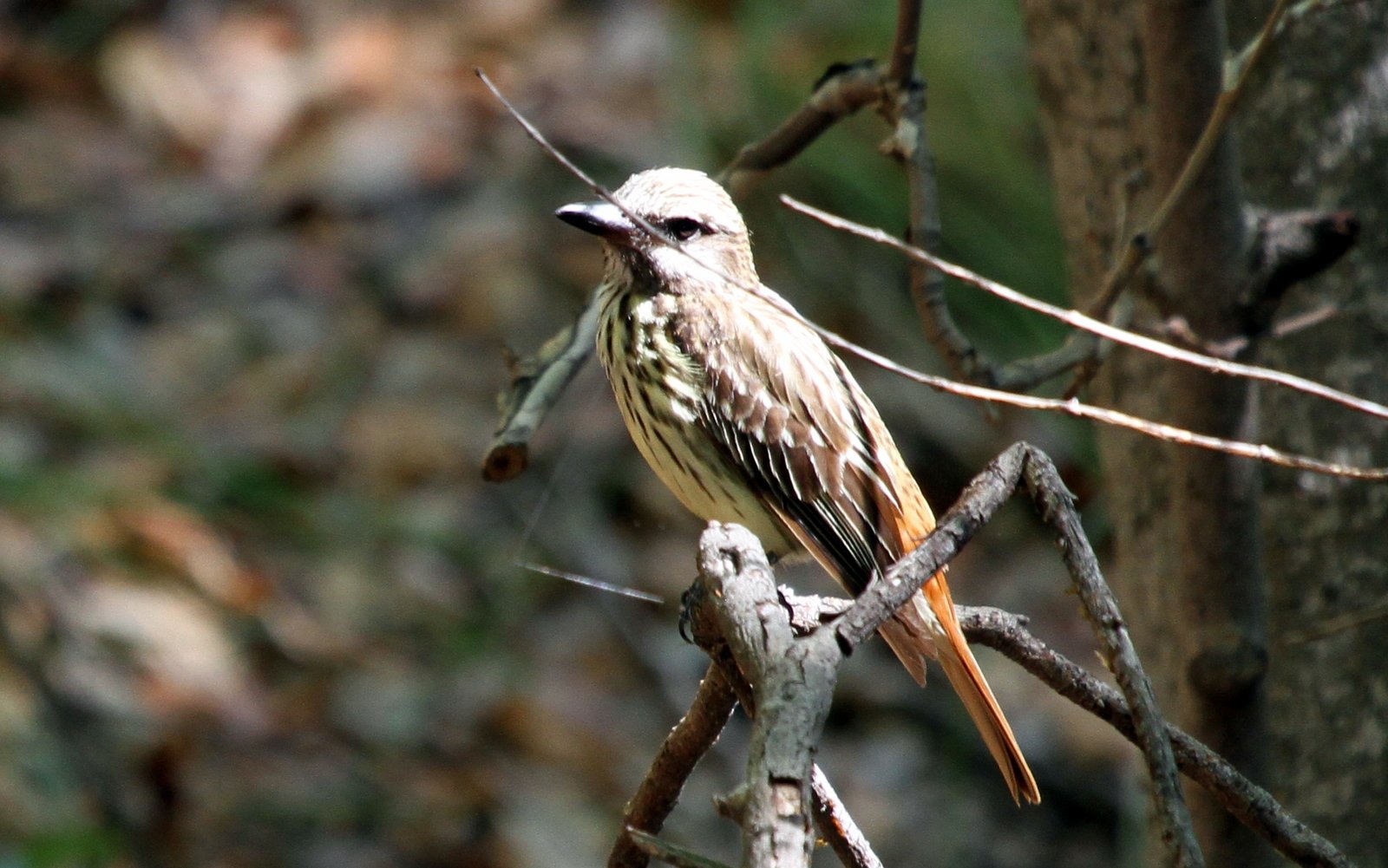
The Sulphur-bellied Flycatcher is a large, streaked tyrant flycatcher with a pale yellow belly and a rufous tail, present in the guide area only in the breeding season. It breeds from northern Mexico to Costa Rica and migrates in autumn to the western Amazon basin. Its high, squeaky call is more noticeable than the bird itself.
Voice
A high, shrill, squeaky kee-ee or squee-zee-yah, reminiscent of a squeaky toy; at dawn a soft, repeated song of a few notes.
Recording: Richard E. Webster — CC BY-NC-SA 4.0 · shortened to the first 60 s, mono · xeno-canto
Identification
19–22 cm, with a large head and a heavy, all-dark bill. Upperparts brown with dark streaks; rump and tail rufous. Head with a broad blackish eyestripe, a white supercilium, a white stripe below the eye and a black malar stripe that meets under the chin; a concealed yellow crown patch. Underparts pale yellow, brightest on the belly, with dark streaks on the breast and flanks. Male and female are alike.
Confusion species
Streaked Flycatcher Myiodynastes maculatus is very similar but has a pale base to the lower mandible, a less sharply defined malar stripe that does not meet under the chin and whiter underparts. Piratic Flycatcher Legatus leucophaius is much smaller, with a short bill, an unstreaked back and no rufous in the tail. Golden-bellied Flycatcher Myiodynastes hemichrysus (montane forest of Costa Rica and western Panama) has a bright yellow, barely streaked belly.
Habitat
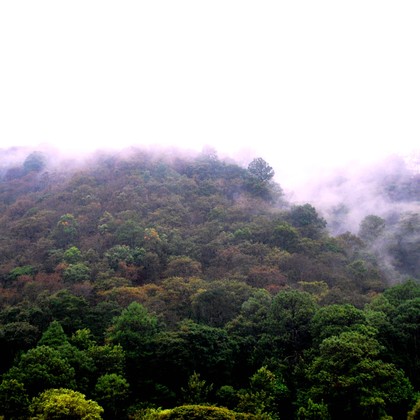
Forest edges, gallery forest, clearings and semi-open country with tall trees, from humid and dry lowland forest to oak and pine-oak forest in the mountains; in the north often in wooded canyons along streams. It eats large insects and fruit. It nests in a tree hole.
Where the bird is most at home, classified by the vegetation units of Mexico and Central America.






Range and movements
Breeds from north-western and north-eastern Mexico south through Mexico, Belize, Guatemala, El Salvador, Honduras and Nicaragua to Costa Rica; passes through Panama on migration. Outside the guide area it also breeds in south-eastern Arizona; it winters in the western Amazon basin, mainly in Peru and Bolivia.
- Summer visitor (c. Apr–Sep)
- dark = core range, pale = thinly spread
How and when to look
Best looked for from April to August, when it calls loudly from a high branch; in the northern winter it is absent from the guide area.
Conservation status
Not threatened. Fairly common in the breeding season at forest edges and in semi-open country with tall trees.
Scientific name
Myiodynastes luteiventris | Sclater, 1859
Sclater described the species in 1859 and placed it straight away in the genus where it still stands. The genus Myiodynastes was introduced in 1857 by Bonaparte. Myiodynastes is Greek, from muia 'fly' and dunastēs 'ruler': 'fly-ruler'. luteiventris is Latin, from luteus 'yellow' and venter 'belly', after the sulphur-yellow belly. The specimen the first description was based on came from Orizaba, Veracruz, Mexico.