All species › Passerines › Ovenbirds and woodcreepers › Tawny-winged Woodcreeper
Position in the tree Birds Aves › Birds with a flexible palate Neognathae › All other modern birds Neoaves › Landbirds Telluraves › Falcons, parrots and passerines Australaves › Falcons and passerines Eufalconimorphae › Parrots and passerines Psittacopasserae
Tawny-winged Woodcreeper | Dendrocincla anabatina
Bruinvleugelmuisspecht | Trepatroncos sepia
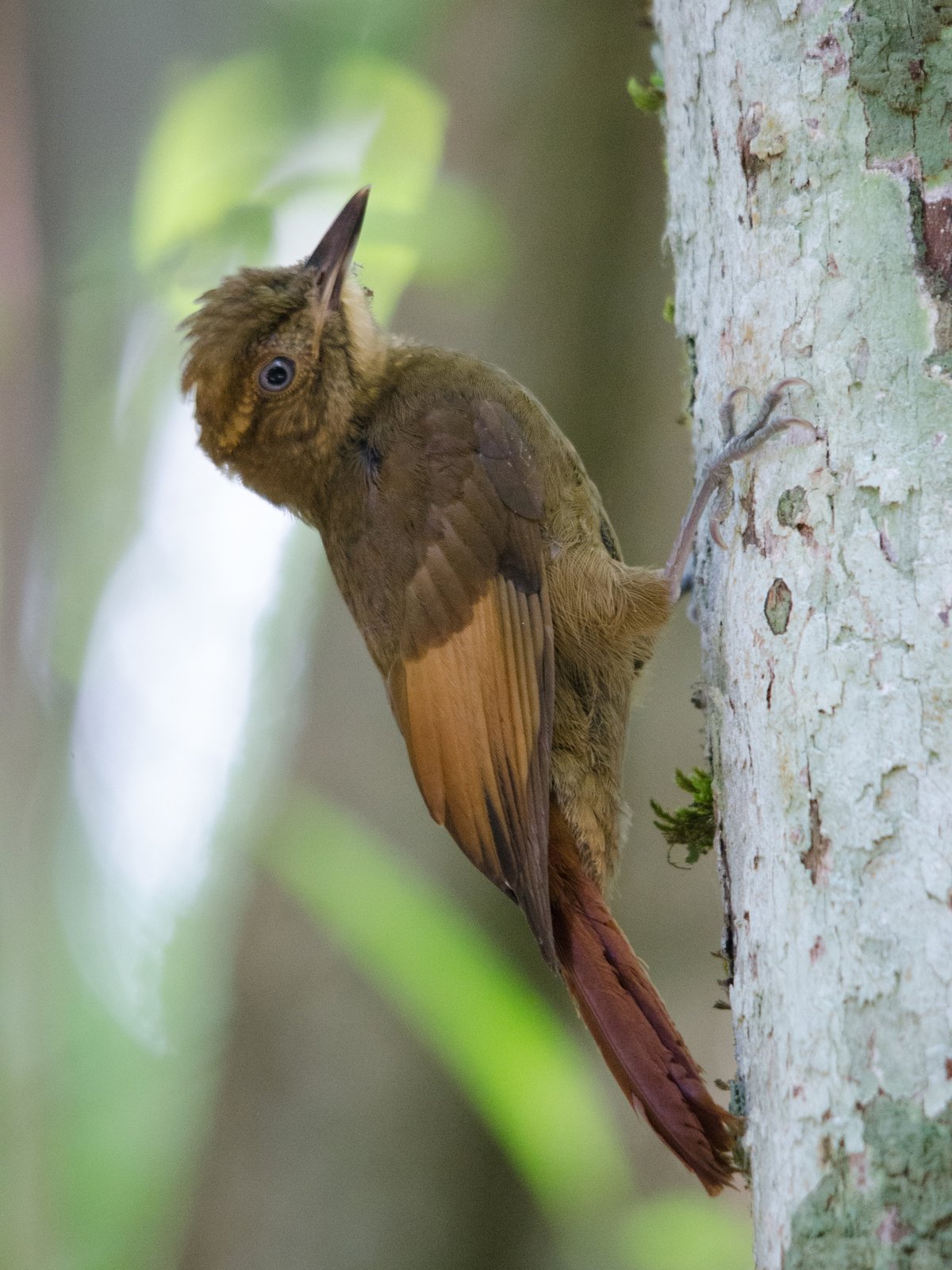
The Tawny-winged Woodcreeper is a medium-sized, olive-brown woodcreeper with bright cinnamon flight feathers that are most obvious in flight. Like Ruddy Woodcreeper it regularly follows army-ant swarms. It occurs only in the guide area.
Voice
A long series of nasal, rather sharp notes and a dry rattle. Regularly heard at ant swarms.
Recording: Paul Driver — CC BY-NC-SA 4.0 · shortened to the first 60 s, mono · xeno-canto
Identification
17–18 cm. Head and upperparts olive-brown, crown slightly darker; a faint pale eyebrow. Throat pale buff, underparts olive-brown without streaks. Flight feathers bright cinnamon to rufous with dark tips, contrasting sharply with the olive-brown back and coverts; tail rufous. Bill straight and fairly stout, dark horn. Male and female are alike.
Confusion species
Ruddy Woodcreeper Dendrocincla homochroa is entirely rufous, with no contrast between body and wings. Plain-brown Woodcreeper Dendrocincla fuliginosa (Honduras to Panama) has a greyish cheek, a dark malar stripe and wings without cinnamon contrast. Streaked woodcreepers such as Streak-headed Woodcreeper Lepidocolaptes souleyetii have a thinner, curved bill and a streaked head and breast.
Habitat
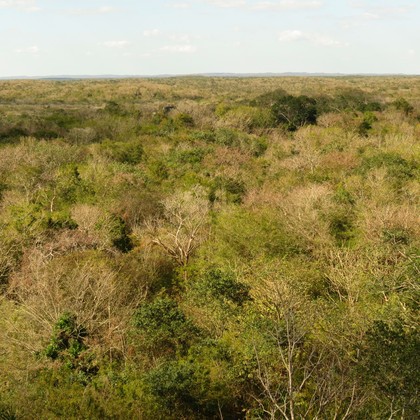
Humid and semi-humid lowland and foothill forest, also seasonal forest on the Yucatán Peninsula, mature secondary forest and forest edges. It forages mainly in the lower storeys, often at army-ant swarms. It nests in a tree cavity.
Where the bird is most at home, classified by the vegetation units of Mexico and Central America.



Range and movements
From south-eastern Mexico (from southern Veracruz and northern Oaxaca through Tabasco, Chiapas and the Yucatán Peninsula) through Belize, Guatemala, Honduras and Nicaragua to northern Costa Rica; also in south-western Costa Rica and western Panama. Found only in the guide area.
- Resident
- dark = core range, pale = thinly spread
How and when to look
Regularly seen at Tikal in Guatemala and Calakmul in Mexico, often low on a trunk at an army-ant swarm. Watch for the cinnamon wings in flight.
Conservation status
Not threatened. Locally fairly common in larger forest tracts; sensitive to deforestation and fragmentation.
Scientific name
Dendrocincla anabatina | Sclater, 1859
Sclater described the species in 1859 and placed it straight away in the genus where it still stands. The genus Dendrocincla was introduced in 1840 by Gray. Dendrocincla is Greek, from dendron 'tree' and kinklos, an unidentified bird mentioned by Aristotle and later linked with wagtails. anabatina derives from Greek anabatēs 'climber' with Latin -inus 'resembling': 'climber-like', after its climbing up trunks. The specimen the first description was based on came from Omoa, Honduras.