All species › Passerines › New World warblers › Tennessee Warbler
Position in the tree Birds Aves › Birds with a flexible palate Neognathae › All other modern birds Neoaves › Landbirds Telluraves › Falcons, parrots and passerines Australaves › Falcons and passerines Eufalconimorphae › Parrots and passerines Psittacopasserae
Tennessee Warbler | Leiothlypis peregrina
Tennesseezanger | Reinita verdillo
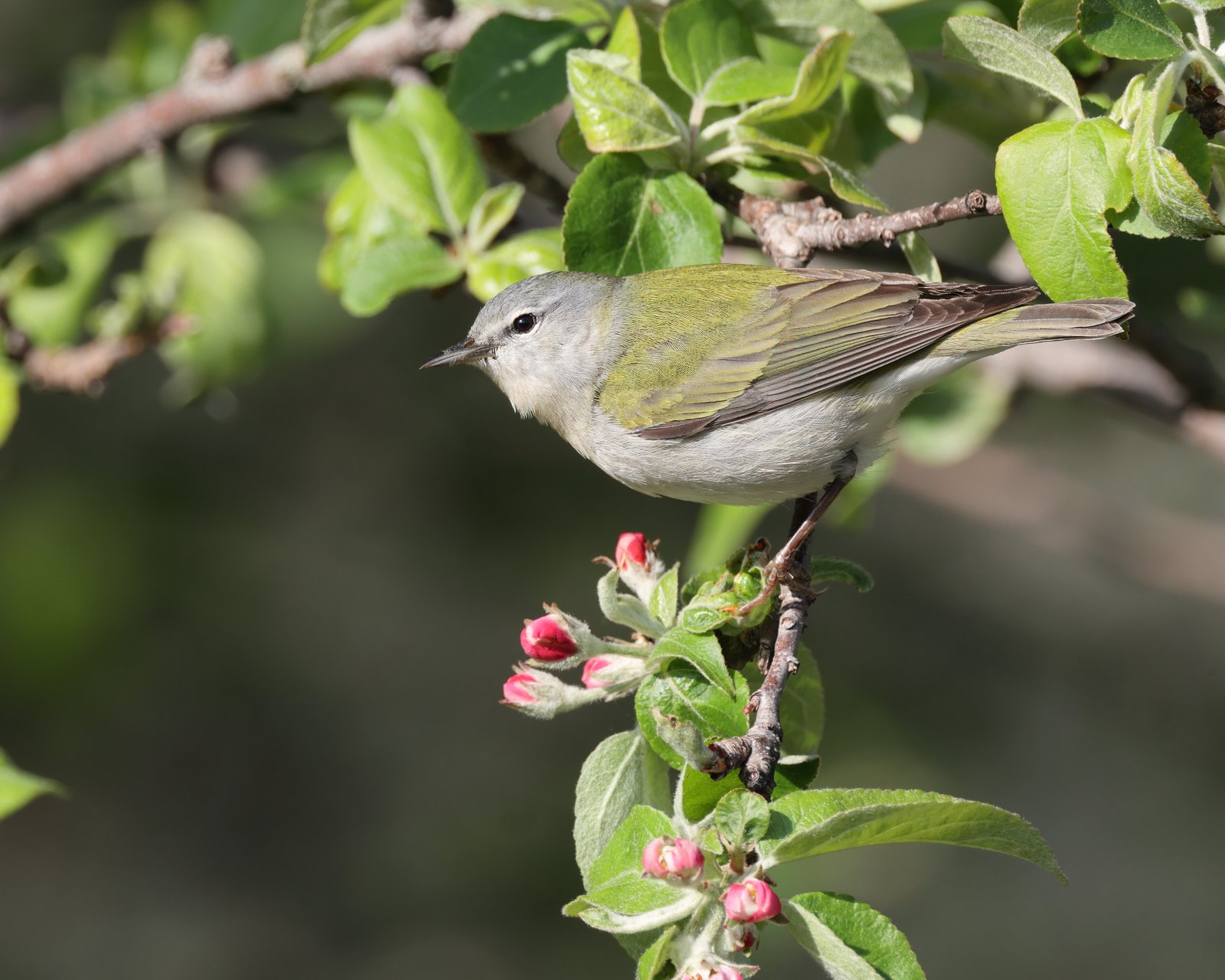
The Tennessee Warbler is a small, greenish warbler with a short tail and a fine, pointed bill. It breeds in the coniferous forests of Canada and winters in large numbers from southern Mexico to Panama. In winter it lives in small groups in flowering and fruiting trees and takes much nectar.
Voice
The song is a loud, staccato three-part series that speeds up, tsit-tsit-tsit chip-chip-chip tititititi; in spring it is also heard in the guide area. Winter flocks give a constant high tsit and a dry chip.
Recording: Jimmy Enfru — CC BY-NC-SA 4.0 · converted to mono · xeno-canto
Identification
11–13 cm. In breeding plumage the male has a grey head with a white supercilium and a dark eyeline, bright green upperparts and white underparts. The female and birds in winter plumage are olive-green above, with a yellowish supercilium and a yellow-green wash on throat and breast; often a narrow pale wingbar. The undertail coverts are always white or whitish. Tail short.
Confusion species
Orange-crowned Warbler Leiothlypis celata is duller and greyer green, with faint breast streaks and yellow undertail coverts. Philadelphia Vireo Vireo philadelphicus and Warbling Vireo Vireo gilvus have a thicker, slightly hooked bill and move more slowly through the foliage.
Habitat
In winter forest edges, secondary forest, open woodland with large trees, shade coffee, gardens and parks, from sea level to about 2500 m. It often visits flowering trees such as Inga, Erythrina and Calliandra to take nectar, and also eats insects and small fruits.
Where the bird is most at home, classified by the vegetation units of Mexico and Central America.





Range and movements
Breeds in the boreal forests of Alaska and Canada to the north-eastern United States. Migrates through eastern Mexico and across the Yucatán Peninsula. Winters from southern Mexico (from Veracruz and Oaxaca) through all of Central America to Panama. Outside the guide area to northern Colombia and Venezuela.
- Winter visitor (c. Oct–Mar)
- dark = core range, pale = thinly spread
How and when to look
In winter one of the most frequently seen warblers in gardens and coffee plantations in Costa Rica and Panama; groups often sit in flowering coral trees and Inga trees.
Conservation status
Not threatened (LC). Common; numbers fluctuate with spruce budworm outbreaks on the breeding grounds.
Scientific name
Leiothlypis peregrina | (Wilson, 1811)
Wilson described the species in 1811 as Sylvia peregrina; because it was later moved to another genus, the author and year stand in brackets. The genus Leiothlypis was introduced in 2008 by Sangster. Leiothlypis is Ancient Greek, from leios 'plain, smooth' and thlypis, an unidentified small bird mentioned by Aristotle. peregrina is from Latin peregrinus 'wanderer, foreigner'. The specimen the first description was based on came from the Cumberland River, Tennessee.