All species › Passerines › Wrens › Timberline Wren
Position in the tree Birds Aves › Birds with a flexible palate Neognathae › All other modern birds Neoaves › Landbirds Telluraves › Falcons, parrots and passerines Australaves › Falcons and passerines Eufalconimorphae › Parrots and passerines Psittacopasserae
Timberline Wren | Thryorchilus browni
Browns winterkoning | Cucarachero del bambú
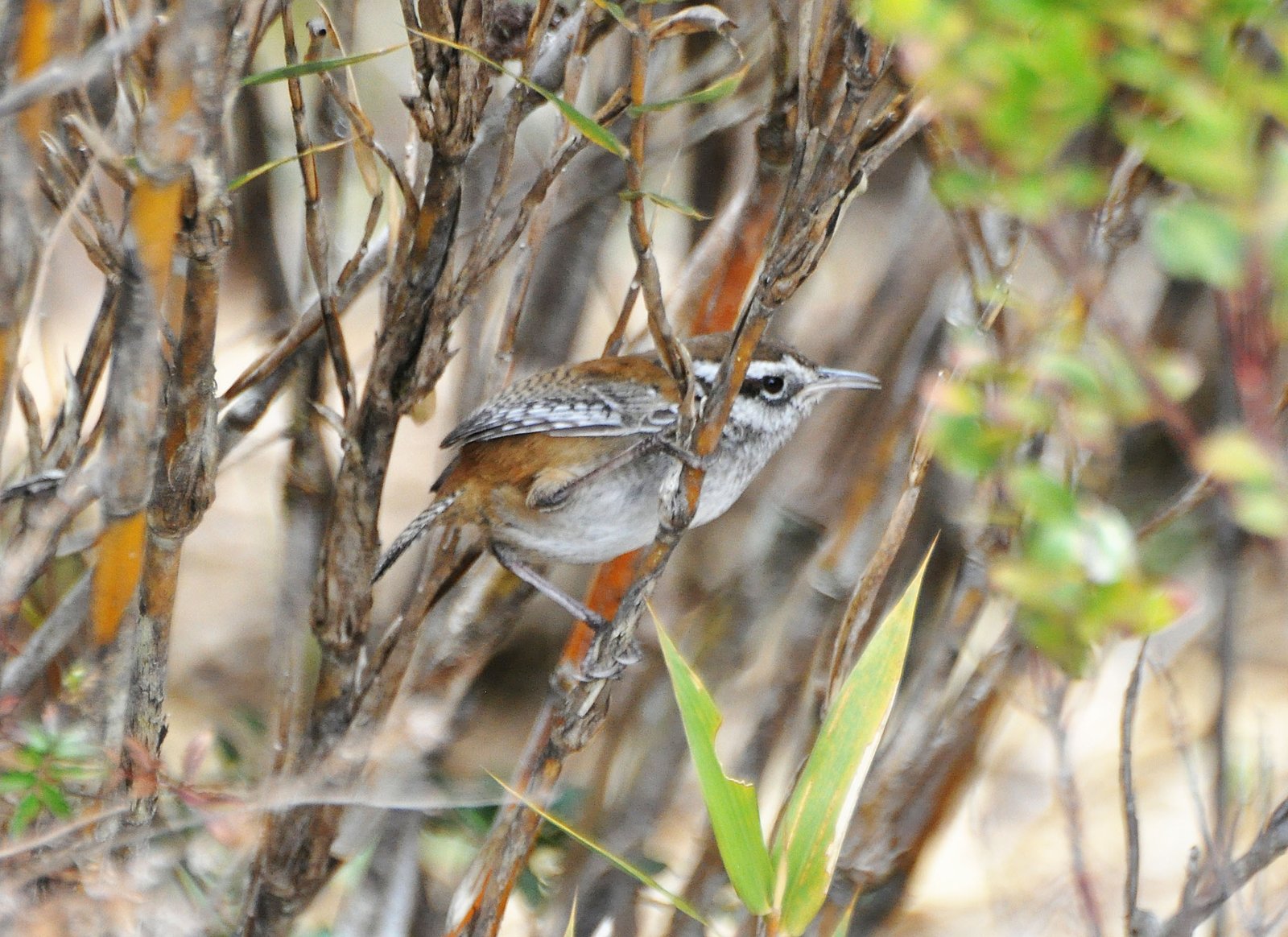
The Timberline Wren is a small wren of the highest mountains of Costa Rica and western Panama, where it lives in bamboo thickets and elfin forest around the treeline and in the páramo. It is endemic to this small highland area and is almost always found above 2500 m.
Voice
A short, somewhat scratchy song with high whistles and trills; the call is a dry, rattling chrr.
Recording: Oscar Campbell — CC BY-NC-SA 4.0 · shortened to the first 60 s, mono · xeno-canto
Identification
10–11 cm. Upperparts warm brown, with a broad white supercilium and a dark eyestripe. Throat and breast white, flanks and lower belly brown. Wings brown with dark bars and a white patch on the outer wing that is most obvious when the bird moves. Short tail brown with dark bars. The sexes are alike.
Confusion species
Grey-breasted Wood Wren Henicorhina leucophrys has a grey breast and a black-and-white streaked cheek and lives lower in the undergrowth of cloud forest. Ochraceous Wren Troglodytes ochraceus is ochre-brown with an ochre supercilium and forages among epiphytes higher in the trees. Southern House Wren Troglodytes musculus lacks the bold white supercilium and the white wing patch.
Habitat
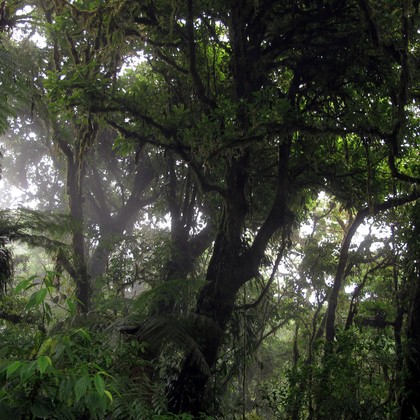
Dense bamboo thickets (Chusquea), scrub and elfin forest at the treeline and in the páramo, also at the edges of high-elevation oak forest; mostly between 2500 and 3500 m. It searches for insects low in the scrub and bamboo.
Where the bird is most at home, classified by the vegetation units of Mexico and Central America.

Range and movements
Endemic to the highlands of Costa Rica (Cordillera Central and Cordillera de Talamanca) and western Panama (Chiriquí, including Volcán Barú). Does not occur outside the guide area.
- Resident
- dark = core range, pale = thinly spread
How and when to look
One of the easiest species to find on Cerro de la Muerte in Costa Rica, in the bamboo along the road and the trails near the summit. Also seen on the slopes of Irazú.
Conservation status
Not threatened. Common in its small habitat, which lies largely within national parks and protected areas.
Scientific name
Thryorchilus browni | (Bangs, 1902)
Bangs described the species in 1902 as Troglodytes browni; because it was later moved to another genus, the author and year stand in brackets. The genus Thryorchilus was introduced in 1904 by Oberholser. Thryorchilus is Greek, from thruon 'rush, reed' and orkhilos 'wren'. browni honours the American professional collector Wilmot W. Brown Jr. (c. 1878–1953), who collected birds in Panama and elsewhere in Central America; the species was described from Volcán de Chiriquí. The specimen the first description was based on came from Volcán de Chiriquí (Volcán Barú), Panama.