All species › Kingfishers, bee-eaters and rollers › Motmots › Turquoise-browed Motmot
Position in the tree Birds Aves › Birds with a flexible palate Neognathae › All other modern birds Neoaves › Landbirds Telluraves › Raptors, owls, kingfishers and woodpeckers Afroaves › Mousebirds, rollers and woodpeckers Coraciimorphae › Trogons and cavity nesters Cavitaves › Hornbills, kingfishers and woodpeckers Picocoraciae › Kingfishers, bee-eaters and woodpeckers Picodynastornithes
Turquoise-browed Motmot | Eumomota superciliosa
Wenkbrauwmotmot | Momoto ceja azul
The Turquoise-browed Motmot is a motmot of dry and semi-open country, from the Yucatán Peninsula to north-western Costa Rica. It is the motmot with the longest bare tail shafts. In El Salvador it is called torogoz and in Nicaragua guardabarranco; in both countries it is the national bird.

Voice
A croaking, nasal kwaank or awk, often repeated and heard mainly around dawn; pairs sometimes call alternately.
Recording: Manuel Grosselet — CC BY-NC-SA 4.0 · converted to mono · xeno-canto
Identification
33–38 cm, much of it tail. The head and upperparts are olive-green, the back and belly rufous. A broad turquoise brow runs from the bill to behind the eye, above a black mask. On the throat is a narrow vertical black stripe edged turquoise. The wings and tail are largely turquoise to blue. The two central tail feathers have a long stretch of bare shaft ending in a blue, black-tipped racket. The sexes are alike.
Confusion species
Lesson's Motmot Momotus lessonii is larger, greener below, has a black crown with a blue ring and a much shorter bare section in the tail. Russet-crowned Motmot Momotus mexicanus has a rufous crown and a green belly. Keel-billed Motmot Electron carinatum is green with a rufous forehead and a broad, keeled bill, and lives in humid forest on the Caribbean side.
Habitat
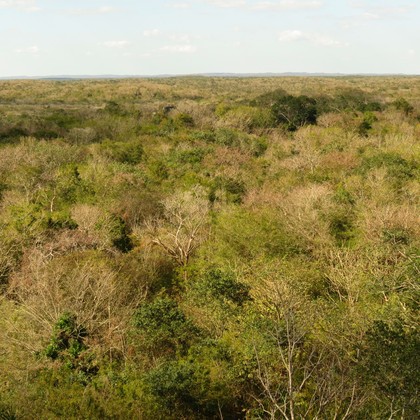
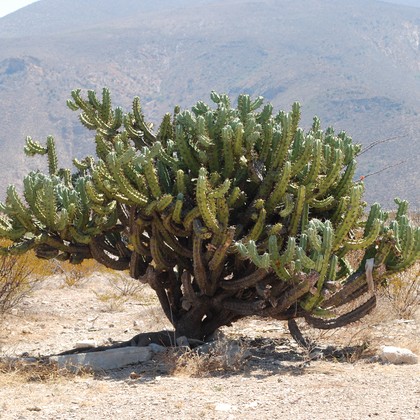
Dry and semi-deciduous forest, gallery forest, thorn scrub, forest edges and open country with trees, also farmyards, gardens and pasture with hedges; up to about 1000 m, locally higher. It often perches in the open on a wire or a low branch, swinging its tail from side to side like a pendulum. It eats large insects and small lizards. It nests in a self-dug tunnel in a steep face: riverbanks, road cuts, quarries, Maya ruins and the walls of cenotes and wells.
Where the bird is most at home, classified by the vegetation units of Mexico and Central America.





Range and movements
In Mexico in southern Veracruz, Tabasco, Chiapas and on the Yucatán Peninsula (Campeche, Yucatán, Quintana Roo), further in Belize, Guatemala, El Salvador, Honduras and Nicaragua, mainly on the Pacific side, to Guanacaste in north-western Costa Rica. Absent from Panama. Not present outside the guide area.
- Resident
- dark = core range, pale = thinly spread
How and when to look
In Yucatán at cenotes, Maya ruins and along roads with steep banks; in Guanacaste along dry-forest edges. A perched bird draws attention by swinging its tail.
Conservation status
Least Concern. The species adapts well to semi-open farmland with trees and is common in most of the region.
Scientific name
Eumomota superciliosa | (Sandbach, 1837)
Sandbach described the species in 1837 as Pyronites superciliosus; because it was later moved to another genus, the author and year stand in brackets. The genus Eumomota was introduced in 1858 by Sclater. Eumomota is formed from Greek eu 'good, true' and the genus Momotus, the motmots: 'true motmot'. superciliosa is Latin for 'eyebrowed', after the turquoise stripe above the eye. The specimen the first description was based on came from Campeche, Mexico.