All species › Passerines › Tanagers and allies › Variable Seedeater
Position in the tree Birds Aves › Birds with a flexible palate Neognathae › All other modern birds Neoaves › Landbirds Telluraves › Falcons, parrots and passerines Australaves › Falcons and passerines Eufalconimorphae › Parrots and passerines Psittacopasserae
Variable Seedeater | Sporophila corvina
Noordelijk bont dikbekje | Semillero variable
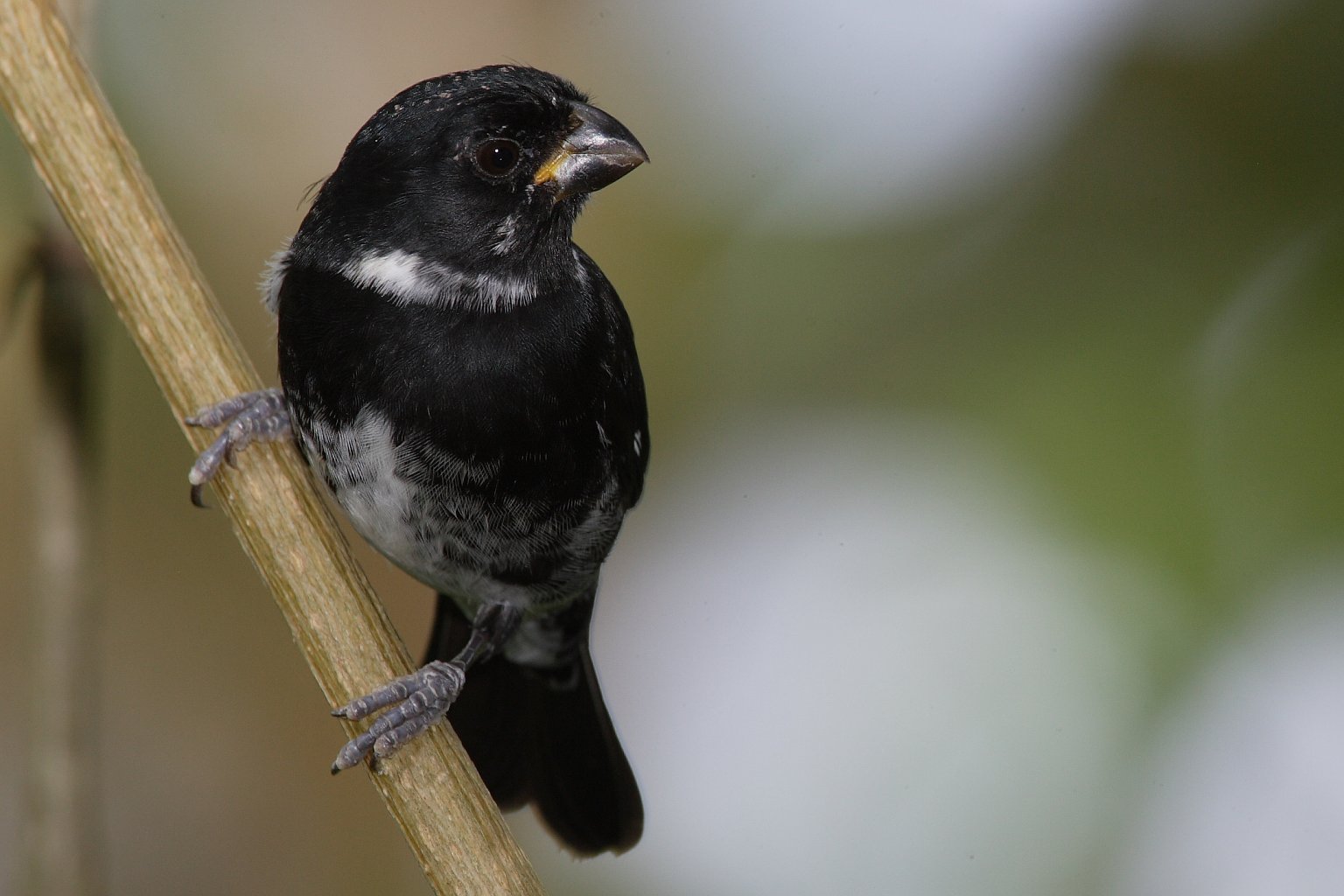
The Variable Seedeater is a small seed-eater of rank grassland, forest edges and pasture in the humid lowlands. The male varies by region: on the Caribbean side it is all black, on the Pacific side of Costa Rica and Panama it is pied black and white. The female is olive brown. It is one of the most frequently seen seedeaters in the south of the guide area.
Voice
The song is a long, fast and varied twittering of clear whistles and trills, often given from an open perch. The call is a soft chee or a nasal chek.
Recording: rudy gelis — CC BY-NC-SA 4.0 · converted to mono · xeno-canto
Identification
10–11 cm. Short, thick, rounded black bill. The male on the Caribbean side is uniform glossy black with a small white wing speculum and white underwing coverts, visible in flight. The male on the Pacific side is black above with a white or grey rump, a white collar and white underparts with a narrow black breast band; intermediates occur. The female is uniform olive brown, slightly yellower below, without wing bars; young males resemble the female with black blotches.
Confusion species
The male Morelet's Seedeater Sporophila morelleti has two white wing bars and a paler back, and the female has buffy wing bars. Black males resemble Blue-black Grassquit Volatinia jacarina, which has a blue-black gloss and a more pointed bill. Thick-billed Seed Finch Sporophila funerea and Nicaraguan Seed Finch Sporophila nuttingi are larger, with a much heavier, angular bill. Females are hard to separate from female Yellow-bellied Seedeater Sporophila nigricollis, which has a slightly paler bill.
Habitat
Rank grassland, scrub, forest edges, overgrown fields, pasture with bushes, reed edges and gardens in humid lowlands and foothills, up to about 1200 m. Lives in pairs or small groups, often with other seed-eaters, and feeds mainly on grass seed.
Where the bird is most at home, classified by the vegetation units of Mexico and Central America.



Range and movements
On the Caribbean side from southeastern Mexico through Guatemala, Belize, Honduras and Nicaragua to Costa Rica and Panama; on the Pacific side in southern Costa Rica and Panama. Beyond the guide area to western Colombia and Ecuador. The limits of the species differ between taxonomies; the southern birds are sometimes treated as a separate species.
- Resident
- dark = core range, pale = thinly spread
How and when to look
Singing males on wires and tall grass stems along roads and pastures are the easiest to find. With females and young birds it helps to look at the males in the same flock.
Conservation status
Not threatened (LC). Common and widespread; benefits from deforestation and the creation of pasture and fields. Locally trapped as a cage bird.
Scientific name
Sporophila corvina | (Sclater, 1860)
Sclater described the species in 1860 as Spermophila corvina; because it was later moved to another genus, the author and year stand in brackets. The genus Sporophila was introduced in 1844 by Cabanis. Sporophila is Greek, from sporos 'seed' and philos 'lover': 'seed-lover'. corvina is Latin for 'raven-like', after the black plumage of the male. The specimen the first description was based on came from Playa Vicente, Oaxaca, Mexico.