All species › Tubenoses › Northern storm petrels › Wedge-rumped Storm Petrel
Position in the tree Birds Aves › Birds with a flexible palate Neognathae › All other modern birds Neoaves › Birds of the elements Elementaves › Tropicbirds and waterbirds Phaethoquornithes › Core waterbirds Aequornithes
Wedge-rumped Storm Petrel | Hydrobates tethys
Galapagosstormvogeltje | Paíño danzarín
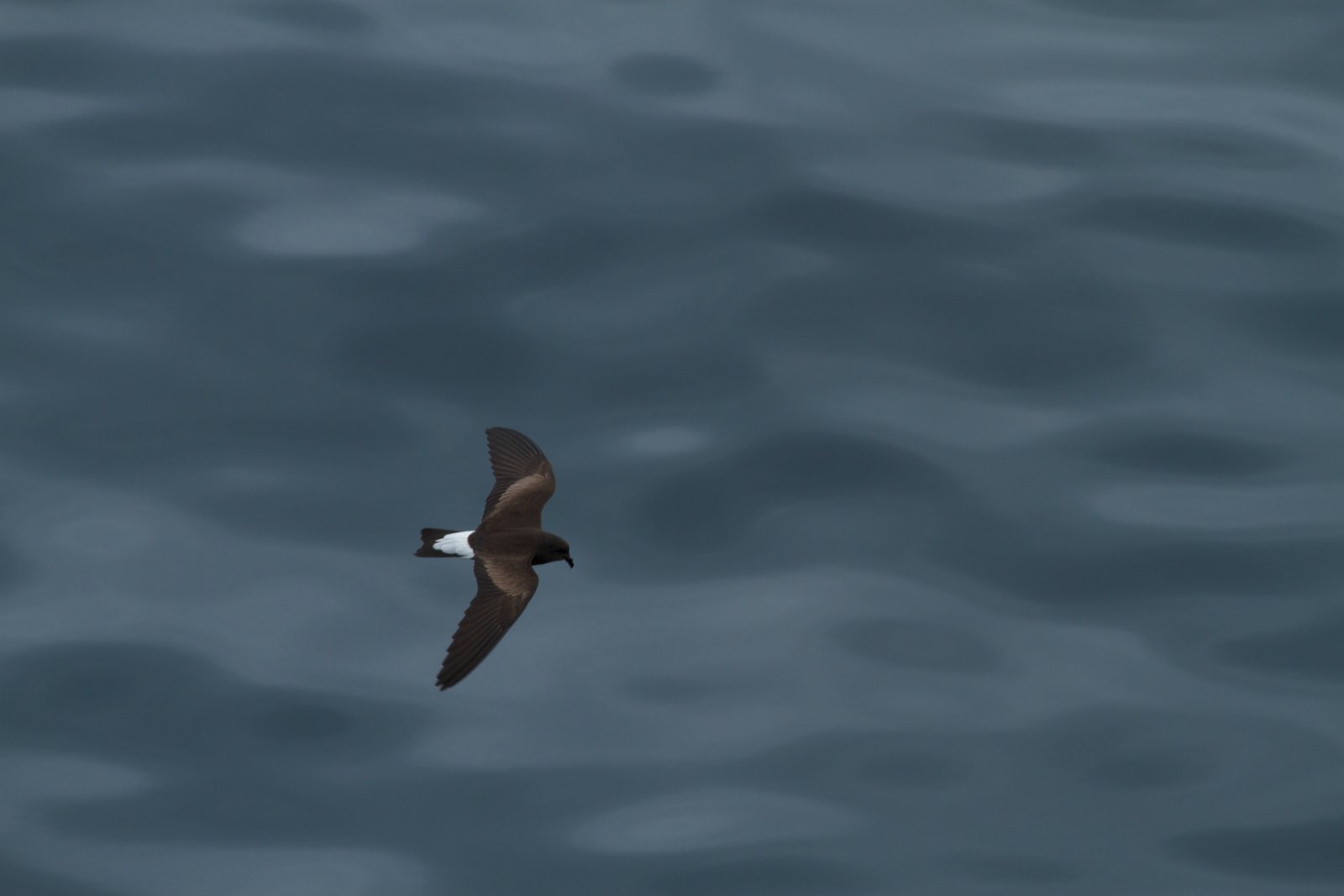
The Wedge-rumped Storm Petrel is a small, dark storm petrel with a very large, wedge-shaped white rump patch that is visible from far away in flight. It breeds on the Galápagos Islands and on islands off Peru and, unusually among storm petrels, is also active at the colonies by day on the Galápagos. In the guide area it is a non-breeding visitor at sea off the Pacific coast, mainly of Panama and Costa Rica.
Voice
Silent at sea. At the colonies various purring, squeaking and grating sounds are heard. No vocalisations are known from the guide area.
Recording: Fabrice Schmitt — CC BY-NC-SA 4.0 · converted to mono · xeno-canto
Identification
16–18 cm. A small storm petrel with fairly short wings and a short, slightly notched tail. The plumage is sooty black, with a pale diagonal band across the upperwing. The white rump patch is exceptionally large and triangular: it extends over the sides of the undertail coverts and far onto the base of the tail, so that the tail looks largely white with only a dark terminal band. Male, female and young birds are alike. Flies fast and low, with fluttering beats and swerves.
Confusion species
The Band-rumped Storm Petrel Hydrobates castro is larger, with a narrower, square-cut white rump band that leaves the tail dark, and flies more calmly and evenly with stiff beats. Leach's Storm-Petrel Hydrobates leucorhous is larger, has a more deeply forked tail and a smaller, often divided white rump, and flies in a bounding, erratic way. Townsend's Storm Petrel Hydrobates socorroensis of north-western Mexico has a much smaller white rump. The all-dark storm petrels of the Pacific coast lack the white rump.
Habitat
Warm water over the continental shelf and beyond, often where cold and warm water meet. Takes small fish, small squid and crustaceans from the surface in flight, often also at night. Breeds in rock crevices and cavities on islands outside the guide area.
Where the bird is most at home, classified by the vegetation units of Mexico and Central America.


Range and movements
The subspecies H. t. tethys breeds on the Galápagos Islands, the subspecies H. t. kelsalli on small islands off the coast of Peru. Outside the breeding season over the eastern tropical Pacific. In the guide area mainly off the Pacific coast of Panama and Costa Rica, where it can be seen year-round; further north, off Nicaragua, El Salvador, Guatemala and southern Mexico, scarcer and more irregular. Records far offshore are few, so its distribution in the guide area is incompletely known.
- Resident
- Summer visitor (c. Apr–Sep)
- Passage (Mar–Apr, Oct–Nov)
- dark = core range, pale = thinly spread
How and when to look
Best on boat trips in the Gulf of Panama and off the Pacific coast of Costa Rica, also over fairly shallow water. The large white rump stands out even at a distance.
Conservation status
Not threatened. The world population is large. Colonies can be affected by introduced rats and cats, and in El Niño years the food supply in the breeding areas falls sharply.
Scientific name
Hydrobates tethys | (Bonaparte, 1852) (GBIF: Oceanodroma tethys)
Bonaparte described the species in 1852 as Thalassidroma Tethys; because it was later moved to another genus, the author and year stand in brackets. The genus Hydrobates was introduced in 1822 by Boie. Hydrobates is Greek, from hudro- 'water' and batēs 'walker': 'water walker'. tethys refers to Tethys, a sea goddess of Greek mythology and wife of Oceanus. The specimen the first description was based on came from Galápagos Islands, Ecuador.