All species › Passerines › Finches, euphonias and allies › West Mexican Euphonia
Position in the tree Birds Aves › Birds with a flexible palate Neognathae › All other modern birds Neoaves › Landbirds Telluraves › Falcons, parrots and passerines Australaves › Falcons and passerines Eufalconimorphae › Parrots and passerines Psittacopasserae
West Mexican Euphonia | Euphonia godmani
West-Mexicaanse organist | Eufonia mexicana
The West Mexican Euphonia is a small euphonia of dry forest and scrub on the Pacific slope of western Mexico. For a long time it was treated as a subspecies of Scrub Euphonia and has only recently been recognised as a separate species. The male is distinguished mainly by its white undertail coverts.

Voice
A clear, often repeated whistle of two or three notes, such as pee-pee or dee-dee-dee. The song is a rapid, twittering series of dry and whistled notes.
Recording: Richard E. Webster — CC BY-NC-SA 4.0 · converted to mono · xeno-canto
Identification
9–10 cm. The male is glossy blue-black above, with a black throat and a small yellow patch on the forehead. Breast and belly are yellow, the undertail coverts white. The female is olive-green above with a grey crown and nape, yellowish to greyish yellow below. The tail is short.
Confusion species
Scrub Euphonia Euphonia affinis is almost identical in colour, but the male has yellow rather than white undertail coverts; the two species meet in south-western Mexico, and females are hardly separable in the field. Yellow-throated Euphonia Euphonia hirundinacea has a yellow throat and lives mainly on the Caribbean slope. The male Elegant Euphonia Chlorophonia elegantissima has a blue cap and orange-tawny underparts.
Habitat
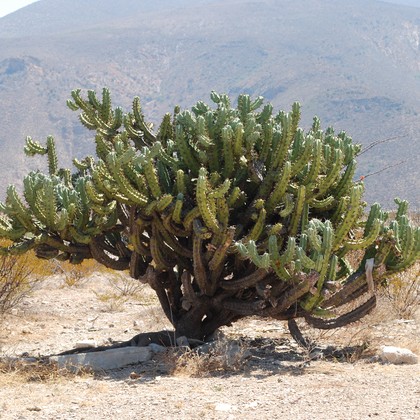
Pacific dry forest, thorn scrub, riparian woodland and semi-open country with trees, also orchards, villages and gardens; mainly in the lowlands and foothills, locally up to about 1500 m. It eats mainly mistletoe berries and other small fruits and often forages in the crowns of trees with mistletoe.
Where the bird is most at home, classified by the vegetation units of Mexico and Central America.




Range and movements
Pacific slope of western Mexico, from southern Sonora and south-western Chihuahua through Sinaloa, Nayarit, Jalisco, Colima and Michoacán to Guerrero; also in the dry interior of the Balsas basin. Does not occur outside the guide area.
- Resident
- dark = core range, pale = thinly spread
How and when to look
In dry forest best found at trees with mistletoe; with its short tail and compact shape the male is also recognisable from below, where the white undertail coverts stand out clearly.
Conservation status
Not threatened (LC). Not yet assessed separately; shown here as not threatened. Fairly common in dry forest and semi-open country with trees.
Scientific name
Euphonia godmani | Brewster, 1889
Brewster described the species in 1889 and placed it straight away in the genus where it still stands. The genus Euphonia was introduced in 1806 by Desmarest, A-G. Euphonia is Greek, from eu 'good' and phōnē 'sound': 'sweet-voiced', after the pleasing calls. godmani honours the British naturalist Frederick DuCane Godman (1834–1919), co-author of the Biologia Centrali-Americana. The specimen the first description was based on came from Mazatlán, Sinaloa, Mexico.