All species › Swifts › Hummingbirds › White-necked Jacobin
Position in the tree Birds Aves › Birds with a flexible palate Neognathae › All other modern birds Neoaves › Birds of the elements Elementaves › Nightjars and swifts Strisores
White-necked Jacobin | Florisuga mellivora
Witnekkolibrie | Colibrí nuca blanca
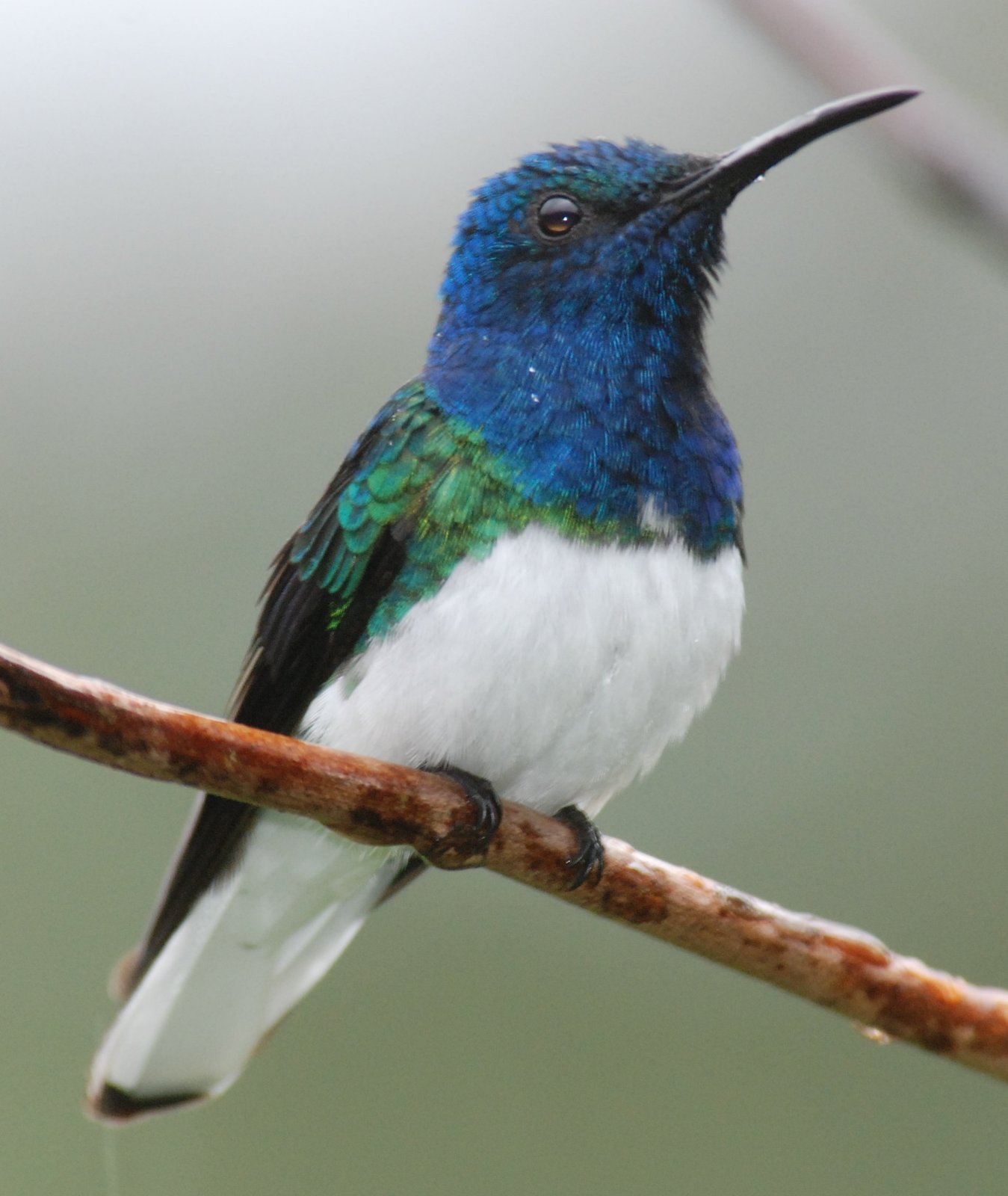
The White-necked Jacobin is a large, robust hummingbird of humid lowland forest, and in the guide area the only species with a dark blue head, a white nape band and a white tail. Males take over flowering trees and feeders and chase other hummingbirds away. Some females wear a plumage resembling the male's, so not every bird in male-like plumage is a male.
Voice
Fairly quiet. The call is a short, high tsik; in chases a rapid, descending series of high notes. The song is a long series of high, separate notes at a slow pace.
Recording: Brice de la Croix — CC BY-NC-SA 4.0 · converted to mono · xeno-canto
Identification
11–12 cm, with a short, straight black bill. The male has a dark blue head and breast, a white band across the hindneck, a glossy green back and a white belly. The tail is white with narrow black tips and is often spread on take-off and while hovering, making it flash. The female is green above; throat and breast are blue-green with white scaling, the belly is white and the tail green with a blue-black terminal band and narrow white tips. Immatures show every transition between female and male plumage.
Confusion species
No other hummingbird in the guide area combines a white tail with a dark blue head. Females of Green-breasted Mango Anthracothorax prevostii and Veraguan Mango Anthracothorax veraguensis have a curved bill and a black central stripe on the white underparts. Brown Violetear Colibri delphinae is grey-brown with a violet ear patch. The female White-necked Jacobin stands out by its white-scaled, blue-green throat and breast contrasting sharply with the white belly.
Habitat
The canopy and edges of humid lowland and foothill forest, tall secondary forest, clearings, gallery forest and shady cacao and coffee plantations, from sea level to about 1000 m, locally higher. It takes nectar in flowering trees and epiphytes, often with several birds in one tree, and catches many small insects in flight, often high above a clearing or a river. Outside the breeding season birds wander with the flowering.
Where the bird is most at home, classified by the vegetation units of Mexico and Central America.






Range and movements
In southern Mexico in the lowlands of southern Veracruz, Oaxaca, Tabasco and especially Chiapas, and on through Belize, Guatemala, Honduras and Nicaragua to Costa Rica and Panama. As far as Nicaragua almost only on the Caribbean side; in Costa Rica on the Caribbean slope and in the south of the Pacific slope, in Panama on both sides. Scarce in Mexico, fairly common further south. Outside the guide area in northern and central South America to Peru, Bolivia and Brazil, and on Trinidad and Tobago.
- Resident
- dark = core range, pale = thinly spread
How and when to look
A regular visitor to lodge feeders in the Caribbean lowlands and foothills of Costa Rica and in the Canal Area of Panama, where males often dominate the spot. A flying male can be recognised from afar by the flashing white tail; above a forest river its insect hunting high in the air can be followed.
Conservation status
Not threatened. The species is widespread and numerous and tolerates secondary forest and plantations; in the north of the guide area it is scarcer and dependent on remaining lowland forest.
Scientific name
Florisuga mellivora | (Linnaeus, 1758)
Linnaeus described the species in 1758 as Trochilus mellivorus; because it was later moved to another genus, the author and year stand in brackets. The genus Florisuga was introduced in 1850 by Bonaparte. Florisuga is Latin, from flos, floris 'flower' and sugere 'to suck': 'flower-sucker'. mellivora is Latin, from mel 'honey' and vorare 'to devour': 'honey-eating', after its nectar feeding. The specimen the first description was based on came from Suriname (originally given in error as 'India').