All species › Passerines › Manakins › White-ruffed Manakin
Position in the tree Birds Aves › Birds with a flexible palate Neognathae › All other modern birds Neoaves › Landbirds Telluraves › Falcons, parrots and passerines Australaves › Falcons and passerines Eufalconimorphae › Parrots and passerines Psittacopasserae
White-ruffed Manakin | Corapipo altera
Witkraagmanakin | Saltarín gorgiblanco
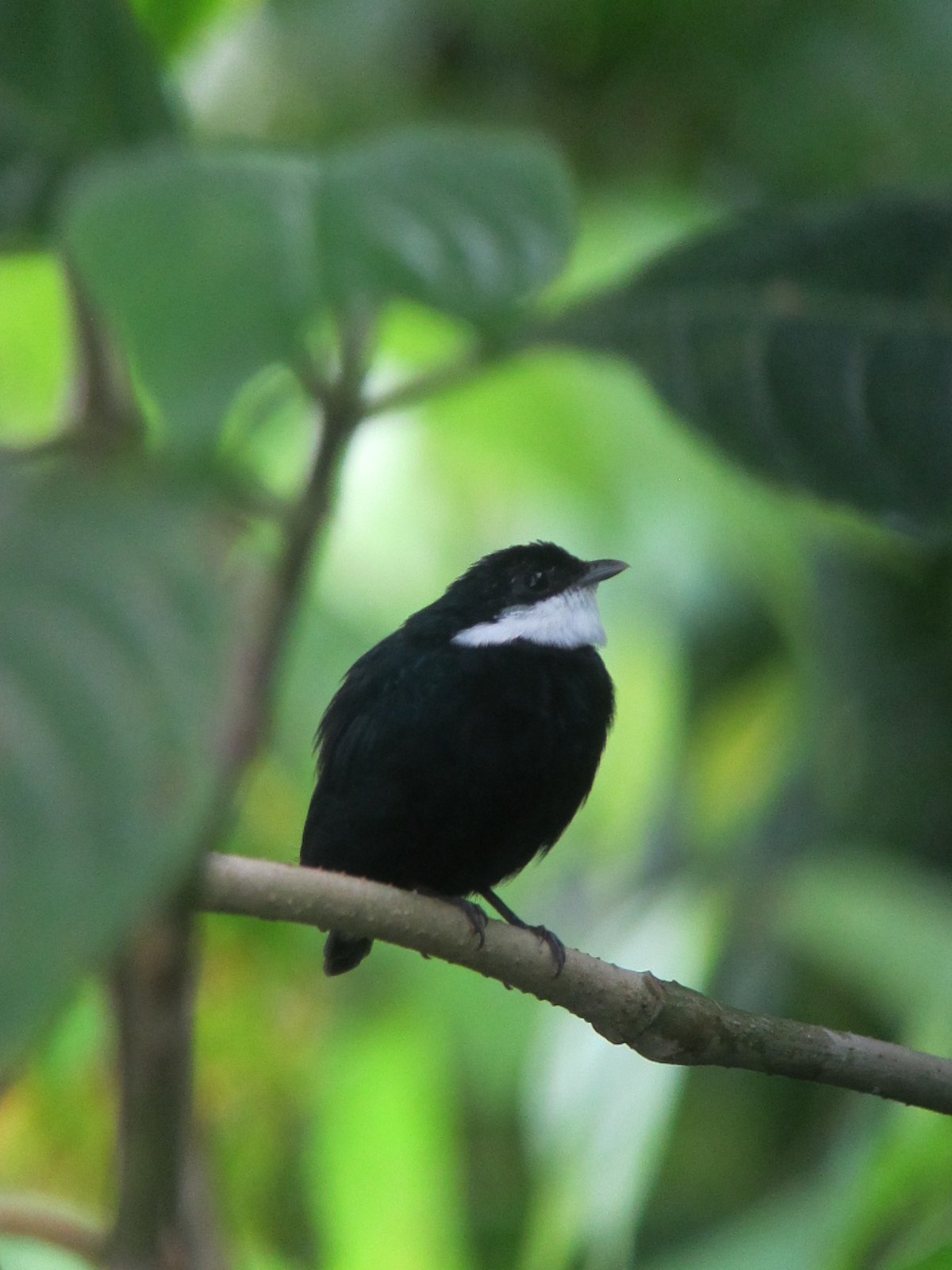
The White-ruffed Manakin is a small manakin of humid foothill and hill forest. The male is glossy blue-black with a white throat that is puffed out like a ruff in display; the female is olive-green. Males display in dispersed groups on mossy fallen logs. In the guide area it lives from eastern Honduras to Panama.
Voice
A thin, high tseee or seeu and short hissing notes. In display the male lands on the log with a sharp snap; in flight the wings make a soft rustling sound.
Recording: Johan Chaves — CC BY-NC-SA 4.0 · converted to mono · xeno-canto
Identification
10 cm. Small and compact, with a short tail. Male glossy blue-black with a white throat and sides of the neck; the long white feathers at the sides of the throat form a spreading ruff in display. Female olive-green with a grey throat and greyish underparts becoming yellowish green on the belly. Bill short and dark, legs dark grey to purplish. Young males resemble females, with some black on the face.
Confusion species
The male White-collared Manakin Manacus candei (Caribbean lowlands) has a white collar and breast, a black cap, an olive-green rump, a yellow belly and orange legs. The male Velvety Manakin Lepidothrix velutina is velvety black with a pale blue crown and has no white. Females of other manakins lack the grey throat; that of Velvety Manakin is brighter grass-green and that of White-collared Manakin has orange legs.
Habitat
Understorey and mid-storey of humid evergreen foothill and hill forest and the lower parts of montane forest, mainly between 400 and 1500 m; outside the breeding season many birds move down to lowland forest and forest edges. It feeds mainly on small fruits plucked in flight, together with insects. Males display in dispersed groups, each on its own mossy fallen log: they fly up and away and then dive back to the log with a high call, hopping to and fro on it with the ruff spread.
Where the bird is most at home, classified by the vegetation units of Mexico and Central America.





Range and movements
Eastern Honduras (Olancho and Gracias a Dios) and Nicaragua, mainly on the Caribbean slope, through Costa Rica, where it occurs on both slopes but on the Pacific side mainly in the south, to Panama, on both slopes east to Darién. Outside the guide area in extreme north-western Colombia.
- Resident
- dark = core range, pale = thinly spread
How and when to look
Regularly seen at Rancho Naturalista near Turrialba and around Arenal in Costa Rica and at El Valle de Antón in Panama. Often at fruiting shrubs and in the understorey of mossy foothill forest.
Conservation status
Not threatened. Fairly common in suitable foothill forest; declines where foothill forest is cleared.
Scientific name
Corapipo altera | Hellmayr, 1906
Hellmayr described the species in 1906 and placed it straight away in the genus where it still stands. The genus Corapipo was introduced in 1854 by Bonaparte. Corapipo ends in pipo 'manakin'; the first part is uncertain: Greek korax 'raven' (i.e. black) or korē 'maiden, nymph' or 'pupil of the eye'. altera is Latin for 'the other, second', as a second form beside the White-bibbed Manakin (Corapipo leucorrhoa), under which it was described. The specimen the first description was based on came from Carrillo, Costa Rica.