All species › Swifts › Hummingbirds › White-tailed Hummingbird
Position in the tree Birds Aves › Birds with a flexible palate Neognathae › All other modern birds Neoaves › Birds of the elements Elementaves › Nightjars and swifts Strisores
White-tailed Hummingbird | Eupherusa poliocerca
Witstaartkolibrie | Colibrí cola blanca
The White-tailed Hummingbird lives only in the Sierra Madre del Sur in Guerrero and western Oaxaca. Both sexes have a rufous patch in the wing and much white in the tail. The species is closely related to the Oaxaca Hummingbird, which occurs further east.

Voice
The song is a high, rapid, somewhat liquid to squeaky warble. The call is a liquid to slightly buzzy, rolled chip, often running into rattled trills.
No recording with a suitable Creative Commons licence is available for this species yet.
Identification
10–11 cm, with a straight black bill. The male is glittering bronze-green above and yellowish green below, with white undertail coverts and a rufous patch on the secondaries. The central tail feathers are bronze-green, the outer ones greyish white. The female has the same wing patch, greyish-white underparts with green spots on the flanks, and white outer tail feathers with dusky or green markings.
Confusion species
Oaxaca Hummingbird Eupherusa cyanophrys occurs further east; the male has a violet-blue forehead and a turquoise crown. In Stripe-tailed Hummingbird Eupherusa eximia the outer tail feathers have black outer webs and black tips. Berylline Hummingbird Saucerottia beryllina also has rufous in the wing, but a purplish-brown tail without white.
Habitat
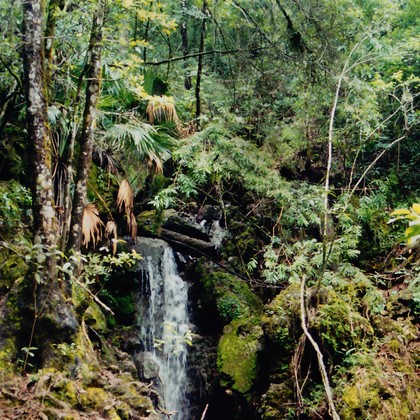
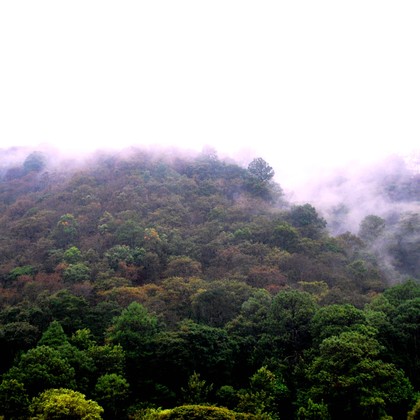
Edges and interior of humid montane forest, semi-deciduous forest and pine-oak forest, at about 800 to 2400 m. It appears to need intact forest. There may be movements between elevations, but they are poorly known.
Where the bird is most at home, classified by the vegetation units of Mexico and Central America.


Range and movements
Endemic to the guide area and to Mexico. Only on the Pacific slope of the Sierra Madre del Sur, in south-western Guerrero and western Oaxaca.
- Resident
- Summer visitor (c. Apr–Sep)
- Passage (Mar–Apr, Oct–Nov)
- dark = core range, pale = thinly spread
How and when to look
In the Sierra de Atoyac in Guerrero, for example around Paraíso, Nueva Delhi and El Molote, and in Omiltemi park near Chilpancingo.
Conservation status
Near Threatened. The range is small and the species occurs patchily within it. The population is estimated at fewer than 15,000 mature birds and is declining through logging and the clearing of montane forest for farming.
Scientific name
Eupherusa poliocerca | Elliot, 1871
Elliot described the species in 1871 and placed it straight away in the genus where it still stands. The genus Eupherusa was introduced in 1857 by Gould. Eupherusa is Greek, from eu 'well, finely' and pherousa 'bearing' (from pherō 'to carry'): 'finely bearing', probably after the boldly patterned tail. poliocerca is Greek, from polios 'grey, hoary' and kerkos 'tail', after the whitish outer tail feathers. The specimen the first description was based on came from Putla, Oaxaca, Mexico.