All species › Passerines › Tyrant flycatchers and allies › White-throated Flycatcher
Position in the tree Birds Aves › Birds with a flexible palate Neognathae › All other modern birds Neoaves › Landbirds Telluraves › Falcons, parrots and passerines Australaves › Falcons and passerines Eufalconimorphae › Parrots and passerines Psittacopasserae
White-throated Flycatcher | Empidonax albigularis
Witkeelfeetiran | Mosquero garganta blanca
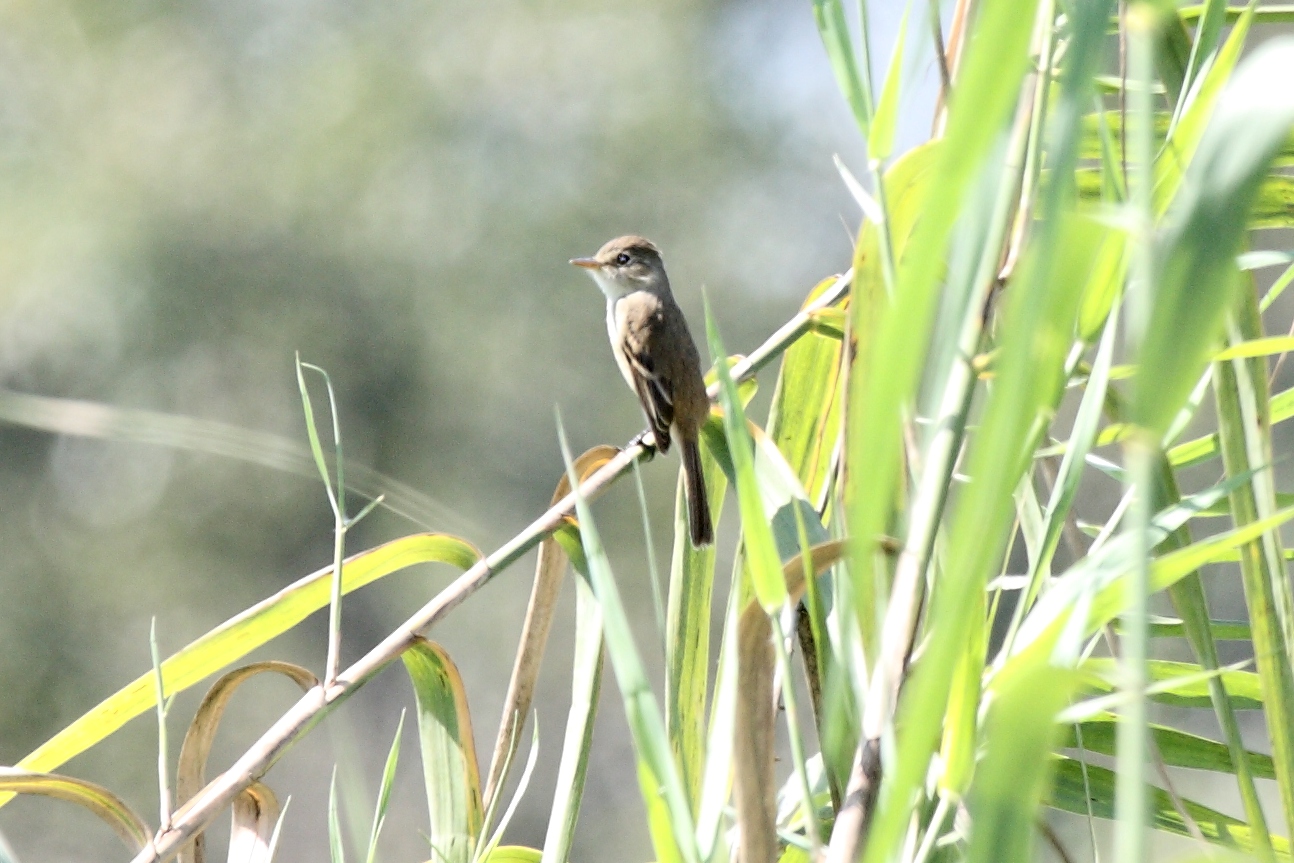
The White-throated Flycatcher is a small, brownish Empidonax of wet, brushy places, mainly in the highlands. It closely resembles Willow and Alder Flycatchers, but is smaller, browner and resident. It occurs only in the guide area, from Mexico to western Panama.
Voice
The usual call is a hoarse, buzzy bzreet or dzrrt.
Recording: Richard E. Webster — CC BY-NC-SA 4.0 · shortened to the first 60 s, mono · xeno-canto
Identification
13 cm. Upperparts brownish olive, head without a distinct eye-ring or with only a faint pale ring. Wings dark with two cinnamon-brown to ochre wing bars. Throat bright white and sharply set off from the brownish-olive breast; belly pale yellow. Lower mandible pale. Male and female are alike.
Confusion species
Willow Flycatcher Empidonax traillii and Alder Flycatcher Empidonax alnorum are larger, greyer olive above, with whitish wing bars and a less brown breast; they occur only as migrants or winter visitors. Least Flycatcher Empidonax minimus (winter visitor) is greyer, with a conspicuous white eye-ring.
Habitat
Wet, brushy places: marsh edges, rank growth along streams, wet pastures with shrubs and thickets at forest edges. Mainly in the highlands and hill country, locally lower. It catches insects from a low perch in shrubs.
Where the bird is most at home, classified by the vegetation units of Mexico and Central America.



Range and movements
Endemic to the guide area: from western and eastern Mexico through the highlands of southern Mexico and Central America to western Panama.
- Resident
- Summer visitor (c. Apr–Sep)
- Winter visitor (c. Oct–Mar)
- Passage (Mar–Apr, Oct–Nov)
- dark = core range, pale = thinly spread
How and when to look
Best found in wet rank vegetation and marsh edges in the highlands, where it perches low in shrubs; the hoarse call helps to locate it.
Conservation status
Not threatened. Locally fairly common, but dependent on wet, brushy places that can disappear through drainage.
Scientific name
Empidonax albigularis | Sclater & Salvin, 1859
Sclater & Salvin described the species in 1859 and placed it straight away in the genus where it still stands. The genus Empidonax was introduced in 1855 by Cabanis. Empidonax is Greek, from empis 'gnat' and anax 'master': 'gnat-king', after its insect hunting. albigularis is Latin, from albus 'white' and gula 'throat', after the white throat. The specimen the first description was based on came from Dueñas, Guatemala.