All species › Passerines › Finches, euphonias and allies › White-vented Euphonia
Position in the tree Birds Aves › Birds with a flexible palate Neognathae › All other modern birds Neoaves › Landbirds Telluraves › Falcons, parrots and passerines Australaves › Falcons and passerines Eufalconimorphae › Parrots and passerines Psittacopasserae
White-vented Euphonia | Euphonia minuta
Witbuikorganist | Eufonia vientre blanco
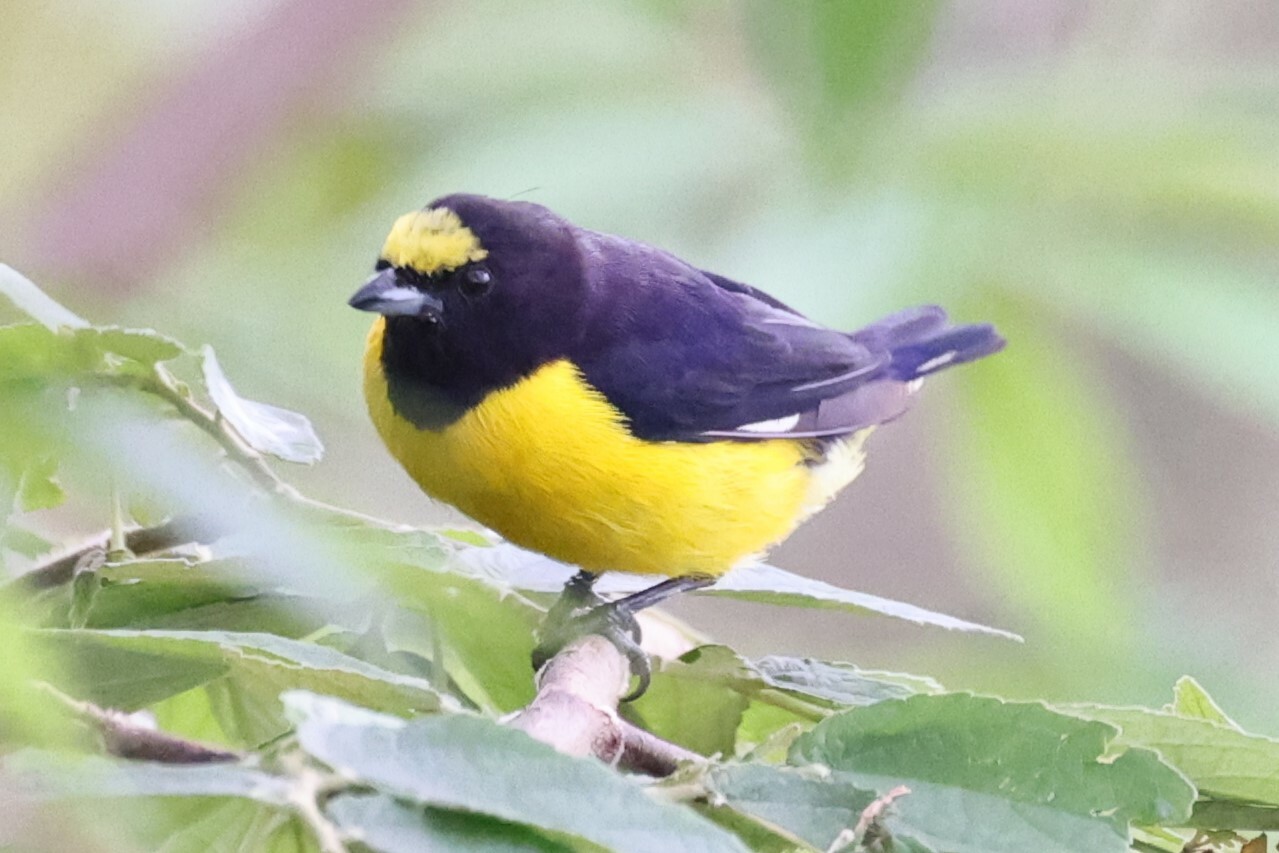
The White-vented Euphonia is one of the smallest euphonias in the guide area: a stocky finch of the canopy of humid lowland forest. The male is blue-black and yellow, and it is the only euphonia in the guide area with a white undertail and centre of belly. It feeds mainly on mistletoe berries and small fruit and is therefore closely tied to treetops and forest edges.
Voice
The call is a thin, clear bee-bee or a short, dry chip, often repeated from the canopy. The song is a rambling series of short chirps and whistled notes without a fixed pattern.
Recording: William Adsett — CC BY-NC-SA 4.0 · converted to mono · xeno-canto
Identification
9–10 cm. Small and stocky, with a short, thick bill and a short tail. Male: upperparts, head and throat glossy blue-black; only a small yellow spot on the forehead. Breast and flanks yellow, centre of belly and undertail coverts white; outer tail feathers with white on the inner web. Female: upperparts olive-green, throat greyish, breast and flanks yellowish olive, centre of belly greyish white and undertail coverts white. Juveniles resemble the female.
Confusion species
Yellow-throated Euphonia Euphonia hirundinacea and Thick-billed Euphonia Euphonia laniirostris have a yellow throat and a yellow undertail; Yellow-crowned Euphonia Euphonia luteicapilla has a dark throat like White-vented, but an entirely yellow crown and a yellow undertail. Fulvous-vented Euphonia Euphonia fulvicrissa has a tawny rather than white belly and undertail. In females the combination of grey throat and white undertail is the best feature.
Habitat
Canopy and edges of humid lowland and foothill forest, also tall secondary forest, clearings with scattered tall trees and shade plantations; mainly below 1000 m. It lives in pairs or small groups, often with other euphonias and tanagers in mixed flocks. It feeds mainly on mistletoe berries and small fruit, and also on insects.
Where the bird is most at home, classified by the vegetation units of Mexico and Central America.





Range and movements
In the guide area from extreme south-eastern Mexico and Belize along the Caribbean side of Guatemala, Honduras and Nicaragua to Costa Rica and Panama, where it also occurs on the Pacific side. Outside the guide area across much of northern South America, into the Amazon basin.
- Resident
- dark = core range, pale = thinly spread
How and when to look
Euphonias are best found in the canopy at fruiting trees and mistletoe; the white undertail is easiest to see on birds perched directly overhead.
Conservation status
Not threatened (LC). Widespread and locally fairly common; it disappears where humid forest is cleared completely, but persists along forest edges and in shade plantations.
Scientific name
Euphonia minuta | Cabanis, 1849
Cabanis described the species in 1849 and placed it straight away in the genus where it still stands. The genus Euphonia was introduced in 1806 by Desmarest, A-G. Euphonia is Greek, from eu 'good' and phōnē 'sound': 'sweet-voiced', after the pleasing calls. minuta is Latin for 'small', after its tiny size. The specimen the first description was based on came from Guyana.