All species › Passerines › Cardinals and allies › White-winged Tanager
Position in the tree Birds Aves › Birds with a flexible palate Neognathae › All other modern birds Neoaves › Landbirds Telluraves › Falcons, parrots and passerines Australaves › Falcons and passerines Eufalconimorphae › Parrots and passerines Psittacopasserae
White-winged Tanager | Piranga leucoptera
Witvleugeltangare | Tángara ala blanca
The White-winged Tanager is the smallest Piranga in the guide area, a small tanager of the canopy of humid montane and foothill forest. Both sexes have black wings with two broad white wing bars. It often travels with mixed flocks of tanagers. In the guide area it lives from eastern Mexico to Panama.

Voice
The call is a high, thin, often two-part wee-tseet. The song is a short series of high, thin whistles.
Recording: Jacob Wijpkema — CC BY-NC-SA 4.0 · converted to mono · xeno-canto
Identification
13–15 cm. A small, compact tanager with a fairly short, dark bill. The male is bright red with black lores, black wings with two broad white wing bars and a black tail. The female is olive-green above and yellow below, with dark lores and the same black wings with two white bars; the tail is dark grey. Young males resemble the female with some orange or red in the plumage.
Confusion species
Flame-colored Tanager Piranga bidentata is larger, with a streaked back, white tail corners and a dark border to the cheek; the male is orange-red rather than pure red. Females of Western Tanager Piranga ludoviciana are larger, with a greyer back, less black wings and a yellow upper wing bar; they occur only as winter visitors.
Habitat
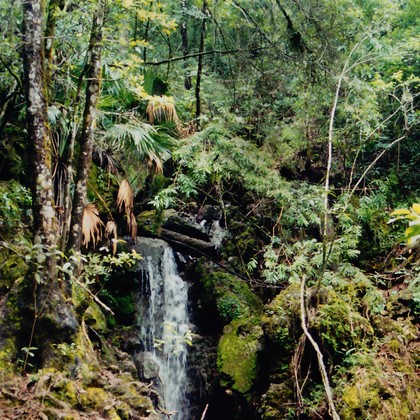
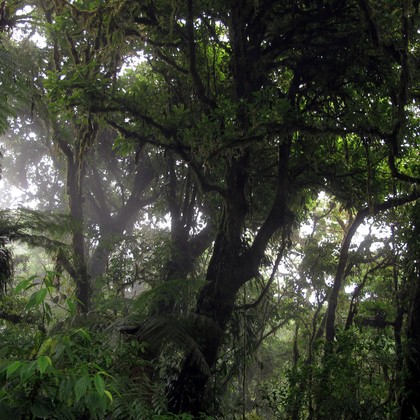
Canopy and edges of humid evergreen foothill and lower montane forest, also cloud forest, tall secondary forest and semi-open country with tall trees, mainly from about 500 to 2000 m. It searches the canopy for insects and small fruits, usually in pairs or in mixed flocks.
Where the bird is most at home, classified by the vegetation units of Mexico and Central America.


Range and movements
In Mexico on the Caribbean slope from San Luis Potosí and Hidalgo to Oaxaca and Chiapas; further through Guatemala, Belize, Honduras and Nicaragua to Costa Rica and Panama, mainly on the Caribbean side of the mountains. Outside the guide area in the Andes from Venezuela to Bolivia and in the tepuis of northern South America.
- Resident
- dark = core range, pale = thinly spread
How and when to look
Best found in mixed tanager flocks in the canopy of foothill forest, for example at Rancho Naturalista on the Caribbean slope of Costa Rica. The white wing bars also show well from below.
Conservation status
Not threatened (LC). Fairly common in suitable forest; disappears where forest is cleared entirely.
Scientific name
Piranga leucoptera | Trudeau, 1840
Trudeau described the species in 1840 and placed it straight away in the genus where it still stands. The genus Piranga was introduced in 1808 by Vieillot. Piranga comes from the Tupi tijepiranga, the name of an unidentified small bird. leucoptera is Greek, from leukos 'white' and pteron 'wing', after the two white wing bars. The specimen the first description was based on came from Mexico (not further specified).