All species › Passerines › Crows, jays and magpies › Woodhouse's Scrub Jay
Position in the tree Birds Aves › Birds with a flexible palate Neognathae › All other modern birds Neoaves › Landbirds Telluraves › Falcons, parrots and passerines Australaves › Falcons and passerines Eufalconimorphae › Parrots and passerines Psittacopasserae
Woodhouse's Scrub Jay | Aphelocoma woodhouseii
Woodhouses struikgaai | Chara de Woodhouse
Woodhouse's Scrub Jay is a long-tailed, crestless jay of dry oak and juniper scrub in the interior. It resembles the California Scrub Jay but is duller, with greyer underparts and a weaker breast band. In the guide area it lives on the plateaus and mountain slopes of northern and central Mexico.

Voice
Harsh, rasping calls such as a rising shreeep, and rapid series of check-check-check, similar to California Scrub Jay.
Recording: Manuel Grosselet — CC BY-NC-SA 4.0 · shortened to the first 60 s, mono · xeno-canto
Identification
27–31 cm, of which much is tail. Head, wings and tail dull blue, back grey to grey-brown. Narrow white supercilium, dark cheek. Throat whitish with fine streaks, breast band blue and often incomplete or faint. Underparts grey to dirty white, undertail coverts often bluish. Bill black, fairly thin and straight. Juveniles are greyer and duller.
Confusion species
Mexican Jay Aphelocoma wollweberi has no white supercilium and no streaked throat and is more uniformly blue and grey; it lives in groups in oak and pine-oak woodland. Pinyon Jay Gymnorhinus cyanocephalus has a short tail, is entirely blue and wanders in large flocks. California Scrub Jay Aphelocoma californica occurs in the guide area only in Baja California.
Habitat
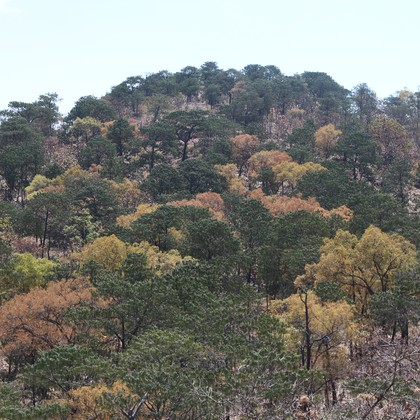
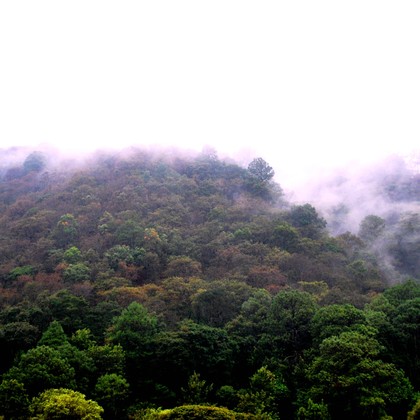
Pinyon-juniper woodland, oak scrub, open oak woodland and edges of pine-oak forest, dry scrub on slopes and along dry washes, and locally around villages. It eats insects, seeds, acorns, pine nuts and fruit. It stores food by burying seeds in the ground.
Where the bird is most at home, classified by the vegetation units of Mexico and Central America.


Range and movements
Interior of the western United States, from the Great Basin and Colorado Plateau to Texas, and south over the plateaus and mountain slopes of Mexico into the south of the country. The range in Mexico is fairly fragmented.
- Resident
- dark = core range, pale = thinly spread
How and when to look
It often perches in the open on top of a shrub or small tree; when disturbed it flies off low with a long glide to the next shrub.
Conservation status
Not threatened. It was formerly treated together with California Scrub Jay as Western Scrub Jay; that combined species was considered not threatened. Locally common.
Scientific name
Aphelocoma woodhouseii | (Baird, 1858)
Baird described the species in 1858 as Cyanocitta woodhouseii; because it was later moved to another genus, the author and year stand in brackets. The genus Aphelocoma was introduced in 1851 by Cabanis. Aphelocoma is Greek, from aphelēs 'simple, smooth' and komē 'hair of the head', after the uncrested head. woodhouseii honours the American physician and naturalist Samuel Washington Woodhouse (1821–1904), who explored the US Southwest in the 1850s. The specimen the first description was based on came from Fort Thorn, Doña Ana County, New Mexico (USA).