All species › Passerines › Tyrant flycatchers and allies › Yellow-crowned Tyrannulet
Position in the tree Birds Aves › Birds with a flexible palate Neognathae › All other modern birds Neoaves › Landbirds Telluraves › Falcons, parrots and passerines Australaves › Falcons and passerines Eufalconimorphae › Parrots and passerines Psittacopasserae
Yellow-crowned Tyrannulet | Tyrannulus elatus
Geelkruinvliegenpikker | Mosquerito coroniamarillo
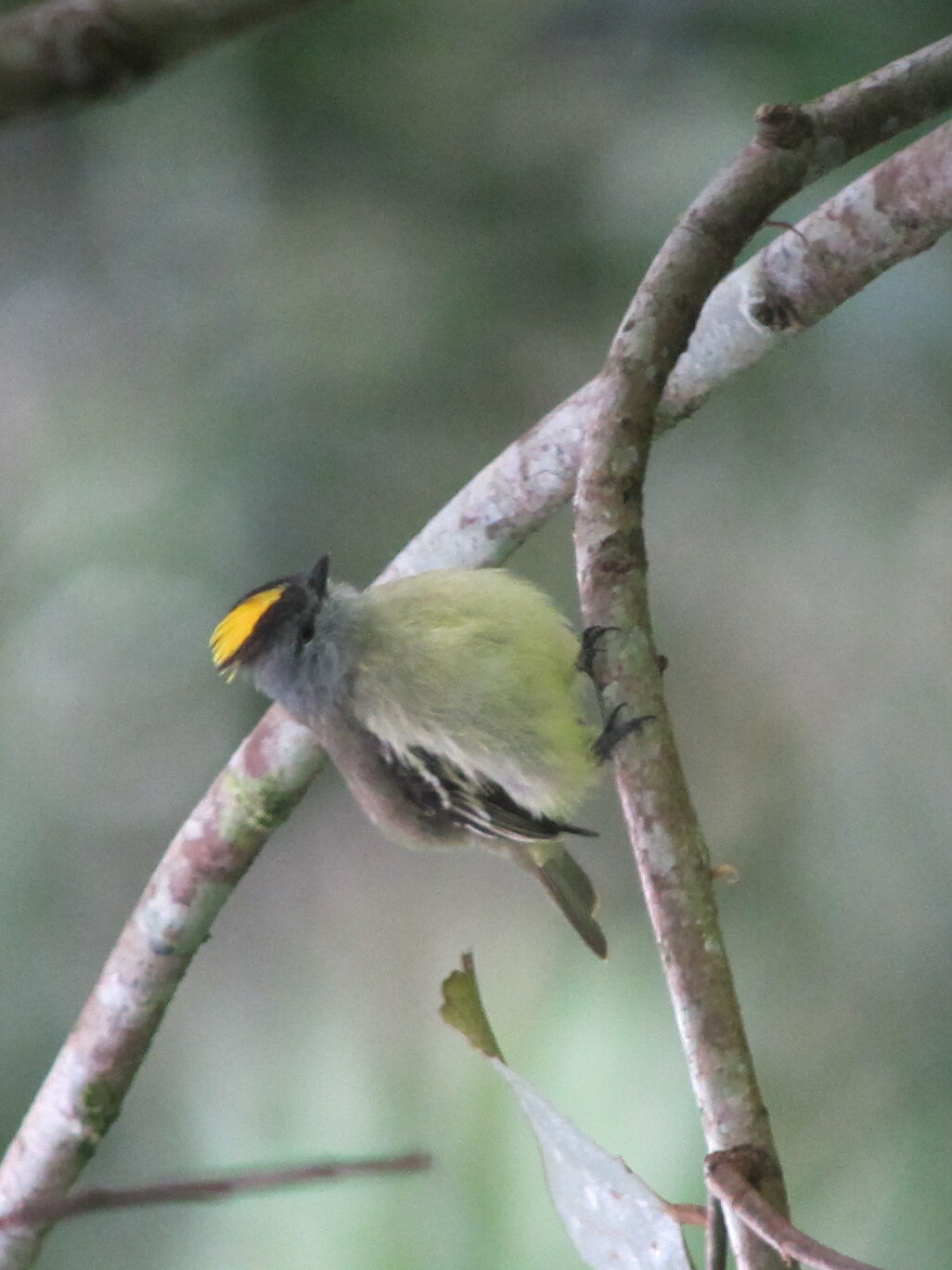
The Yellow-crowned Tyrannulet is a small, compact tyrant flycatcher with a short, stubby bill, a grey face and a yellow crown stripe that usually stays largely hidden. It lives in treetops at forest edges, in gardens and in semi-open country. In the guide area it occurs in southern Costa Rica and in Panama.
Voice
A clear, two-noted whistled pree-peer, often repeated and also heard in the middle of the day. The call usually gives the bird away before it is seen.
Recording: Juan Freile — CC BY-NC-SA 4.0 · shortened to the first 60 s, mono · xeno-canto
Identification
10–11 cm. Head with a dark grey crown and a yellow central stripe that shows mainly when the crown feathers are raised; face grey with a faint pale eyebrow. Upperparts olive-green, wings dark with two whitish wing-bars. Throat and upper breast grey, belly bright yellow. Bill very short and black. Male and female are alike.
Confusion species
Southern Beardless Tyrannulet Camptostoma obsoletum has a ragged crest, buffy or dull wing-bars and a longer tail that it often cocks. Yellow-bellied Tyrannulet Ornithion semiflavum has a prominent white eyebrow, no wing-bars and entirely yellow underparts. Elaenias such as Forest Elaenia Myiopagis gaimardii are larger and slimmer, with a longer bill.
Habitat
Treetops at forest edges, in clearings, gardens, parks, plantations and pasture with scattered trees, also mature secondary forest; in the lowlands and foothills. It searches high in the trees for small insects and also eats small berries, including mistletoe.
Where the bird is most at home, classified by the vegetation units of Mexico and Central America.





Range and movements
In the guide area on the Pacific slope of southern Costa Rica and over much of Panama. Outside the guide area widespread in tropical South America east of the Andes, to Amazonia, and in western Colombia and Ecuador.
- Resident
- dark = core range, pale = thinly spread
How and when to look
Listen for the short two-noted whistle in gardens and parks with tall trees in Panama. Then patiently search the canopy for a tiny bird with a grey face and a stubby bill.
Conservation status
Not threatened. Widespread and locally common; benefits from semi-open country with trees.
Scientific name
Tyrannulus elatus | (Latham, 1790)
Latham described the species in 1790 as S[ylvia] elata; because it was later moved to another genus, the author and year stand in brackets. The genus Tyrannulus was introduced in 1816 by Vieillot. Tyrannulus is Modern Latin for 'little tyrant', diminutive of Tyrannus, the kingbird genus. elatus is Latin for 'raised, elevated', after the yellow crown patch that can be raised in the crest. The specimen the first description was based on came from Cayenne, French Guiana.