All species › Passerines › New World blackbirds, troupials and allies › Yellow-headed Blackbird
Position in the tree Birds Aves › Birds with a flexible palate Neognathae › All other modern birds Neoaves › Landbirds Telluraves › Falcons, parrots and passerines Australaves › Falcons and passerines Eufalconimorphae › Parrots and passerines Psittacopasserae
Yellow-headed Blackbird | Xanthocephalus xanthocephalus
Geelkoptroepiaal | Tordo cabeza amarilla
The Yellow-headed Blackbird is a large blackbird of marshes with reeds and cattails. It breeds in western and central North America and in winter moves in large flocks to northern and central Mexico, where it often feeds together with other blackbirds on farmland and in cattle country.
Voice
The song is a hoarse, grating sound, like the creak of a rusty hinge, preceded by a few short clicks. The call is a low, dry kruk or chek. Winter flocks keep up a continuous chatter.
Recording: Richard E. Webster — CC BY-NC-SA 4.0 · converted to mono · xeno-canto
Identification
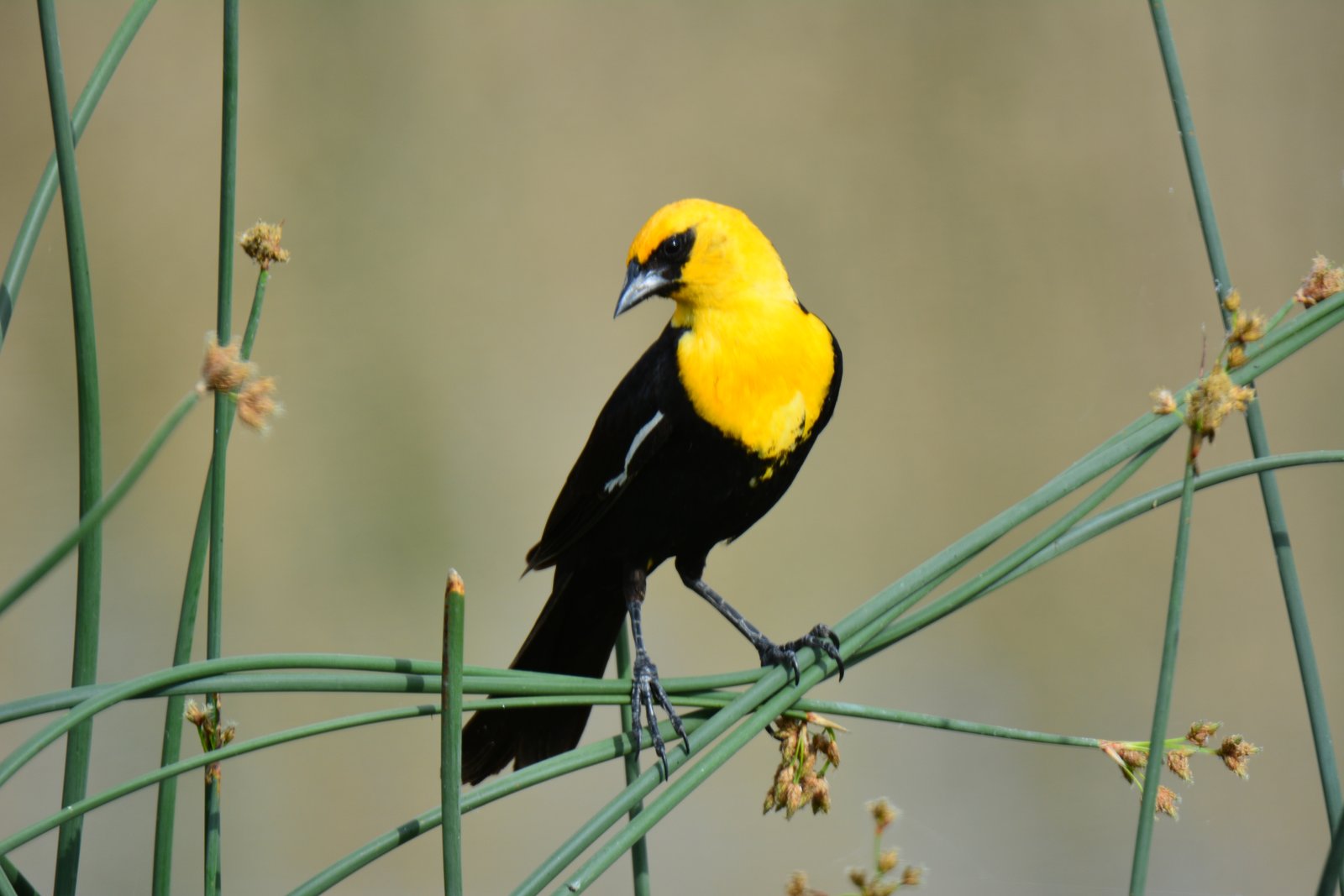
21–26 cm. The male is much larger than the female. Male black with a yellow head and breast, a black mask around the eye and a white patch on the wing that is visible mainly in flight. Female and young birds brown, with a yellowish throat, breast and supercilium and some white streaks on the lower breast; the wing patch is absent. In winter the male's colours are somewhat duller.
Confusion species
An adult male cannot be confused with other species in the guide area because of the yellow head. The female Red-winged Blackbird Agelaius phoeniceus is smaller, densely streaked brown across all the underparts and lacks the yellow throat and breast. Western Meadowlark Sturnella neglecta also has yellow on the throat and breast, but with a black V on the breast and streaked brown upperparts.
Habitat
Breeds in freshwater marshes with reeds, cattails or bulrushes. In winter on farmland, stubble fields, pastures, around cattle sheds and feedlots and along the shores of lakes and reservoirs; roosts in reedbeds. Eats seeds and grain, in the breeding season mainly insects.
Where the bird is most at home, classified by the vegetation units of Mexico and Central America.



Range and movements
Breeds from western Canada and the United States into the far north of Mexico, where it has been found breeding very locally in north-eastern Baja California and in Chihuahua. Winters in the south-western United States and in Mexico, south to the central highlands around Jalisco, Michoacán and Puebla; rare further south.
- Winter visitor (c. Oct–Mar)
- dark = core range, pale = thinly spread
How and when to look
In winter best found among large flocks of blackbirds on farmland and around cattle farms in northern and central Mexico; the yellow heads of the males can be seen from far away in such mixed flocks.
Conservation status
Not threatened (LC). Widespread and numerous. The loss of marshes in the breeding range and poisoning during bird control in arable areas are local problems.
Scientific name
Xanthocephalus xanthocephalus | (Bonaparte, 1826)
Bonaparte described the species in 1826 as Icterus xanthocephalus; because it was later moved to another genus, the author and year stand in brackets. The genus Xanthocephalus was introduced in 1850 by Bonaparte. Xanthocephalus is Greek, from xanthos 'yellow' and kephalē 'head': 'yellow-head'. xanthocephalus is Greek, from xanthos 'yellow' and kephalē 'head', after the male's yellow head and breast. The specimen the first description was based on came from Loup River near Fullerton, Nebraska (USA).