All species › Passerines › Tanagers and allies › Yellow-winged Tanager
Position in the tree Birds Aves › Birds with a flexible palate Neognathae › All other modern birds Neoaves › Landbirds Telluraves › Falcons, parrots and passerines Australaves › Falcons and passerines Eufalconimorphae › Parrots and passerines Psittacopasserae
Yellow-winged Tanager | Thraupis abbas
Geelvleugeltangare | Tangara ala amarilla
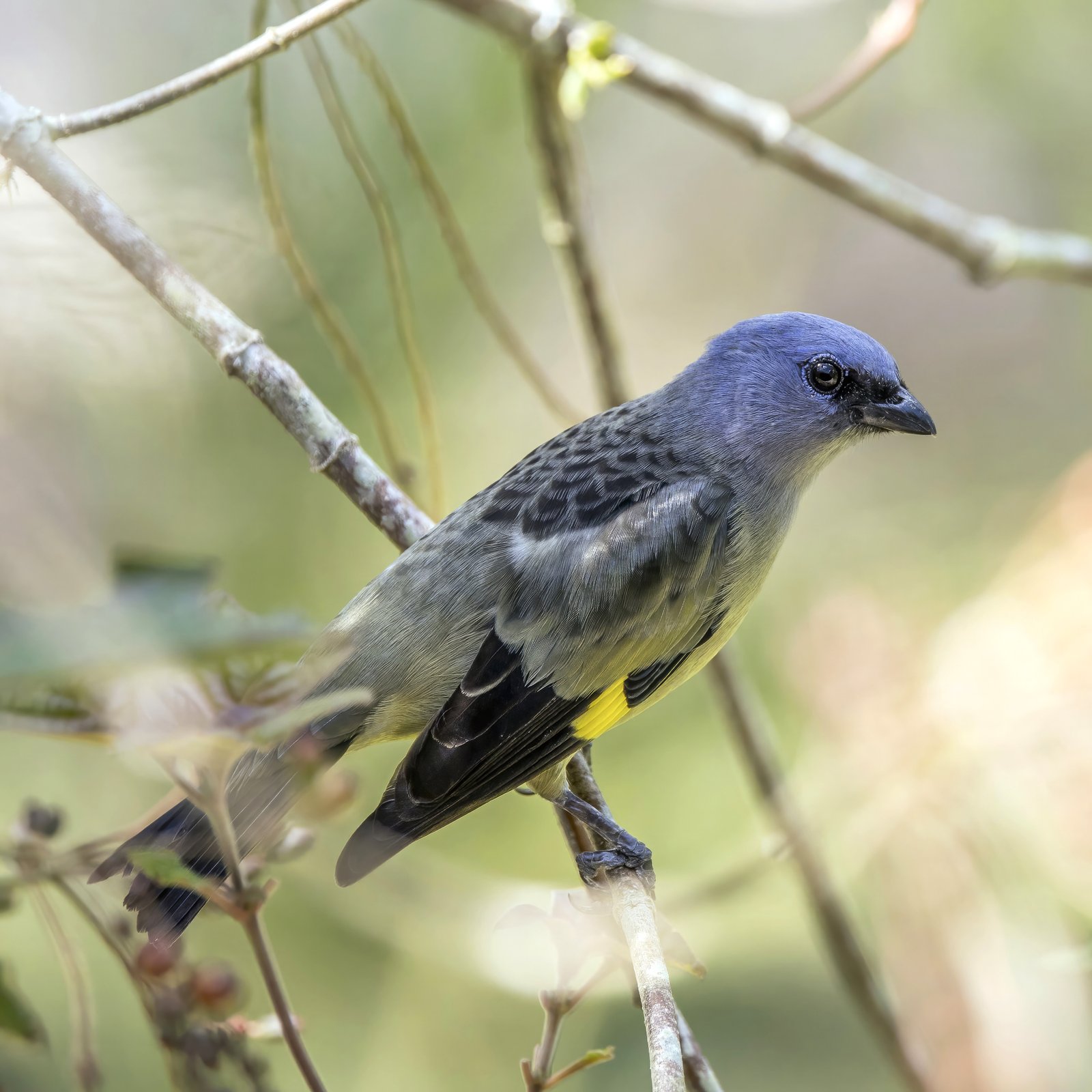
The Yellow-winged Tanager is a large tanager with a lilac-blue head and a yellow patch in the black wing. It lives in pairs or small groups in forest edges, plantations, gardens and villages. Its entire range lies within the guide area, from southern Mexico to Nicaragua.
Voice
Calls include a thin, squeaky tseep and a somewhat hoarse chek. The song is a rapid series of squeaky, twittering notes, similar to that of Blue-grey Tanager but fuller.
Recording: Max Noack — CC BY-NC-SA 4.0 · converted to mono · xeno-canto
Identification
17–19 cm. A large tanager with a stout, dark bill. Head and throat lilac-blue, with black lores; back olive-grey with faint dark mottling; breast and belly greyish olive, yellower towards the rear. Wings black with blue-green edges to the coverts and a yellow patch at the base of the primaries, which shows as a yellow band in flight. Male and female are alike; the female is duller, with less blue on the head.
Confusion species
Blue-grey Tanager Thraupis episcopus is smaller and entirely blue-grey, without yellow in the wing. Palm Tanager Thraupis palmarum is greyish olive with a yellowish forehead and a black rear half to the wing, and lacks the lilac head; the two species hardly overlap. In flight the yellow wing patch separates Yellow-winged Tanager from all other tanagers in its range.
Habitat
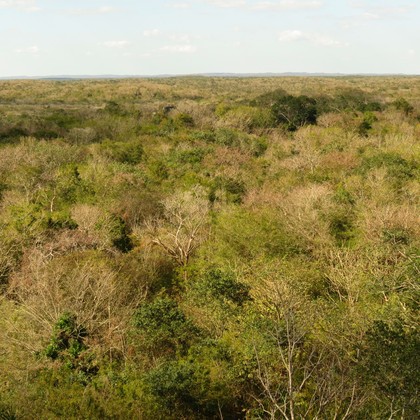
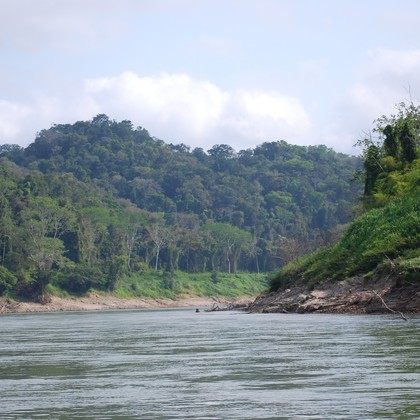
Forest edges, open woodland, secondary forest, riverine forest, semi-deciduous forest, cacao and coffee plantations, pasture with trees, gardens and villages, in lowlands and hills up to about 1200 m, locally higher. It eats mainly fruit, as well as nectar and insects, and often feeds alongside Blue-grey Tanagers in fruiting trees.
Where the bird is most at home, classified by the vegetation units of Mexico and Central America.



Range and movements
From southern Veracruz, Oaxaca and Chiapas through Tabasco, the southern Yucatán Peninsula, Belize, Guatemala, El Salvador and Honduras to Nicaragua, with scattered records in northern Costa Rica. Mainly on the Caribbean slope, but locally also on the Pacific slope. Found only in the guide area. Resident.
- Resident
- dark = core range, pale = thinly spread
How and when to look
Regularly seen in Belize and Petén, for example around the ruins of Tikal, where small groups sit in fruiting trees among Blue-grey Tanagers.
Conservation status
Not threatened (LC). Common over most of its range; adapts well to farmland.
Scientific name
Thraupis abbas | (Deppe, 1830)
Deppe described the species in 1830 as Tanagra Abbas; because it was later moved to another genus, the author and year stand in brackets. The genus Thraupis was introduced in 1826 by Boie. Thraupis is the Ancient Greek word for an unidentified small bird mentioned by Aristotle. abbas is Late Latin for 'abbot'. The name is probably a counterpart to Tanagra episcopus ('bishop'), the related Blue-grey Tanager. The specimen the first description was based on came from Xalapa, Veracruz, Mexico.