All species › Passerines › Shrike-babblers, Erpornis and vireos › Yucatan Vireo
Position in the tree Birds Aves › Birds with a flexible palate Neognathae › All other modern birds Neoaves › Landbirds Telluraves › Falcons, parrots and passerines Australaves › Falcons and passerines Eufalconimorphae › Parrots and passerines Psittacopasserae
Yucatan Vireo | Vireo magister
Yucatánvireo | Vireo yucateco
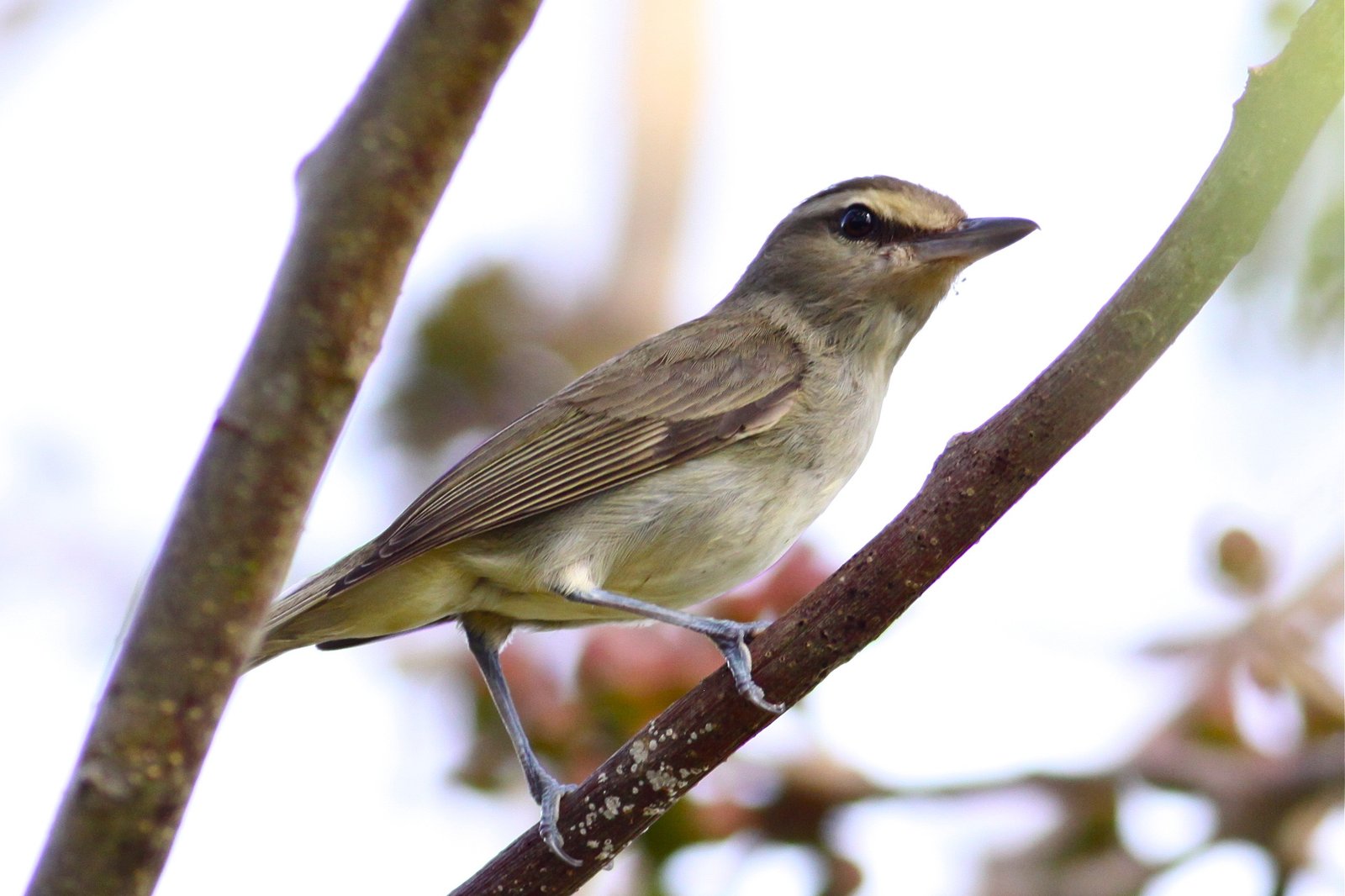
The Yucatan Vireo is a large, dull-coloured vireo with a strikingly heavy bill. It lives in coastal woodland, scrub and mangroves along the coast of the Yucatán Peninsula, in Belize and on islands off Honduras.
Voice
The song consists of short, clear phrases separated by pauses, resembling that of Red-eyed Vireo. The call is a nasal, scolding sound.
Recording: Alfonso Auerbach — CC BY-NC-SA 4.0 · converted to mono · xeno-canto
Identification
15 cm. Upperparts dull olive-brown. Long, dull buffy supercilium and dark eye-stripe. Underparts dingy white, washed greyish brown on the breast and flanks. No wing bars. Bill long and heavy.
Confusion species
Red-eyed Vireo Vireo olivaceus is greener, has a grey crown with a black border above the white supercilium and a slimmer bill. Yellow-green Vireo Vireo flavoviridis has bright yellow flanks. Black-whiskered Vireo Vireo altiloquus has a black malar stripe.
Habitat
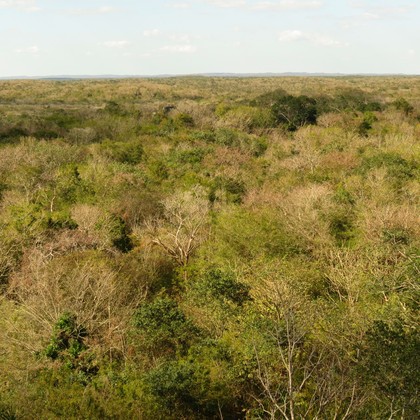
Coastal woodland and scrub, mangroves and low dry forest near the coast, also on islands and cays. It searches for insects in dense vegetation.
Where the bird is most at home, classified by the vegetation units of Mexico and Central America.



Range and movements
Along the coast of the Yucatán Peninsula and on islands off Quintana Roo, on the cays and along the coast of Belize, and on the Bay Islands of Honduras. Outside the guide area on Grand Cayman.
- Resident
- dark = core range, pale = thinly spread
How and when to look
Look for it in coastal woodland and mangroves along the coast of Quintana Roo and on the cays of Belize. Note the heavy bill and the dull supercilium.
Conservation status
Not threatened. Locally fairly common, but confined to a narrow coastal strip where habitat is locally lost to development.
Scientific name
Vireo magister | (Baird, 1871)
Baird described the species in 1871 as Vireosylvia magister; because it was later moved to another genus, the author and year stand in brackets. The genus Vireo was introduced in 1808 by Vieillot. Vireo was used by Latin authors for a small, green, migratory bird, probably the Eurasian golden oriole, though the European greenfinch has also been suggested. magister is Latin for 'master, chief', probably after its large size among vireos. The specimen the first description was based on came from Belize.