All species › Passerines › Antbirds › Zeledon's Antbird
Position in the tree Birds Aves › Birds with a flexible palate Neognathae › All other modern birds Neoaves › Landbirds Telluraves › Falcons, parrots and passerines Australaves › Falcons and passerines Eufalconimorphae › Parrots and passerines Psittacopasserae
Zeledon's Antbird | Hafferia zeledoni
Zeledons miervogel | Hormiguero de Zeledón
Zeledon's Antbird is a large, long-tailed antbird of humid foothill forest with bare blue skin around the eye. It walks on the forest floor, pumping its tail. In the guide area it lives from Nicaragua to Panama.

Voice
A loud series of clear, whistled notes. Also sharp, short calls.
Recording: Daan van der Hoeven — CC BY-NC-SA 4.0 · converted to mono · xeno-canto
Identification
18–19 cm. Tail fairly long. The male is entirely black, with a patch of bare, pale blue skin around and in front of the eye and a small white patch at the bend of the wing that is often hidden. The female is dark chestnut-brown, with the same blue skin around the eye.
Confusion species
Male Bare-crowned Antbird Gymnocichla nudiceps is smaller, has a bare blue crown and white tips to the wing coverts, and lives mainly in lowland thickets. Jet Antbird Cercomacra nigricans and Dusky Antbird Cercomacroides tyrannina are much smaller and slimmer, without blue skin. Female Chestnut-backed Antbird Poliocrania exsul is smaller, with a short tail and a grey head.
Habitat
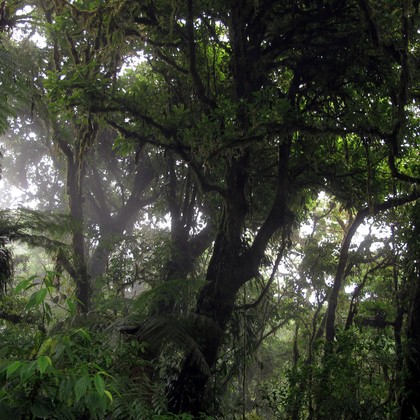
Undergrowth and floor of humid foothill and lower montane forest, locally also in the lowlands; especially in dense growth in ravines and along streams. It searches for insects while walking and sometimes follows army-ant swarms. Lives in pairs.
Where the bird is most at home, classified by the vegetation units of Mexico and Central America.



Range and movements
Caribbean slope of Nicaragua and Costa Rica, in Costa Rica also on the southern Pacific slope; in Panama in the foothills on both slopes. Outside the guide area in western Colombia and Ecuador.
- Resident
- dark = core range, pale = thinly spread
How and when to look
Look in foothill forest on the Caribbean side of Costa Rica and in the hills of Panama. The bird is shy and is often first noticed by its voice or as it walks across a trail.
Conservation status
Not threatened. Generally uncommon; tied to fairly undisturbed forest and therefore sensitive to deforestation.
Scientific name
Hafferia zeledoni | (Ridgway, 1909)
Ridgway described the species in 1909 as Myrmeciza zeledoni; because it was later moved to another genus, the author and year stand in brackets. The genus Hafferia was introduced in 2013 by Isler, Bravo & Brumfield. Hafferia honours the German geologist and ornithologist Jürgen Haffer (1932–2010), known for his work on speciation in Amazonia. zeledoni honours the Costa Rican ornithologist José Castulo Zeledón (1846–1923), founder of ornithology in Costa Rica. The specimen the first description was based on came from Guayabo, Costa Rica.