All species › Hedgehogs, shrews and moles › Moles and desmans › Aquitanian Mole
Aquitanian Mole | Talpa aquitania
Talpa aquitania | Talpa aquitania
Talpa aquitania is the mole of south-western France and northern Spain and was formally described as a species only in 2017. Until then these animals were included in the Common Mole; DNA studies showed that the moles south and west of the Loire form a lineage of their own, most closely related to the Iberian Mole. The species is therefore absent from older field guides.
No photograph of a living wild animal of this species with a suitable Creative Commons licence exists. Do you have one that meets the rules? Send it in.
Tracks
As in the other moles, the molehill is the main sign; it cannot be distinguished from the hills of the Common Mole or the Iberian Mole. The tunnels lie 5 to 30 cm deep. No other signs have been described specifically for this species; as far as is known, molehills, surface tunnels and earthworm stores correspond to those of the Common Mole.
Identification
Externally identical to the Common Mole: cylindrical body, spade-shaped digging forefeet, black velvety coat and a short tail. The only difference visible on a whole animal concerns the eye: in the Aquitanian Mole the eyelids are fused and the eye lies beneath the skin, whereas the Common Mole has a small open eyelid slit. The species is medium-sized to large: males weigh 45 to 120 grams, females 48 to 89 grams, and the tail measures 1.9 to 3.8 cm; the original description gave a mean head-body length of 14.9 cm and a mean weight of 89 grams for the animals examined. The skull has a relatively narrow rostrum, and the mesostyle of the first upper molar is single. Females have four pairs of nipples; the chromosome number is 2n = 34.
Similar species
The main confusion species is the Common Mole (Talpa europaea), which lives north and east of the Loire. Externally the eye is the only character: an open eyelid slit in the Common Mole, fused eyelids in this species; otherwise teeth and DNA are decisive. The Iberian Mole (Talpa occidentalis), its sister species, adjoins it in the north-west of the Iberian Peninsula; it also has covered eyes, but is on average smaller, has a shorter snout, broader forefeet and an often two-cusped mesostyle on the first upper molar. In practice locality is the usable character: in most of France south of the Loire and in the Spanish Pyrenees, the Ebro basin and Catalonia a mole is almost certainly this species. Older distribution maps of the Common Mole in Spain in fact refer to this species.
Habitat
Pastures, arable land, gardens, mountain meadows and broadleaved woodland with deep, light soil and plentiful prey, from sea level to about 2000 m. The species is absent from poorly drained soils and from very dry, stony or sandy ground, and acid soils are sparsely occupied owing to lack of prey. In northern Spain it lives on deep soils with many earthworms, gentle slopes and few stones.
Where the animal is most at home, classified with EUNIS — the European standard for habitats.
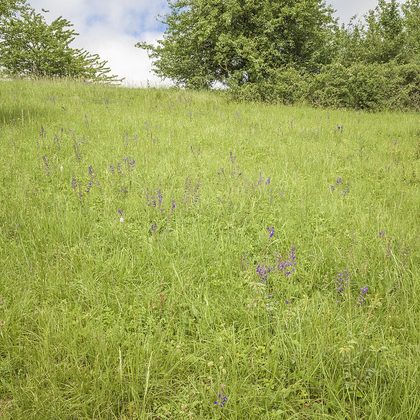

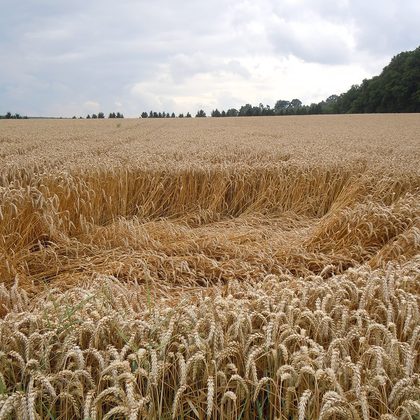


Distribution
France south and west of the Loire (the type locality lies at Saint-Benoît in the Vienne department) and the north and north-east of the Iberian Peninsula: the Cantabrian coast and mountains, the northern Iberian System, the northern Ebro basin, the Pyrenees and northern Catalonia. In the north-west of the peninsula its range borders that of the Iberian Mole, in France that of the Common Mole. Museum specimens and newly collected animals have defined the boundaries in France more precisely since 2017.
- Native
- dark = core range, pale = thinly spread
Way of life
A burrowing, territorial species. In Catalonia activity peaks in the morning and early afternoon. In northern Spain the diet consists mainly of earthworms and the larvae of flies and beetles, supplemented by centipedes, adult beetles, hymenopterans and snails; its composition is nearly constant throughout the year. In north-eastern Spain breeding runs from December to June, peaking from January to March; pregnant females have been found from January to June and lactating females from February to June. Litters contain 2 to 4 embryos, about 3 on average, and some females may have two or three litters per season. The young become sexually mature in the year after their birth.
Where and when to look
Range is the most useful field character for this species: molehills in Aquitaine, the Pyrenees, Navarre, the Basque Country and Catalonia belong to the Aquitanian Mole. Near the Loire and in the Cantabrian Mountains, where its range borders that of another species, a dead animal is needed: check with a lens whether the eye lies beneath the skin or has an open slit, and record the exact locality. In northern Spain breeding falls in winter and early spring; fresh hills are most numerous in those months.
Conservation status
Least Concern (LC, 2024). The species is common in suitable habitat and is also assessed as Least Concern in the Spanish Red List. As in the other moles, occurrence depends on deep, worm-rich soils; poorly drained, very dry or acid soils limit its distribution. Because the species has been recognised separately only since 2017, much of what has been published on the Common Mole in south-western France and northern Spain in fact refers to this species.
Scientific name
Talpa aquitania | Nicolas, Martínez-Vargas, & Hugot, 2017
Nicolas, Martínez-Vargas, & Hugot described the species in 2017 and placed it straight away in the genus where it still stands. Talpa is the Latin word for 'mole'. aquitania is Aquitania, the Roman name of south-western Gaul, placed as a proper noun in apposition to the genus name: that is where the range of the species centres. The specimen the first description was based on came from France.