All species › Rodents › Voles and hamsters › Balkan Pine Vole
Balkan Pine Vole | Microtus felteni
Feltens woelmuis | Topillo de Felten
Felten's Vole (Microtus felteni) is one of the least known mammals of Europe. Malec and Storch described the species in 1963 from Mount Babuna in North Macedonia. It lives in a fragmented range of an estimated 40,000 km² in the southern Balkans, is scarce everywhere, and very little has been published about its way of life.
No photograph of a living wild animal of this species with a suitable Creative Commons licence exists. Do you have one that meets the rules? Send it in.
Tracks
The species is semi-fossorial: it digs, but does not live as completely underground as the Mediterranean Pine Vole. Its signs have hardly been described. The expected pattern is that of the small pine voles: shallow tunnels under the turf, small soil heaps with the opening at the side and an even, stone-free texture, because the animal digs with its teeth, cleared runways through the vegetation, and droppings of 4 to 7 mm. In this area, however, Thomas's Pine Vole makes similar heaps and is about thirty times commoner; a soil heap in Albania therefore says nothing about the species. To establish which pine voles occur in a district, Barn Owl pellets are the appropriate source, with the teeth as the identification character and, for full certainty, laboratory analysis.
Identification
Small: head-body 8.3 to 10.5 cm, tail 2.3 to 3.9 cm (25 to 33 per cent of head-body length) and 16 to 28 g. The build is that of a pine vole: short ears and very small eyes, a blunt head and a compact body. The coat is long and soft, dark brown above and grey to silvery below. The skull is delicately built, flattened and low, with expanded zygomatic arches and a wide interorbital region; the upper incisors project only slightly forwards. The second upper molar is simple, with only three inner salient angles. Females have four nipples, all inguinal.
Similar species
The species cannot be identified in the field, nor in the hand without the skull. The main confusion species is Thomas's Pine Vole (Microtus thomasi), which occurs alongside it in Albania and north-western Greece and is about thirty times more abundant there; a small burrowing vole from that area is therefore very probably Thomas's Pine Vole. The Common Pine Vole (M. subterraneus) also shares the area and the size. All three are small, dark brown voles with short ears and very small eyes; separation rests on molar structure, skull measurements and chromosomes. Felten's Vole can be distinguished from larger species of the area: Microtus hartingi is considerably larger and heavier, with clearly projecting ears and large eyes; the Common Vole and Microtus mystacinus are yellower and smoother-coated and have clearly visible ears, bare inside, and larger eyes; the Bank Vole is chestnut, with large eyes, free-standing ears and a tail twice as long. A small, dark brown vole with very small eyes in northern Greece, Albania, Kosovo or western North Macedonia is one of the three pine voles; which of the three cannot be determined from field characters.
Habitat
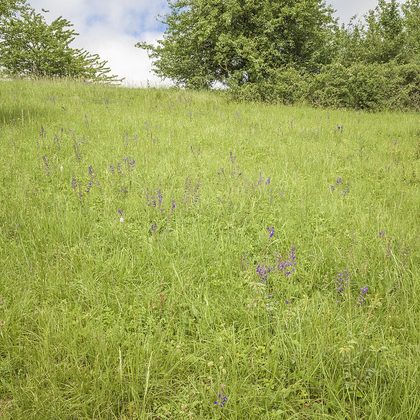
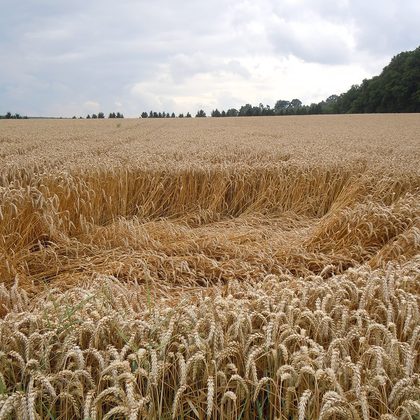
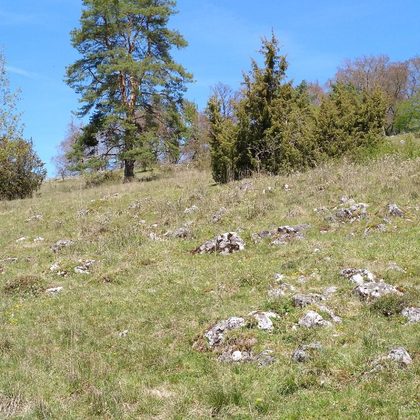
Open ground in mountainous landscape: hay meadow and pasture, woodland edges and clearings, scrub, stream banks and occasionally arable land. The species occurs from 40 to 2050 m, a wide range for a small species; the centre of its occurrence is in the middle mountains of the southern Balkans. Densities there are low; this has been established and is not the result of few records.
Where the animal is most at home, classified with EUNIS — the European standard for habitats.


Distribution
Southern Serbia, Kosovo, western North Macedonia, Albania and north-western Greece; the species does not occur elsewhere. The total range is estimated at about 40,000 km² and is fragmented; within the related group of European voles only Cabrera's Vole has a smaller range. The type locality is near Trnovo-Magarevo on Mount Babuna in the Pelister range. Little mammal research has been carried out in this part of Europe, and the outline of the range rests on a fairly small number of localities.
Way of life
Predominantly nocturnal and active throughout the year, without winter dormancy. Its food has not been studied; the Handbook of the Mammals of the World records 'no information'. Like related species it probably eats green plant parts and underground roots, tubers and bulbs. Regarding breeding, it is recorded that females in reproductive condition have been collected from June to October, and that three pregnant females each carried two embryos. That is a small litter for a vole, consistent with the low densities. Nothing is known of home range size, social organisation or movements.
Where and when to look
The chance of seeing and recognising this species in the field is very small. Search the middle mountains of western North Macedonia, the Pelister massif, the Albanian mountains or the Pindos for hay meadows and woodland edges with a dense herb layer, and look for small soil heaps and runways, bearing in mind that these may equally belong to Thomas's Pine Vole. Collect pellets below a Barn Owl or Eagle Owl roost; in the southern Balkans these are easier to find than the vole itself, and analysing them is the only practical survey method for this species.
Conservation status
Least Concern (LC, 2024). This assessment is recent; before it the species was listed as Data Deficient (DD) on the Red List. The range is small and fragmented, the species lives everywhere at low densities and in Albania is about thirty times scarcer than Thomas's Pine Vole. Specific threats have not been identified, because they have not been studied. The mountain pastures and hay meadows of the southern Balkans are, however, changing rapidly: extensive grazing is disappearing, hay meadow is becoming scrub or being converted, and the middle mountains are becoming depopulated. The largest gap is knowledge; it must come from targeted fieldwork in Albania, North Macedonia and north-western Greece.
Scientific name
Microtus felteni | (Malec & Storch, 1963)
Malec & Storch described the species in 1963 as Pitymys savii felteni; because it was later moved to another genus, the author and year stand in brackets. Microtus is Greek, from mikros, 'small', and ous, genitive ōtos, 'ear', after the small ears hidden in the fur. felteni honours the German zoologist Heinz Felten, curator of mammals at the Senckenberg Museum in Frankfurt, where Storch worked. The specimen the first description was based on came from North Macedonia.