All species › Carnivores › Bears › Brown Bear
Brown Bear | Ursus arctos
Bruine beer | Oso Pardo
The brown bear is the largest land mammal in Europe. Most visitors to bear areas see only its signs: broken-open ant hills, turned stones, droppings full of bilberries and tree trunks with hairs in the resin. The brown bear does not truly hibernate, but enters winter dormancy.

Tracks
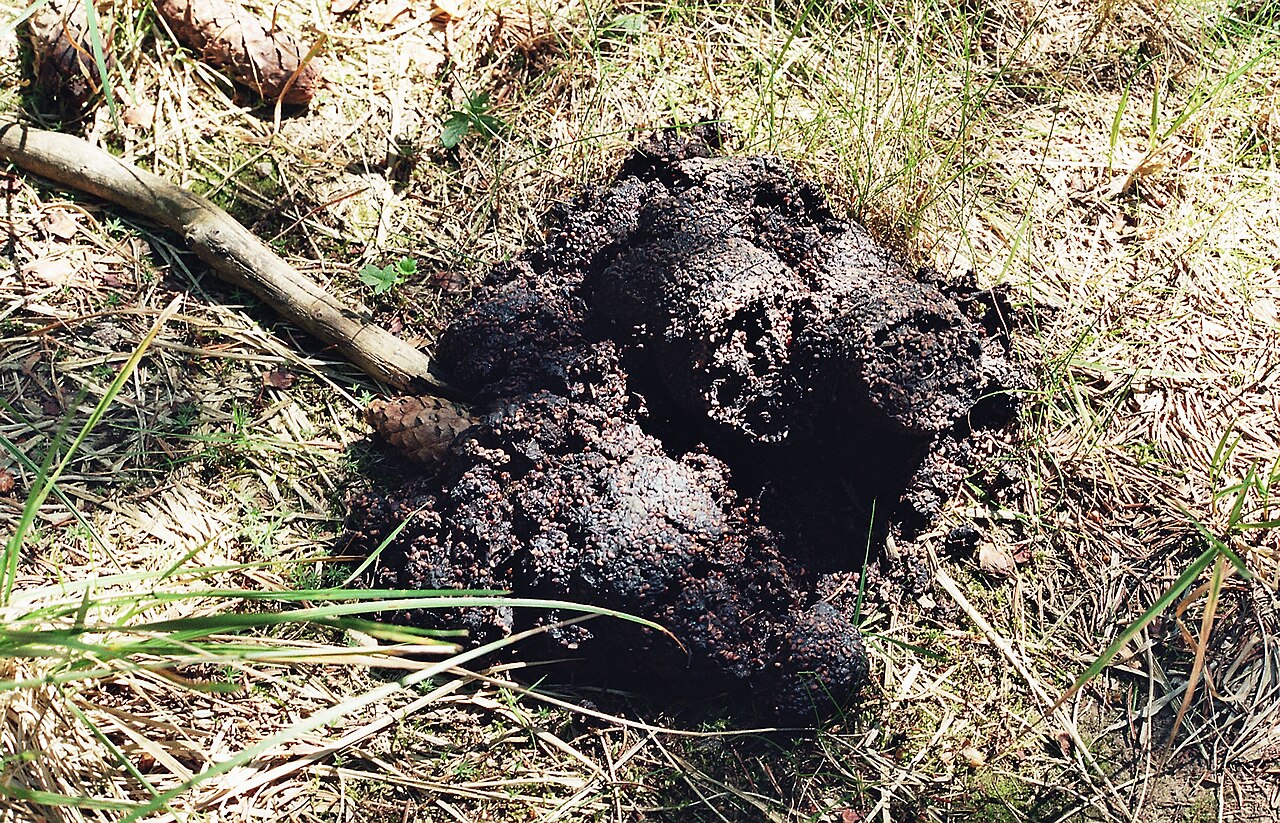
All prints show five toes, which separates them from those of other large European mammals. The fore foot leaves a broad, short print about 12 to 17 cm wide and 15 to 20 cm long, with the five toes in a shallow arc above a wide transverse pad and the claw marks 3 to 6 cm ahead of the toes. The hind foot is 20 to 30 cm long and shows the whole elongated sole; the print has the shape of a broad, flat human footprint, but the smallest toe is on the outside, the reverse of a human foot. The largest toe is the outermost. The trail is wide and slightly turned inwards. The scat is a shapeless heap 5 to 7 cm thick, with contents that vary by season: green and fibrous with grass and herbs in spring, black and crumbly with remains of ants and beetles in summer, and in late summer and autumn large purple-black heaps consisting almost entirely of bilberry, rowan or beech mast, often with whole berries. There are also marking trees: along fixed routes and among conifers at the wood edge stand trunks rubbed smooth and shiny by the bear's back, with coarse brown hairs in the resin at 60 to 120 cm, and above that bite marks and vertical claw grooves up to two metres; the height of the marks gives an indication of the size of the bear. Further, digging signs: ant hills broken open and rotten stumps pulled apart, turned stones, pits where roots and bulbs have been dug out, and on mountain pasture whole strips of turned turf. Carcasses a bear has fed on are often covered with branches and soil, with runs leading to them. The winter den lies under a root plate, in a chamber dug into a steep slope or in a rock crevice, with a narrow entrance and a bed of moss, grass and spruce branches.

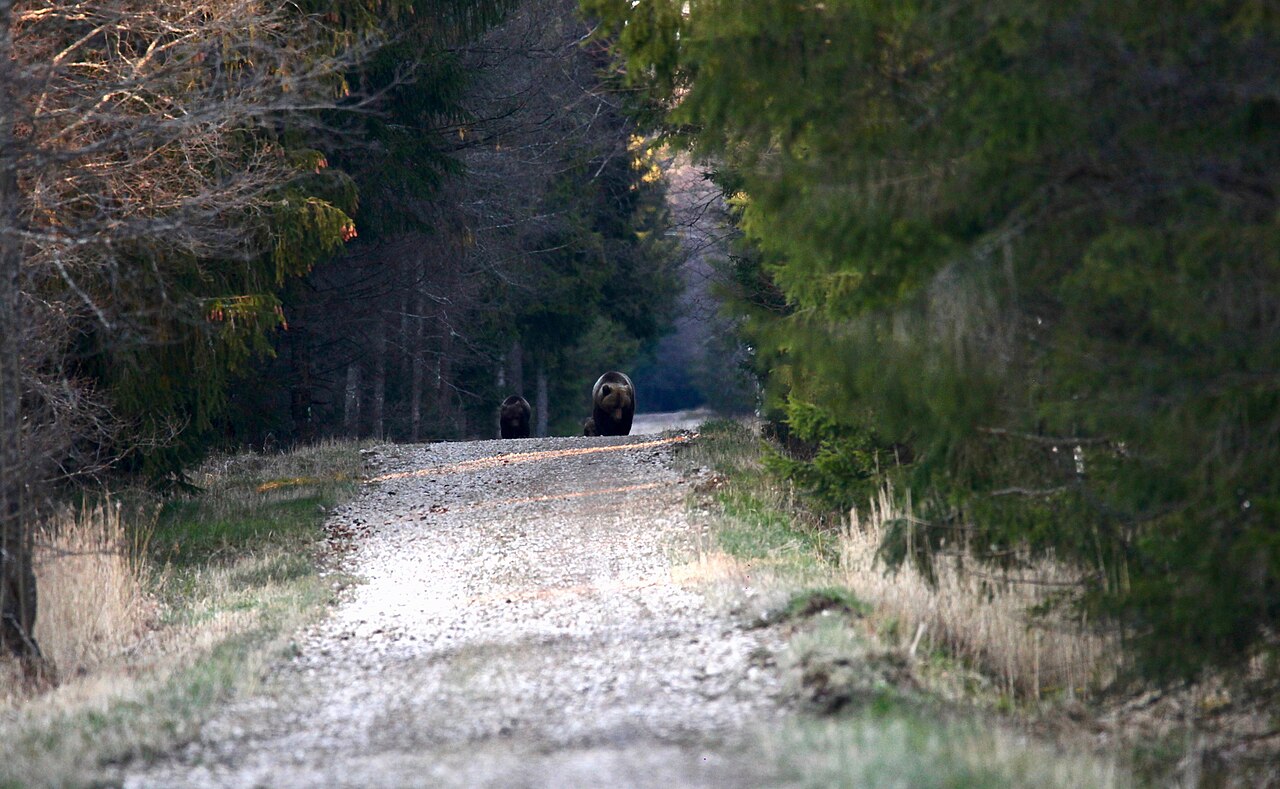
In its habitat
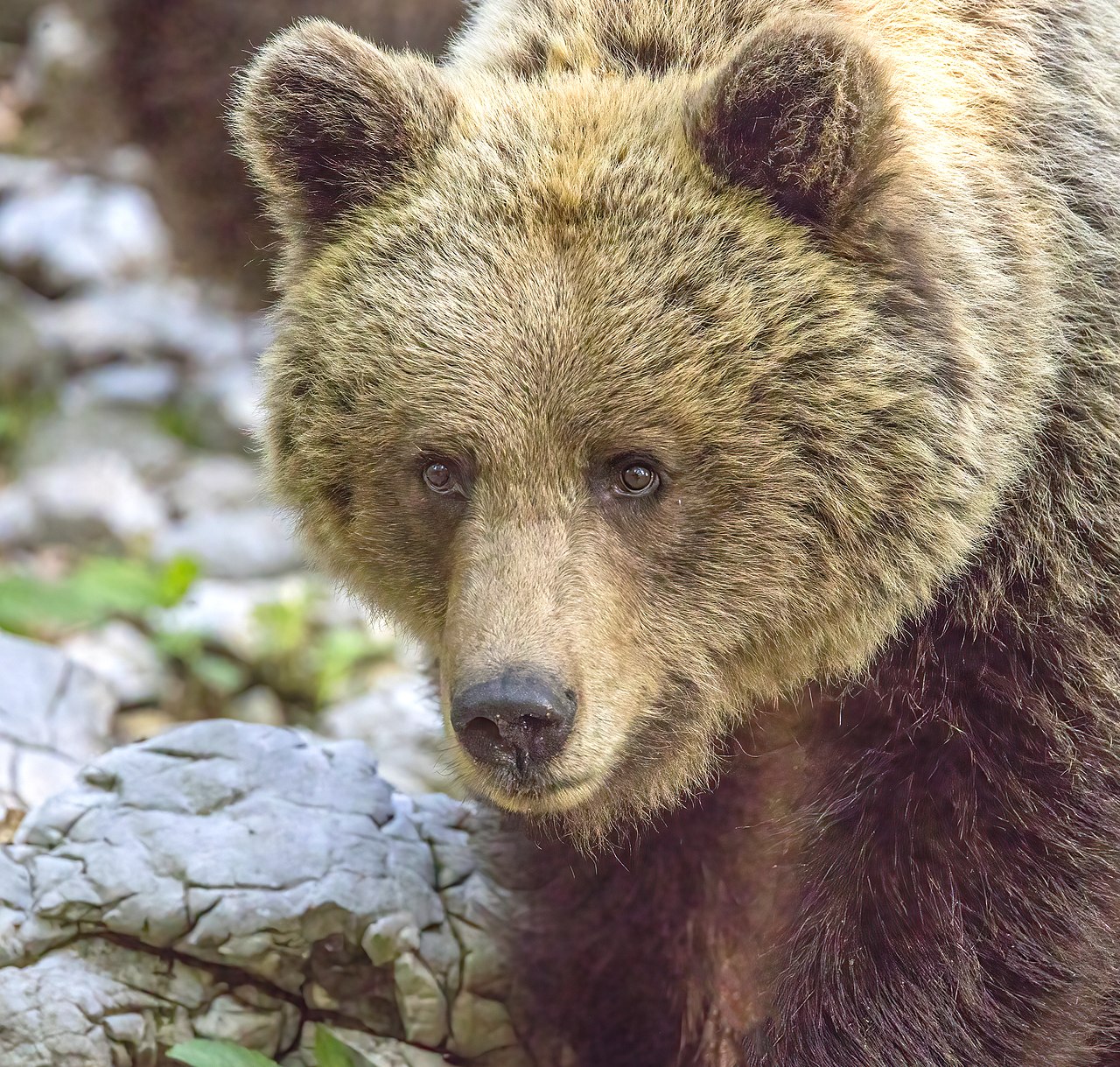
Head close-up
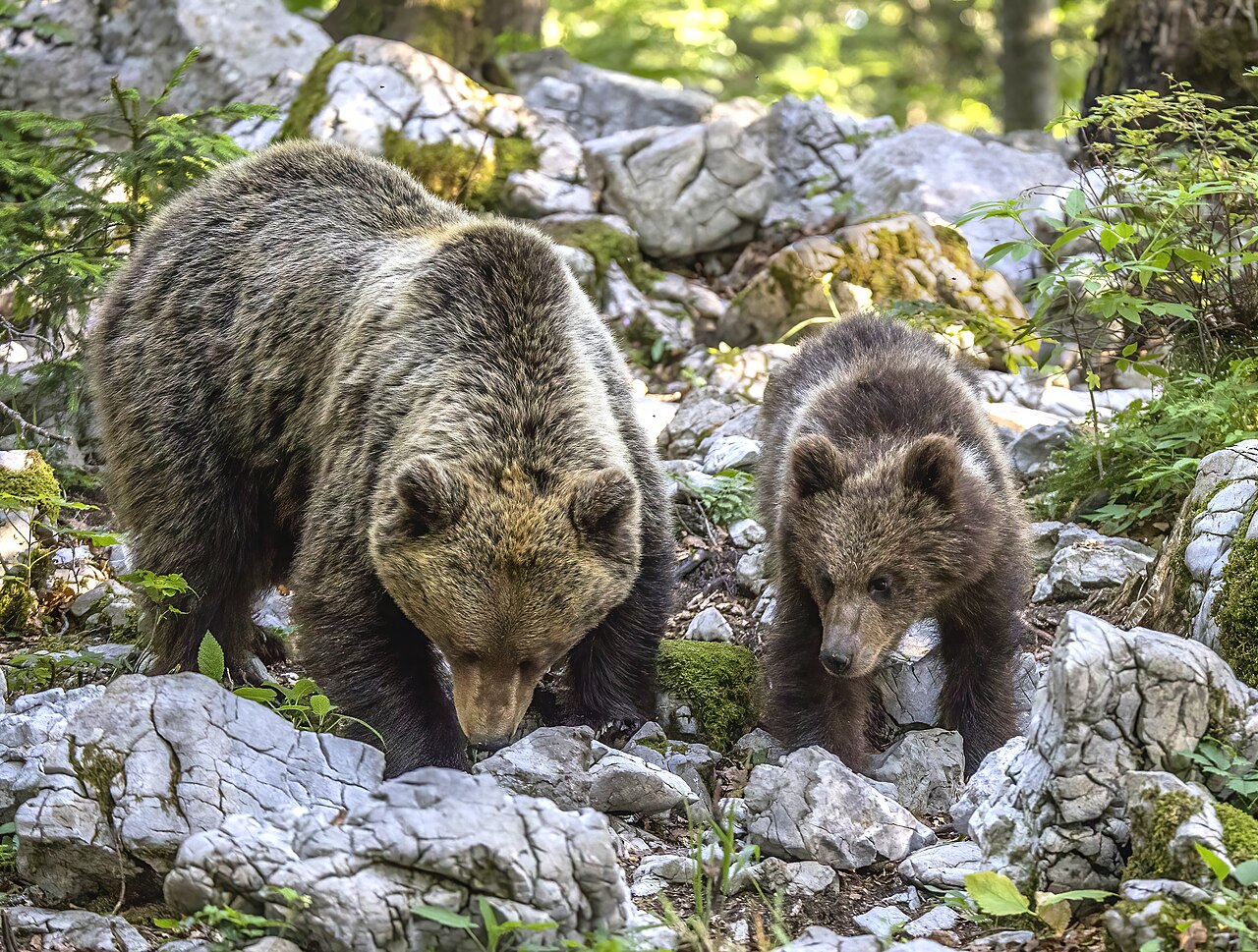
The young
Identification
Massive and heavy, with a pronounced hump of muscle over the shoulders that moves up and down as it walks, a broad head with a slightly dished forehead profile, small round ears and a short tail of 6.5 to 21 cm hidden in the fur. It is plantigrade: the whole sole touches the ground. For the species as a whole head-body length is 100 to 280 cm and shoulder height 90 to 150 cm; on its hind legs, a posture it adopts to smell and look rather than to threaten, it is considerably taller than a person. The coat varies from cream-blond through cinnamon and ochre-brown to almost black, often with paler shoulders and darker back and legs; cubs often have a pale collar that disappears after one or two years. The fore claws are 5 to 10 cm long, slightly curved and not retractile, and press into the ground when it walks. European bears lie at the lower end of that range. In southern Europe an adult may weigh no more than seventy kilos; in northern and central Europe male averages are between 150 and 250 kg, higher in the Carpathians and Scandinavia, and Cantabrian males average about 115 kg. Females weigh about half as much as males. In autumn an animal is up to a third heavier than in spring.
Similar species
In Europe the species cannot be confused in good view; mistakes arise at long range and in poor light. A wild boar is dark and heavy but much lower, with a straight back, a pointed head and no shoulder hump, and moves with short, quick steps. A large dog on a mountain pasture is the most frequent confusion in southern Europe, because livestock-guarding dogs there are large and pale. A wisent is heavier, has horns and a different head shape. At long range, in the Carpathians or Cantabria, rocks or stumps on open slopes are the most frequent false bears; movement and the shoulder hump are then decisive. Tracks are unambiguous: a large dog shows four toes with claws, a bear five toes in a shallow arc above a broad sole print.
Habitat
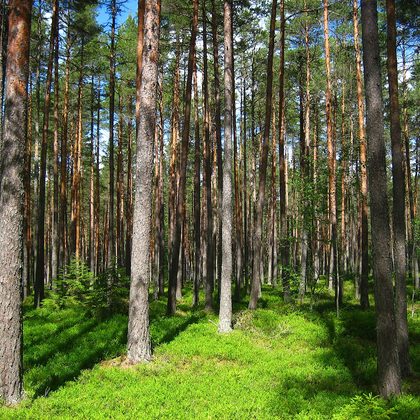
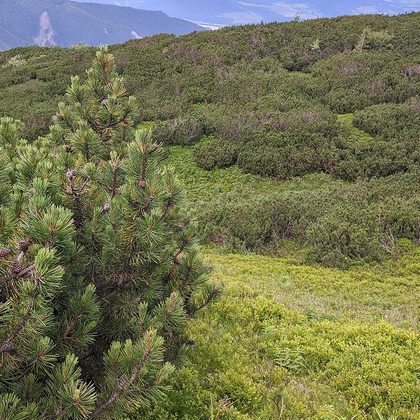
Extensive, quiet forest with food that changes through the seasons: broadleaved, coniferous and mixed woodland, and especially the edges, clear-fells and glades where herbs, bilberry and raspberry grow. Above that subalpine scrub and alpine grassland, where it grazes in spring and searches for ants in summer, and screes and rock outcrops that provide cover and denning sites. More important than woodland type are extent and quiet: a valley with a road every ten kilometres and continuous forest between them is suitable, a fragmented landscape is not.
Where the animal is most at home, classified with EUNIS — the European standard for habitats.





Distribution
From Spain to Kamchatka and from Alaska to the Himalaya; in Europe divided into ten separate populations. The large populations are in the Carpathians (Romania holds by far the most bears of any European Union state), in the Dinaric-Pindos chain from Slovenia to Greece, and in Scandinavia and Finland; small and vulnerable are the populations of the Alps, the Apennines, the Pyrenees and the Cantabrian Mountains. The Cantabrian population had fallen to about seventy animals by the early 1990s, divided into two separate nuclei on either side of the Huerna corridor, in Asturias, León, Cantabria and Galicia. Since then it has grown to an estimated 370 bears; females with cubs are recorded every year in the western nucleus and recently also in the eastern, and males move between the two nuclei. In the Pyrenees the native population was effectively extinct; from 1996 it was reinforced with bears from Slovenia (Ziva, Melba, Pyros and later releases in 2006 and 2018), and about eighty to ninety animals now live in Spain, France and Andorra, with a continuing conflict with extensive sheep farming. Dispersing young males from Trentino and Slovenia reach Bavaria, Austria and Switzerland. In the rest of western Europe the species has disappeared: in the Low Countries it occurred in prehistory and was already rare in Roman times; in Britain it was widespread after the last glaciation, survived into the Roman period (British bears were exported to the arenas) and disappeared through hunting and forest clearance by around the tenth century, in Ireland earlier still.
- Native
- Reintroduced
- dark = core range, pale = thinly spread
Way of life
In Europe mainly active at dusk and at night; this is learned behaviour, because where the species is not persecuted it is also active by day. Solitary, except for females with cubs and temporary gatherings at a rich food source. The brown bear is an omnivore that lives largely on plant food, three-quarters to nine-tenths of the diet: grass and herbs in spring, ants and their brood in summer (a bear eats tens of thousands of ants a day), and in late summer and autumn bilberry, crowberry, rowan, beech mast, acorns and chestnuts, in Cantabria also wild cherry and hazel. In addition carrion, insect larvae, rodents and occasionally a deer calf or a sheep. Winter dormancy is not true hibernation. In a true hibernator, such as a marmot, hamster, bats and dormice, body temperature falls to just above ambient, sometimes to a few degrees above freezing, and the animal is cold and stiff and can be roused only after hours of rewarming. In the bear, body temperature falls by only three to five degrees, from about 37 to about 33 degrees; the heart rate falls from forty to fifty to eight to twenty beats a minute and metabolism to about a quarter, but the animal remains rousable and can leave the den within a minute. For five to seven months it does not eat, drink, urinate or defecate: it lives on fat reserves, recycles urea from its own waste and loses hardly any muscle tissue. Because body temperature remains high, the female can give birth during winter dormancy. Mating takes place from May to July, but the fertilised egg does not implant until autumn, and only if the female has built up enough fat (delayed implantation). In January one to three cubs of 300 to 500 grams are born in the den, blind and almost naked; they suckle while the mother is dormant and emerge in April. They stay with the mother for one and a half to two and a half years, so that a female breeds only every two to three years. As a result, bear populations grow slowly and recover slowly.
Where and when to look
Most sightings are made from hides. In Finland and Estonia hides stand at feeding sites in the taiga, where bears are almost certainly seen during a short night from June to August; in Slovenia (Notranjska, Kočevje) high seats offer the same opportunity. For observation on foot, northern Spain is the best area in Europe: in Somiedo, Fuentes del Narcea, Degaña and Ibias and the Alto Sil the valleys are deep and the slopes open, so that the far side can be scanned from the road with a telescope. The best periods are April and May, when bears graze the still-bare slopes, and September and October, when they feed on cherries and beech mast. Go early, take up a position on the opposite side of the valley and scan the slopes systematically. Safety: make noise on trails with poor visibility in bear country, never leave food behind and always keep away from a female with cubs; that is the only situation in which a European brown bear is genuinely dangerous.
Conservation status
Least Concern (2017) globally. In Europe the species consists of ten separate populations, several of which number a few tens of animals. Numbers have generally increased. Protection, the end of bounty hunting and rural depopulation have raised numbers since the 1990s; the Cantabrian population grew in thirty years from about seventy to about 370 animals. Threats are illegal killing, poison and snares, road and rail collisions, fragmentation by roads and ski resorts, habituation to rubbish and supplementary feeding (a bear that comes to expect food from people can become a problem bear) and the continuing conflict with sheep farming and bee-keeping. The species is listed in Annexes II and IV of the Habitats Directive and is treated there as a priority species. An important issue in Europe is whether the separate populations will be reconnected.
Scientific name
Ursus arctos | Linnaeus, 1758
Linnaeus described the species in 1758 and placed it straight away in the genus where it still stands. Ursus is the Latin word for 'bear'. arctos is Greek arktos, 'bear'; the name thus says bear twice, first in Latin and then in Greek. The specimen the first description was based on came from Sweden.