All species › Rodents › Blind mole-rats › Bulgarian Blind Mole-rat
Bulgarian Blind Mole-rat | Nannospalax bulgaricus
Nannospalax bulgaricus | Nannospalax bulgaricus
Nannospalax bulgaricus, the Bulgarian Blind Mole-rat, is the most recently described European species of the genus: Savić and Soldatović described it in 1984 from animals from the village of Kozarevets. Its species status rests on its divergent karyotype. Most blind mole-rats have 54 to 58 chromosomes; this species has 46 or 48, while its fundamental number (the number of chromosome arms) is almost the same as that of related forms. This indicates fusion of whole chromosomes into one without loss of genetic material. Animals with different chromosome numbers no longer interbreed, so that a new species arises without external change.
No photograph of a living wild animal of this species with a suitable Creative Commons licence exists. Do you have one that meets the rules? Send it in.
Tracks
What is observed of this species is almost exclusively earthwork. The mounds are broad and low rather than conical, consist of coarse clods rather than fine crumbs, have no visible opening (the tunnel is sealed with soil from inside) and lie in a meandering line twenty to thirty metres apart. This line follows the main tunnel, which with side branches can be tens of metres to nearly two hundred metres long. The tunnels are five to seven centimetres wide; the shallow feeding tunnels lie at fifteen to twenty-five centimetres depth, the grass-lined nest chamber and the store chambers deeper. A molehill, which occurs in the same meadows, is smaller, higher, finer-grained and comes from a vertical shaft; the Hungarian field protocol only counts a mound as a blind mole-rat's at a base diameter of more than sixty centimetres. There are also gnawed bulbs, tubers and rhizomes in the tunnel, and skull remains in pellets of Barn Owl, Little Owl, Long-eared Owl and Eagle Owl; in Bulgaria, as elsewhere, these have provided a large part of the distribution data.
Identification
Externally identical to the other blind mole-rats of south-eastern Europe: cylindrical and without a visible neck, with a broad, flat, wedge-shaped head, a large bare triangular nose pad and a stiff fringe of pale bristles running back from it. The fur is velvety and lies in any direction, brownish grey with a yellow or rufous tinge, the belly greyer. The yellow to orange incisors protrude in front of the lips. Ear pinnae are absent, the eyes are reduced to millimetre-sized lenses beneath a closed fold of skin, and there is no external tail. No head-body lengths, tail lengths or weights have been published for this species; the measurements are therefore left blank, because adopting those of the Lesser Blind Mole-rat would imply a measurement never taken on this species. The distinguishing character is karyological: 2n = 46 or 48 chromosomes with a fundamental number NF = 76, the lowest chromosome numbers within the European complex.
Similar species
The European blind mole-rats of the genus Nannospalax cannot be distinguished externally. Shape, colour variation, bristle fringe and teeth are the same, and the differences that exist are smaller than the variation within each species. The species are distinguished by chromosome number, fundamental number and DNA, and their species status rests partly on crossing experiments in which no embryos resulted between different forms. In Bulgaria locality does not give a conclusive answer either: besides this species the country holds the Lesser Blind Mole-rat (to which the srebarnensis form of Ruse, Targovishte and Silistra is assigned) and, in the west, N. serbicus; among these three only a karyogram can decide. What can be excluded are the mole, with spade-shaped forefeet, a short tail and a smaller size, and the Water Vole, with normal ears, eyes and tail. A field record is best entered as 'blind mole-rat', with the exact locality.
Habitat
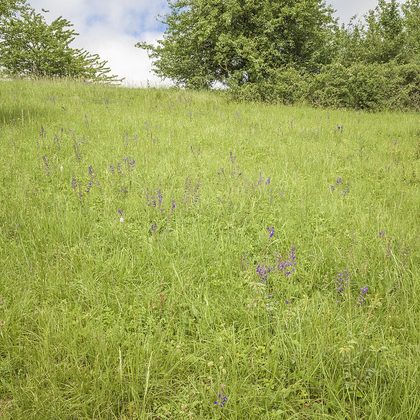
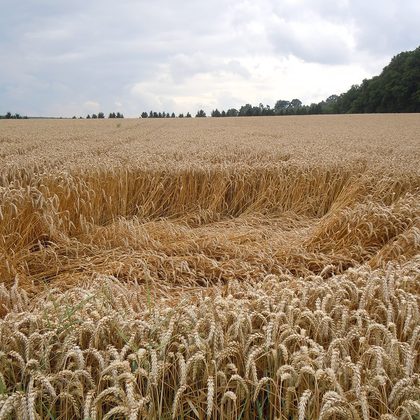
Dry and moderately moist grassland on deep, loose, well-drained soil: steppe and loess slopes, pasture, hay meadow, grazed wood pasture and the unploughed margins and corners of arable land, and also road verges and old dykes. Because the lowlands of Bulgaria have largely been brought into cultivation, in practice this means remnants and margins. Woodland, rocky ground and wet soil are avoided; intensively worked arable land is unsuitable because the plough goes deeper than the feeding tunnels.
Where the animal is most at home, classified with EUNIS — the European standard for habitats.



Distribution
As far as known, Bulgaria only, with Kozarevets as the type locality. The limits are unclear. Bulgaria has been well studied karyologically, but several chromosomal forms have been described there, some of which are now assigned to the Lesser Blind Mole-rat and others to N. serbicus. Where the range of this species ends and that of related species begins can only be established by trapping and karyotyping, and this has been done at only a few sites. Maps from before 2024 show the whole of Bulgaria under the name Nannospalax leucodon. Blind mole-rats are absent from western and northern Europe and from the Iberian Peninsula.
Way of life
Little has been described for this species specifically; the following applies to the complex, within which the way of life varies little. The animals live solitarily and almost entirely underground, are active by day and night with most digging at the beginning and end of the day, and do not hibernate: the winter is bridged with store chambers that may hold six to twenty kilograms of bulbs, tubers and roots. The diet consists of underground plant parts, supplemented in late spring with green material and occasionally insects; daily intake is over a third of body weight. One burrow system is the territory of one animal, which tolerates no conspecifics outside the mating season at the end of winter. Gestation is about thirty days; two to four young are born in March or April, and females first breed in their second year. Predators are Red Fox, Weasel, Stoat, Steppe Polecat, dog and cat, and owls, Egyptian Vulture, Eastern Imperial Eagle and Long-legged Buzzard.
Where and when to look
In March or April, search grassy hills or unploughed field margins in Bulgaria, preferably early in the season when the grass is short, for a line of low, broad mounds. Fresh soil is dark, damp and coarsely clodded; overgrown mounds indicate an abandoned system. Comparison with a nearby molehill shows the differences in height, width and grain size. The animal itself is rarely seen; the few observations concern animals crossing a road or caught by a cat. Record the coordinates of every find; in this group the locality is the only identification character available in the field.
Conservation status
Not evaluated by the IUCN. The Red List recognises only the collective species Nannospalax leucodon, assessed as Least Concern; that assessment does not apply to this species, which has never been assessed separately. The Handbook of the Mammals of the World and the Serbian research group around Savić and Bugarski-Stanojević point out that several species of this complex are threatened, appear on no list and need an assessment of their own. For this species not even the number of known localities has been published. The threats are the same as elsewhere in south-eastern Europe: conversion of grassland to arable, deep ploughing, the loss of extensive grazing, building and road construction, and the killing of animals regarded as agricultural pests. Because the animals are rarely observed and not counted, populations can disappear unnoticed.
Scientific name
Nannospalax bulgaricus | Savić & Soldatović, 1984
Savić & Soldatović described the species in 1984 and placed it straight away in the genus where it still stands. Nannospalax joins Greek nannos, 'dwarf', to Spalax: the small blind mole-rat. bulgaricus means 'Bulgarian'; Savić and Soldatović described the animal from Kozarevets in northern Bulgaria. The specimen the first description was based on came from Bulgaria, Kozarevets.