All species › Rodents › Dormice › Common dormouse
Common dormouse | Muscardinus avellanarius
Hazelmuis | Muscardino
The Hazel Dormouse is a golden-orange dormouse of about fifteen grams that climbs through the shrub layer at night, hibernates for about seven months of the year and seldom moves more than a hundred metres from its birthplace. The animal itself is rarely seen. Its presence is best established from opened hazelnuts, which can be found in October under old hazel coppice stools.

Tracks
The Hazel Dormouse opens a hazelnut in a way found in no other animal, and opened nuts remain on the ground for years. It gnaws a round hole in the shell from the outside. The diagnostic feature lies not in the shape of the hole but in two characters together: the inner rim of the hole is smooth, without transverse grooves, and on the shell surface around the hole there are fine, oblique tooth marks running towards the rim at an angle of about 45 degrees. Oblique marks outside combined with a smooth inner rim indicate the Hazel Dormouse. For comparison: the Wood Mouse leaves grooves on the rim itself, across it, and rough tooth marks on the shell surface; the rim feels ribbed. The Bank Vole leaves regular parallel grooves across the rim but no marks on the surface outside the hole. The Red Squirrel makes no round hole: it sets its lower incisors into the tip of the nut and splits the shell into two halves, or gnaws a large ragged opening in it. Woodpeckers and nuthatches wedge the nut into a crevice in the bark and hammer it open, splintering the shell. A handful of empty shells from under an old hazel, examined hole upwards under a hand lens, shows which rodents live in that compartment. There is also the summer nest: a ball about the size of a fist, woven from strips of honeysuckle bark, grass and green leaves, low in bramble, hazel or an old hedge, and smoothly lined inside. The use of honeysuckle bark is in itself diagnostic. The winter nest lies on the ground: a compact ball of leaves and moss under the leaf litter, at the foot of a coppice stool or under a fallen trunk. Droppings are 3 to 4 mm long, cylindrical with blunt ends, dark and glossy, and are found in nest boxes and nest tubes. In surveys nest boxes or black nest tubes are hung in the shrub layer; an occupied box with a leaf nest provides the data on which management plans are based.

In its habitat

Head close-up

Identification
One of the smallest European dormice, and the only one that is entirely golden-orange to honey-coloured, slightly paler below and with a white throat patch. Head-body 6 to 9 cm, tail 5.5 to 8 cm; the tail is almost as long as the body and densely furred along its whole length in the colour of the back, with no bush and no white tip. This is the main character. Blunt muzzle, long white whiskers, large, domed black eyes without dark markings around them, and small, round, thinly furred ears half hidden in the fur. The feet are pink with long grasping toes; the species climbs nimbly and hangs upside down from a bramble to reach a berry. Young animals in their first autumn are greyer and duller than adults. In late summer the animal builds up fat reserves and then weighs up to 43 grams; it is then visibly rounder and slower.
Similar species
Confusion is possible with other dormice and with two mice and voles. The Garden Dormouse is about twice the size, grey-brown rather than golden-orange, has a black mask that extends behind the ear and a tail ending in a black-and-white tuft; confusion is possible almost only on a poor photograph. The Forest Dormouse, in central and eastern Europe, is grey-brown with white underparts and also has a dark eye stripe, which however stops at the ear; the tail is slightly bushy and bicoloured. The Edible Dormouse is much larger and grey. The Wood Mouse lives in the same woodland but has very large ears, bulging eyes and a naked, scaly tail, and leaps rather than climbs. The Bank Vole is red-brown above but has a blunt head, small eyes and a short, thinly haired tail at most half the body length. A gnawed hazelnut often gives a more certain identification than a sighting of the animal.
Habitat
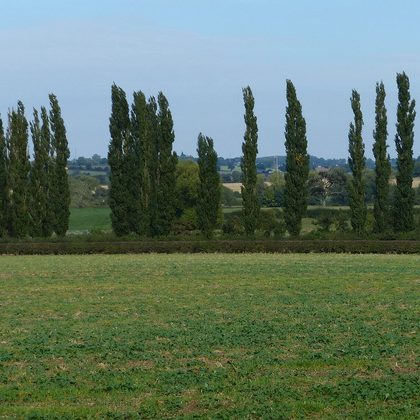
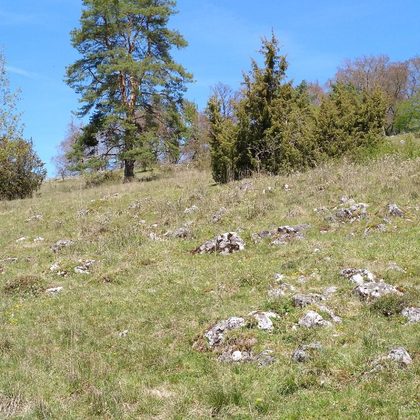
Structurally diverse broadleaved and mixed woodland with a dense, varied shrub layer, especially coppice with hazel and honeysuckle, woodland edges, scrub margins and old, wide hedgerows. The species lives on flowers, pollen, berries and nuts that must follow one another through the season; the more woody species in one compartment, the better: hazel, hawthorn, blackthorn, honeysuckle, bramble, dogwood, beech, oak and hornbeam mixed together. Connectivity is equally important: the Hazel Dormouse avoids the ground and prefers not to cross a gap of ten metres, so a continuous canopy from hedge to shelterbelt to woodland determines whether an area is occupied. From sea level to about 1500 m in the southern mountains.
Where the animal is most at home, classified with EUNIS — the European standard for habitats.




Distribution
From southern Sweden and southern England to central Italy and the Balkans, and east to central Russia and northern Turkey. In France the south-western limit runs through the centre and east of the country; south of the Loire the species occurs locally, and no populations are known in the Pyrenees. It is entirely absent from the Iberian Peninsula, where Garden and Edible Dormice do occur. In Germany and central Europe the Hazel Dormouse is more common, but fragmented everywhere. In Britain it is confined to southern England and Wales and becomes scarce north of a line through the Midlands, with some reintroduced populations in the north; it is absent from Scotland and Ireland. In the Netherlands it is one of the rarest mammals, occurring only in a few hillside woods in South Limburg, including the Vijlenerbos and the Bunder- and Elsloërbos; in Belgium in the Voeren and a few Limburg woods.
- Native
- dark = core range, pale = thinly spread
Way of life
Nocturnal and almost entirely arboreal: the Hazel Dormouse rarely comes to the ground and moves through the shrub layer along twigs thinner than a pencil. The diet follows the season: in spring flowers and pollen of hawthorn and honeysuckle, in summer insects and especially aphids, in late summer blackberries and rowan and then hazelnuts and beech mast, on which fat reserves are built up. From October to April or May the animal hibernates on the ground, curled up with the tail over the head, body temperature falling to just above that of the soil; this takes up more than half of its life. In the summer half of the year too, the animal enters daily torpor on cold or wet nights. This energy saving helps the species survive a poor year but also explains why populations respond slowly to a good year. One litter a year, in July or August, of about four young, born grey and blind and independent only in September; a second litter succeeds only in a warm summer and often comes too late to build up enough fat before winter. For a small rodent the lifespan is long: four to five years in the wild is normal, whereas a Wood Mouse rarely lives beyond a year.
Where and when to look
Search for nuts rather than for the animal. In October or November, go to an old coppice wood or a wide, old hedge with hazels and search the leaf litter under the bushes: empty shells often lie there by the dozen. Take a hand lens or a phone camera with a macro setting, because the oblique marks on the outside are barely visible to the naked eye. In June a summer nest can sometimes be found in the same wood: search bramble and honeysuckle half a metre to two metres up for a fist-sized ball of shredded bark, and leave the nest alone. The animal itself is seen only by chance, on a summer night with a weak lamp along a woodland edge, or during an accompanied nest-box check; such checks require a licence.
Conservation status
Least Concern globally (LC, 2021). In north-western Europe, however, the species is declining. In Britain the national nest-box monitoring has shown roughly a halving since 2000; in the Netherlands the species is listed as endangered on the Red List and the population is confined to a few woods in South Limburg. The causes are the same everywhere: the end of coppice management, so that the shrub layer disappears under a closed canopy, the removal of hedges and shelterbelts, and fragmentation, which a species with such a small home range tolerates poorly. The Hazel Dormouse is listed in Annex IV of the Habitats Directive and is strictly protected. Effective management is known: keeping coppice in rotation, connecting hedges and retaining the shrub layer.
Scientific name
Muscardinus avellanarius | (Linnaeus, 1758)
Linnaeus described the species in 1758 as Mus avellanarius; because it was later moved to another genus, the author and year stand in brackets. Muscardinus is formed on French muscardin, a word for both the hazel dormouse and a musk-scented lozenge, from Provençal muscat, 'musky'. avellanarius is Latin for 'of the hazelnut', from avellana, 'hazelnut', after the animal's food; the nut in turn is named after Abella, a town in Campania. The specimen the first description was based on came from Sweden.