All species › Rodents › Voles and hamsters › Common Pine Vole
Common Pine Vole | Microtus subterraneus
Ondergrondse woelmuis | Topillo Europeo
The Common Pine Vole lives in tunnels beneath the turf and seldom comes above ground. The species was described in 1836 from an animal taken at Waremme (Borgworm) in the Belgian province of Liège. In a photograph it cannot be separated from the other pine voles; identification rests on the teeth, the chromosome count and the range.

Tracks
The animal is seldom seen; the species is recorded mainly from signs. It digs tunnels about 3 cm across, both just under the litter and down to 40 cm, and also uses existing mole runs. The spoil comes out as small, low heaps of fine earth, close together in a line above the tunnel. A molehill is much larger, tall and conical, built of clods and thrown up from a vertical shaft; a water vole's heap has a tunnel mouth at one side. The entrances are plugged with soil, which is characteristic of the group. Under the moss and leaf layer of a sunken lane, wood edge or hedgebank lie swept runways 3 to 4 cm wide, worn to bare ground. Also peeled and bitten-through roots and rhizomes, hollowed tubers, bulbs and beets in kitchen gardens, and in winter gnawed bark at the foot of young trees and shrubs, always at or below ground level. Droppings are 4 to 6 mm, cylindrical with blunt ends, left in small latrines in the tunnel. In north-western Europe the species is usually recorded from pellets of Barn, Tawny and Long-eared Owl. The cheek teeth are flat, folded into sharp zigzag prisms and ever-growing; the first lower molar determines the species.
Head close-up

Identification
One of the smallest voles of north-western Europe, with a head-body length of 7.9 to 11.5 cm and a weight of 10 to 26 g. The build is that of a digger: rounded head, blunt muzzle, very small eyes and short rounded ears almost wholly buried in the fur. The tail is 2 to 4.4 cm, a fifth to a good third of head-body length, and bicoloured. The fur is long and soft, yellowish to dark brown above and silver to blue-grey below, without a sharp division on the flank. Females have four nipples in two inguinal pairs; the true grey voles have eight. In the hand one character is decisive against the surface-living voles: the hind foot carries five plantar pads, where Common Vole, Field Vole and Bank Vole have six.
Similar species
Within the pine voles this species cannot be separated from the others in the field or in a photograph. Separation rests on three characters, the first two of which need an animal in the hand or under a lens: the shape of the first lower molar, the chromosome count (the Tatra Pine Vole has 32, Thomas's Pine Vole 44) and the range. In France, the Benelux, Germany, Poland, Czechia and most Balkan countries this is the only pine vole, and identification follows from the locality. In the south-eastern Alps and the Dinarides it lives alongside Liechtenstein's Pine Vole; the two cannot be told apart without the teeth. In the Carpathians the Tatra Pine Vole occurs, with a longer tail (35 to 41 per cent of head-body length) and six plantar pads on the hind foot. In the western Alps lives the Alpine Pine Vole, with a tail of nearly 40 per cent of head-body length. The southern Balkans hold Thomas's Pine Vole, with a short tail. The species is absent from the Iberian Peninsula, where the pine voles are the Mediterranean Pine Vole, the Lusitanian Pine Vole and Gerbe's Vole; the larger Cabrera's Vole also lives there, but belongs to a subgenus of its own, Iberomys, and is not a pine vole. In the field it can be separated from the surface-living voles: Common Vole and Field Vole are larger, with bigger eyes, visible ears and six plantar pads, and use runways in the grass; the Bank Vole has a chestnut back, bulging eyes, projecting ears and a tail half the body length.
Habitat
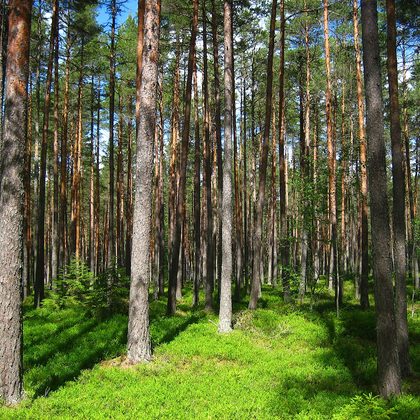
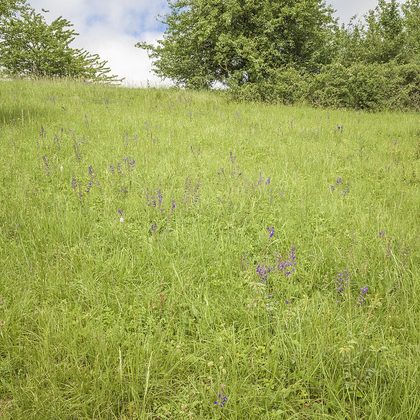
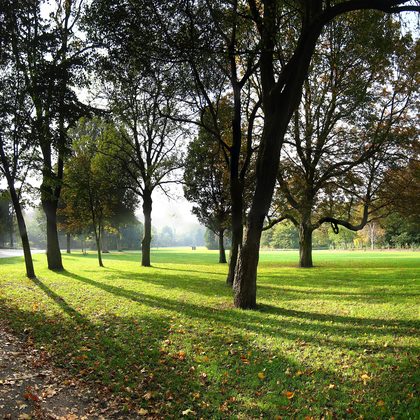
Small-scale country with a dense grass or herb layer and a light, damp, diggable soil. In north-western Europe that means verges, sunken lanes, field banks, lines of trees, hedgebanks, wood edges, chalk grassland and high-lying pasture and arable; in central Europe broadleaved and mixed woodland with a dense field layer, wood edges and clearfells; in the mountains alpine meadows and the dwarf pine zone. It occurs from sea level to about 2,335 m. It avoids close-grazed pasture without cover, dense spruce stands without a field layer, and rock.
Where the animal is most at home, classified with EUNIS — the European standard for habitats.




Distribution
From north-western France and the Benelux east into Russia and south to Greece and north-western Turkey; at nearly three million square kilometres the largest range of any pine vole. At the north-western edge of the range it occurs in the Netherlands in Zeeland, North Brabant and Limburg and, north of the great rivers, only in the Achterhoek around Winterswijk; in Belgium it is more widespread. It is absent from Britain and Ireland, Scandinavia, the Iberian Peninsula and Italy south of the Alps.
- Native
- dark = core range, pale = thinly spread
Way of life
Polyphasic and mainly nocturnal: twelve to fourteen bouts of activity in 24 hours, each of 20 to 40 minutes, with most activity after dark. It moves almost entirely within its tunnels. A little over half the diet consists of green parts of herbaceous dicotyledons — dandelion, alpine coltsfoot, hawkweed and other composites, roses and legumes — with about 15 per cent grasses and sedges, 10 per cent mosses, a good 10 per cent fruits and a few per cent fungi; in winter roots and bark as well. Breeding continues through most of the year with a break in winter; gestation lasts 21 days, and captive females have produced up to ten litters a year. A litter holds one to five young, usually two or three; in the Netherlands five litters a year are taken as normal. It does not hibernate and continues tunnelling beneath the snow and the frozen crust.
Where and when to look
Look for the tunnel system rather than the animal. Choose a sunken lane, field bank or old hedgebank with a dense herb layer, carefully lift the moss and leaf litter and follow the swept runways; the line of small heaps of fine soil and the plugged holes mark out the system. Fresh earth is easiest to see after summer rain. For a reliable species list of an area, collect pellets beneath a Barn Owl nest site or a Long-eared Owl roost and pick them apart; the distribution of the species in north-western Europe has largely been mapped this way. The animal itself is visible for a fraction of a second at most.
Conservation status
Least Concern (LC, 2021) and common throughout its range. At the north-western edge of the range the species depends on small landscape features lost in land consolidation — verges, field banks, hedgebanks, sunken lanes and rough field margins — and increases where these are restored. Knowledge of its distribution there rests largely on pellet analysis rather than on sightings of the animal.
Scientific name
Microtus subterraneus | (de Sélys-Longchamps, 1836)
De Sélys-Longchamps described the species in 1836 as Arvicola subterraneus; because it was later moved to another genus, the author and year stand in brackets. Microtus is Greek, from mikros, 'small', and ous, genitive ōtos, 'ear', after the small ears hidden in the fur. subterraneus is Latin for 'underground', from sub, 'under', and terra, 'earth', after the life spent in runs just below the turf. The specimen the first description was based on came from Belgium, Liège.