All species › Rodents › Mice and rats › Cypriot Mouse
Cypriot Mouse | Mus cypriacus
Mus cypriacus | Mus cypriacus
Mus cypriacus is a mouse found only on Cyprus. In 2004 it was noticed that mice from the vineyards of the Troodos mountains differed from house mice; in 2006 the species was described. It is the only endemic rodent of Cyprus to have survived the arrival of humans: the island's dwarf elephant, dwarf hippopotamus and Cypriot genet became extinct afterwards.

Tracks
No signs specific to this species have been described. The signs are those of a Mus: droppings three to eight millimetres long, spindle-shaped with pointed ends, black and glossy when fresh, scattered along runs rather than in latrines; gnawing with paired grooves about a millimetre wide on seeds, figs, grapes and almonds, the kernel hollowed out; and prints of less than a centimetre, with four toes on the forefoot and five on the hind foot and a thin tail drag mark, in dust or fine sand. These signs cannot be distinguished from those of the House Mouse. Locality gives an indication: signs of a small mouse on an abandoned terrace, in a vineyard, along a dry-stone wall or in open pine woodland are more likely to be of this species, signs in a barn more likely of the House Mouse. Pellets of Barn Owl and Scops Owl are the appropriate method for demonstrating the species at a site; the skull material must then be measured by someone able to separate the two species.
Identification
A robust mouse with a head-body length of seven to nine and a half centimetres and a tail slightly shorter than head and body and clearly bicoloured: dark above, pale below. The back is dark wood-brown, the belly creamy grey. In the field the head is most characteristic: large ears, large eyes and large teeth; these proportions led to the discovery of the species. The hind foot measures fifteen to nineteen millimetres, the ear nearly fourteen to nearly seventeen millimetres, and weight reaches twenty-four grams; the species is therefore on average larger and heavier than the house mice on the island. The skull is large. The upper incisor has the notch common to all Mus species.
Similar species
Two Mus species occur on Cyprus. The House Mouse (Mus musculus) lives mainly in villages, barns and stores; it is smaller and drabber, has a tail as long as head and body that is not bicoloured, and a belly that grades into the back colour without a sharp line. Mus cypriacus lives mainly outdoors: larger ears, eyes and teeth, a bicoloured, slightly shorter tail and a creamy grey belly that contrasts more clearly. Locality gives an indication: indoors the House Mouse is more likely, in maquis, vineyard and abandoned fields this species. In farmland, however, both occur together, and there an animal in the hand is needed. The Balkan Short-tailed Mouse (Mus macedonicus), the outdoor mouse of mainland Turkey and the Levant, does not occur on Cyprus and also has smaller ears and eyes. The island's other small rodents, Black Rat and Brown Rat, are much larger; the shrews of Cyprus have a pointed snout and are not rodents.
Habitat
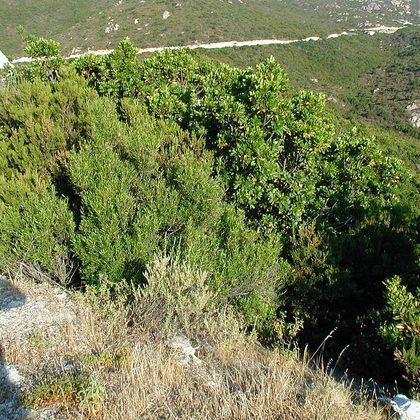
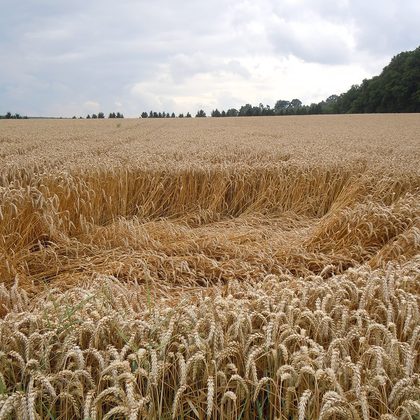
Mediterranean scrub and dense maquis, garrigue, abandoned and overgrown fields, vineyards and orchards, field margins and semi-natural woodland, from sea level to 1,600 m, to just below the summit of the Troodos. The species has been found over more than eighty per cent of the island and prefers the small-scale landscape of vineyards and small fields in the Troodos mountains, with all forms of extensive human use. It is a species of the old cultivated landscape; this is probably why it survived the Holocene extinction wave on the island.
Where the animal is most at home, classified with EUNIS — the European standard for habitats.





Distribution
Endemic to Cyprus. The type locality is the village of Alassa, north of Limassol.
Way of life
Terrestrial and almost certainly nocturnal; activity has never been studied systematically. The diet is probably varied, with seeds, fruit and insects, but this too has not been studied. Of breeding it is known that trapped females carried five to seven embryos. No data exist on territories, social behaviour, movements or longevity. There is no hibernation. Research on Mus cypriacus has so far been almost entirely genetic and morphometric; as a result almost nothing is known of its way of life.
Where and when to look
The best chances are in spring in the traditional farmland of Cyprus: a vineyard with dry-stone walls, an abandoned terrace with broom and cistus, a field margin in the Troodos foothills. Wait after sunset with a weak lamp; a mouse that looks larger than a House Mouse, with large ears and a tail dark above and pale below, is this species. In villages the House Mouse is the likely species. Certain identification requires an animal in the hand, and on Cyprus that requires a licence.
Conservation status
Least Concern (2023). The species is distributed over almost the whole island, locally common and not tied to a disappearing habitat. Two concerns are named: loss of farmland and maquis to building and tourism, especially along the coast and around Limassol and Paphos, and competition with the introduced House Mouse, which enters farmland where its use intensifies. As a single-island endemic it has no second population. The species was described in 2006 in Zootaxa by Cucchi and co-workers and was announced in the press as the first new European mammal species in more than a hundred years. That was not correct: dozens of European mammal species had been described in the preceding decades, such as the Alcathoe Myotis (Myotis alcathoe) in 2001. The species nonetheless remained undescribed until 2006, in the farmland of a heavily visited island.
Scientific name
Mus cypriacus | Cucchi, A. Orth, J.-C. Auffray, Renaud, L. Fabre, J. Catalan, Hadjisterkotis, Bonhomme, & Vigne, 2006
Cucchi, A. Orth, J.-C. Auffray, Renaud, L. Fabre, J. Catalan, Hadjisterkotis, Bonhomme, & Vigne described the species in 2006 and placed it straight away in the genus where it still stands. Mus is the Latin word for 'mouse', cognate with Greek mys. cypriacus means 'Cypriot', after the island where the species occurs and nowhere else. The specimen the first description was based on came from Cyprus, Alassa village.